For generations, researching family history has meant searching through dusty archives, reading handwritten documents, studying old photographs, and piecing together fragmented stories. Today, artificial intelligence is beginning to change that process. Modern AI genealogy tools, including platforms such as Vestigee, can help people explore family records, identify potential connections, restore historical photographs, and turn static pieces of family history into more engaging experiences. For anyone interested in family search, these technologies are opening new ways to discover the people and stories hidden in the past.
Traditional genealogy platforms have made enormous amounts of historical information available online, including census records, birth certificates, marriage documents, immigration records, newspaper archives, and other historical sources. However, access to information is only part of the challenge. Finding the right record, understanding its context, and connecting it to the correct person can still require considerable time and patience.
AI has the potential to make that process considerably more intuitive.
From Searching Records to Understanding Relationships
One of the biggest challenges in genealogy is that historical records rarely tell a complete story. A person’s name may have been spelled differently across several documents. Dates can be inconsistent, addresses can change, and the same name may belong to multiple people.
AI-assisted matching systems can help researchers identify potential connections between records by analyzing patterns across large collections of information. Instead of relying exclusively on exact names or individual searches, these systems can consider multiple pieces of evidence and suggest relationships that might otherwise be difficult to discover.
This doesn’t eliminate the need for human verification. Family historians still need to examine original records and determine whether a suggested connection is genuinely relevant. However, AI can reduce some of the tedious searching and give researchers promising directions to investigate.
Making Old Photographs Feel Alive Again
Genealogy isn’t only about documents. Photographs are often among the most emotionally powerful pieces of family history.
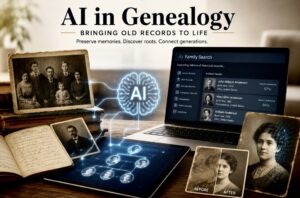
Unfortunately, many historical family photographs are damaged, faded, or stored away in albums that are rarely opened. AI-powered image technologies can now restore aspects of old photographs, improve their clarity, and in some cases create subtle animations from static portraits.
Watching an old photograph move can create a surprisingly powerful emotional connection. A photograph of a great-grandparent who died decades ago suddenly feels less distant when facial expressions or small movements are reconstructed digitally.
There is an important distinction, however, between restoration and invention. AI-generated movement does not recreate exactly what a person actually did. It creates an interpretation based on the available image. For that reason, animated historical photographs are best understood as creative reconstructions rather than authentic recordings of the past.
Reconstructing Family Portraits Across Generations
Another fascinating application of AI involves bringing together relatives who never had the opportunity to meet.
Consider a family in which photographs exist of a great-grandparent, grandparent, parent, and child, but the individuals lived in different periods. Traditionally, there would be no photograph showing all of them together.
Generative AI can potentially create a composite family portrait using separate photographs as references. The resulting image can visually represent multiple generations in a single scene, creating an imaginative representation of a family relationship that was never captured by a camera.
For families, this can be particularly meaningful. It can provide a visual way to tell stories about relatives who lived decades apart and help younger generations engage with people they know only through photographs and family anecdotes.
At the same time, transparency matters. Such images should be clearly identified as AI-generated rather than presented as genuine historical photographs. Preserving the distinction between documented history and creative reconstruction is essential when dealing with family archives.
Genealogy Becomes More Accessible
The scale of historical information available online can be overwhelming. Genealogy researchers may have access to billions of records, but having access does not necessarily mean being able to find the right information quickly.
AI can act as an additional layer between the researcher and these enormous databases. Instead of requiring users to understand complex search techniques, an AI-assisted system can potentially interpret natural-language questions and identify records or relationships that deserve closer examination.
For example, a researcher might want to investigate a relative who lived in a particular town during a certain period. Rather than performing numerous individual searches, AI can help identify potentially relevant documents and organize the information into a more understandable research path.
This could make genealogy more appealing to people who have always been interested in their family history but found traditional research methods intimidating.
Preserving More Than Names and Dates
The ultimate value of genealogy is not simply building a family tree. It is understanding the lives behind the names.
A birth certificate can establish when someone was born. A census record can show where they lived. A photograph can reveal what they looked like. A letter can provide clues about their personality, relationships, or circumstances.
When these different sources are brought together, a much richer family story emerges.
AI can help researchers connect these fragments and present them in ways that are easier to explore. Instead of viewing genealogy as a collection of disconnected records, people can begin to see the relationships between individuals, places, events, and generations.
The Importance of Responsible AI in Family History
As exciting as these developments are, technology should complement historical research rather than replace it.
AI systems can make mistakes, misinterpret photographs, create inaccurate matches, or generate details that were never documented. Family historians should therefore treat AI-generated suggestions as starting points for investigation rather than unquestionable facts.
Privacy is another important consideration. Genealogy involves highly personal information about families, including names, photographs, dates, and relationships. Users should understand how their data is handled and consider the implications of uploading sensitive family material to digital services.
Used responsibly, however, AI can become a powerful tool for preserving and exploring family history.
A New Chapter for Family Search
Genealogy has always been about connecting the present with the past. What is changing is the technology available to make those connections.
AI can help search vast collections of historical records, identify possible relationships, restore old photographs, animate static portraits, and create visual representations of family members who never had the opportunity to stand together.
The technology does not replace the stories, photographs, and documents that families have preserved over generations. Instead, it can provide new ways to understand and experience them.
As artificial intelligence continues to develop, the future of genealogy may become less about simply finding another name in an archive and more about discovering the human story behind it. For families exploring their roots, that could make the journey into the past more accessible, visual, and personal than ever before.
__________________________
POPULAR ARCHAEOLOGY ON INSTAGRAM

__________________________