No one knows her name.
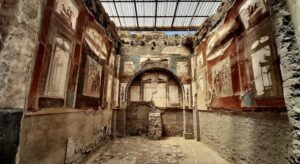
The hollow cavities that once held her eyes in her last, terrifying, desperate moment of life nearly 2,000 years ago stared back at me in silence. Surrounded by the articulated skeletal remains of family and friends, her bones told a story of a catastrophe that still echoes across time to this day. I was peering into a cave-like construction that once housed fishing equipment — one among 12 of them — neatly arranged, built in a straight-line row along the back perimeter of what is today a flat but stoney surface. It defined the dimensions of what was once an ancient city’s inviting seaside beach…..
The Town That Waited for the Sky to Fall
There is a particular hour in Naples, somewhere between four and five in the morning, when the city goes so quiet you can hear the water moving in the bay. I know that hour better than I should. I was awake for it again last night, sitting at a rented kitchen table with notebooks fanned out around me and a rucksack half-packed by the door. Tomorrow the fieldwork begins. Tonight, sleep refuses to come.
I have spent much of my working life traveling to places that are no longer alive. That is not a morbid confession. It is simply what I do. I fly somewhere, rent a room, walk through trenches and depots and fenced-off ruins, and try to write down what I find before the light changes. I have done this in Turkey, in Greece, in Egypt, in a dozen hilltop sites where the wind never stops. The work suits me. It offers the one thing journalism rarely provides: a subject that will never contradict what you wrote.
Over the years I stopped tracking my life by city or by story and started tracking it by ash. I could tell you what I was doing when I first stood in the shadow of a buried wall in Anatolia, or which year I watched a colleague brush dust off a mosaic floor in a trench outside Rome. These are the marks I use now. Layers of ash, one on top of another. Each one holds a season, a decision, a person I was at the time.
People sometimes ask—why ancient sites? They assume it is about escape, or romance, or some private nostalgia for a world that once existed. The truth is closer to the opposite. An ancient site is a place where every comfortable story falls apart. The people who lived there were not waiting to become history. They were making dinner, arguing about money, hiring a contractor, buying a new pair of sandals. Then everything stopped. What is left behind is the most honest record we have of what it meant to be alive when everything stopped.
That is the part of the job I keep returning to. Not the temples or the frescoes, which are beautiful and endlessly photographed, but the interruptions. A pot left on a stove. A door bolted from the inside. Coins dropped on a floor by someone who never again had the chance to bend down to pick them up. These are the details that make the past feel present tense, and they are the reason I keep going to places many people may not think to visit.
When I tell people about my work, I notice they often want the romance. They want to hear about the sunsets over the Forum and the morning coffee in a piazza that has not changed in four hundred years. I understand that. I have felt it too. But the sites that stay with me are never the postcard ones. They are the ones where something went wrong, and where the evidence of that wrongness is still sitting there, patiently, waiting for someone to look.
That is how I came to Herculaneum. Not through a grand plan, not through a research grant, not because a publisher sent me. I came because of a photograph I could not put down, and because a question had begun forming in my mind that no other site could answer. What does a town look like when it is caught in the middle of an ordinary day and never allowed to finish it? I did not know then that I would spend years trying to answer that question. I only knew that I could not stop looking.
The Boat Houses I Could Not Forget
The first time I saw them, I was not prepared. I want to say that plainly, because the experience is the reason this book exists. I had read the excavation reports. I had seen the published photographs. I had even written about the site in a short piece years before, and I thought I understood what was there. I did not understand anything.
Herculaneum sits below the modern town of Ercolano, on the Bay of Naples, about halfway between Naples and the shadow of the mountain that killed it. There is a long ramp that descends from the ticket office into a trench cut through volcanic rock. You walk down, the noise of the city above fades, and eventually you are standing at the edge of what was once a shoreline which now has not seen the sea since the first century.
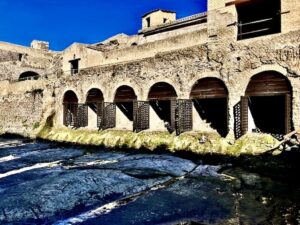
The boat houses line the edge of that waterfront. They are vaulted chambers, originally built to shelter ships and fishing gear, and they still do the job they were built for: they hold things. What they hold now is people. Dozens of them, crowded into a handful of small stone rooms, pressed together so tightly that the excavators had to work carefully to figure out whose arm belonged to whom.
I remember the posture of one of them more clearly than I can describe. A young woman, turned toward the wall, her hand raised near her face. The forensic work later suggested she may have been shielding herself from the heat, or simply covering her eyes. What struck me was not the science. It was the gesture. It was so recognizably human, so completely ordinary, that for a moment I forgot she had been dead for nearly two thousand years and I was standing in front of her, healthy, well fed, holding a notebook.
I did not write anything down that afternoon. I took a few photographs, walked back up the ramp, and sat in a cafe near the station for two hours without ordering anything. That image followed me home. It followed me to the airport. It followed me to my desk at home, where I sat down to work on other stories and found myself opening the same mental folder on Herculaneum again and again.
What I could not shake was not the horror of it. I have seen horror in other places, and I can usually file it away. What I could not shake was the intimacy. Those skeletons were not arranged for display. They were not posed. They were exactly where the people had placed themselves when they understood there was nowhere left to go. I was looking at a decision. Not a symbol of one. A decision.
__________________________
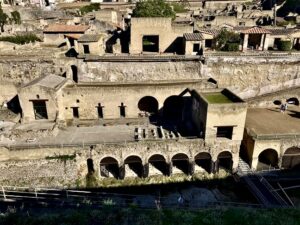
Above, Herculaneum, showing boathouses lining what was once an ancient shore.
__________________________
__________________________
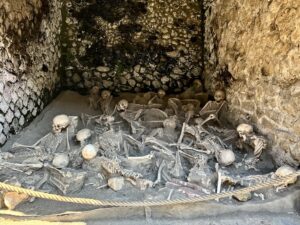
The unforgettable scene within one of the boathouses.
__________________________
I began reading everything I could find. Excavation bulletins, volcanology papers, forensic anthropology monographs, the letters of eighteenth-century diggers written in Italian and almost illegible handwriting. I ordered books I could barely afford from university presses. I learned terms I had no business knowing, and I noticed that the more I learned, the more the empty spaces in the story bothered me. There was so much that we did not know, and so much that we had once known and lost. Something in me wanted to fill in the gaps.
Eventually I understood that I was not going to put this down. This experience had become a project. The project had become a question. The question was simple and enormous: what happened here, hour by hour, to the people who lived in this town? I had read many accounts of Pompeii, and I will say more about that in a moment, but Herculaneum had never been given the same treatment. It had the better-preserved remains, the stranger fate, and the smaller audience. That imbalance is the reason this book exists.
The Problem This Book Confronts
There are two famous towns on the Bay of Naples, and almost everyone is familiar with only one. Pompeii appears in textbooks, in films, in children’s books, in the brochures that fan out across hotel lobbies. Herculaneum appears in parentheses. It is the smaller name, the lesser sibling, the town that gets mentioned when the conversation is running long.
This is not because Herculaneum is uninteresting. It is because Pompeii has a better story for retelling. Pompeii was buried in falling ash, which is dramatic and easy to picture. People fled through the streets, and some of them died in those streets, and their bodies left hollows in the ash that excavators were later able to fill with plaster. Those plaster casts are among the most recognizable images in the world. They travel well. They reproduce beautifully on a coffee-table book cover.
Herculaneum had a different ending. It was not buried by falling ash. It was buried by something much more violent, much hotter, and much faster, and the result is a town that was simultaneously destroyed and preserved in ways Pompeii was not. If I explain the science here, I will be stealing from a later part of the book. What matters for now is this: the two towns experienced two different catastrophes, and the town that experienced the more unusual one is the town that gets the shorter chapter in most histories.
I want to correct that. Not because Pompeii is overrated, and not because Herculaneum deserves a kind of archaeological revenge. Pompeii is extraordinary, and I have spent long hours there too. What bothers me is the way one story crowds out the other. When we reduce this eruption to a single image, we lose the fact that it happened differently in different places, at different times, to different people. We lose the human texture. We lose the girl in the boat house with her hand near her face.
There is also a practical problem. Much of what was once possible to recover from Herculaneum was destroyed centuries ago by people who meant well and did terrible damage. The earliest excavators came for statues and marbles and anything they could sell or display in a royal collection. They tunneled through walls, cut through floors, and dumped what they considered rubble into the sea. Whole rooms vanished before anyone thought to photograph or draw them. There are things we will never know because someone with a lamp and a chisel got there first.
That loss shapes everything I write in this book. I am not working with a complete archive. I am working with fragments, some of them magnificent, some of them barely legible. Every claim I make about the last day rests on evidence that survived a series of accidents. When I describe what a room looked like, or what a person was doing in it, I am describing the best reconstruction that the surviving evidence will support, and I am trying to be honest about where the gaps are.
What I am not going to do is pretend the gaps do not matter, or fill them in with imagination and call it history. There is a genre of writing about the ancient world that does exactly that, and it produces beautiful books that mislead their readers. I have no interest in that. My job is to take the fragments seriously, to follow them as far as they go, and to stop where they stop. The people of Herculaneum deserve that much. They cannot correct me, but I can at least decline to invent them.
The problem this book confronts, then, is twofold. The first problem is that Herculaneum’s story is under-told. The second problem is that the version we do tell is often incomplete, or wrong, or softened in ways the evidence does not support. I am trying to write a book that is honest about both. That means telling a story most readers have not heard in full, and telling it with the seams showing.
My Method
I am a journalist, not an archaeologist. That distinction matters, because it shapes what I can see and what I cannot. I do not have the training to read a stratigraphic section on my own, and I do not pretend otherwise. What I do have is the habit of asking people what they do and then listening carefully to the answer. I have spent years interviewing archaeologists, volcanologists, forensic anthropologists, conservators, and guards. This book is the product of that habit, applied over a long period to a single town.
My method has four sources. The first is the excavation record itself: the reports, the drawings, the photographs, the daybooks kept by the people who dug. These are not neutral documents. They reflect the assumptions of whoever was holding the trowel and the budget of whoever was paying for it. But read carefully, and read alongside each other, they form the closest thing we have to a continuous account of what was found and where.
The second source is volcanology. In the last several decades, a great deal of work has been done on the deposits around Vesuvius, and that work has given us a timeline of the eruption that earlier scholars could only guess at. Ash layers act as timestamps. Different deposits correspond to different phases of the event, and the order of those deposits tells us what happened when. This is the part of the book where I lean most heavily on other people’s expertise, and I try to represent their conclusions accurately, including the places where they disagree.
The third source is forensic anthropology. The skeletons at Herculaneum have been studied in ways that would have been impossible a century ago. We can now say a great deal about the age, health, and living conditions of the people who died, and in some cases about the final moments of their lives. This research is unglamorous and painful and slow, and it has changed the way we understand the last day more than any single excavation. I owe a debt to the specialists who do this work and who agreed to explain it to me.
The fourth source is the town itself, in the expanded sense. Not just the buildings, but the objects, the graffiti, the tools, the food residue, the repairs made to a floor after a leak, the extra lock on a door that suggests somebody had been worried about theft. This is the material that lets us date the moment of destruction precisely and that shows us what real people were doing when the eruption caught them. It is also the material that most rewards patience. A single object, looked at closely, can carry more information than a paragraph of speculation.
My job is to bring these four sources into the same room and see what they say to each other. Most of the time they agree, and the picture sharpens. Sometimes they conflict, and I say so. Occasionally they leave a hole in the story that no amount of careful reading can fill, and I say that too. The result is not a seamless narrative. It is a reconstruction with visible joints, and I would rather show you the joints than pretend they are not there.
There is one more thing I should mention, because it affects how this book reads. I have walked the site many times, at different hours and in different seasons. I have stood in the same rooms the people died in, and I have tried, without much success, to feel what they felt. I do not trust that feeling. It is too easy to project, too easy to confuse my own discomfort with their experience. But I have not stopped walking. The physical experience of a place is not evidence, but it is a way of noticing evidence. It keeps me attention to details a photograph flattens. I use it as a tool, and I do not confuse it with a source.
The Promise
This book tells the story of Herculaneum’s final twenty-four hours in the order the town experienced them. That is a simple promise and a demanding one. It means starting the clock before most accounts do, in the ordinary hours when nothing seemed wrong, and stopping it only after the last residents had been sealed inside the place they had lived. It means resisting the temptation to open with the dramatic images, even though I could. It means earning the eruption before I describe it.
The order matters because the people of Herculaneum did not know they were living on the last day of their lives. They awakened that morning the way they always did, with errands to run and customers to serve. Any account that begins in the middle of the catastrophe is an account that has already cheated. It has given the reader knowledge the residents did not have, and in doing so it has made them into victims before it has made them into people. I want to do it the other way around.
There will be a mountain in this story, and ash, and heat, and waves of destruction that I will describe in their proper place. There will also be bread, and baths, and a town that was, by every account we have, pleasant to live in. That last detail is the one I keep circling back to, because it is the one that makes the story hard to hold in my head. The place was good. People liked it there. They had no reason to expect the sky to fall.
I have been asked more than once why I would spend years on this when there are living disasters to write about. The answer is not that the ancient dead are more important. The answer is that distance can make us honest. When the event is recent, we argue about blame and prevention and politics. When the event is two thousand years old, we can finally see the simplest fact about it, which is that ordinary people did everything right and still did not survive. There is something in that fact that I have not been able to put down, and I do not think I am alone.
What I am offering here is not a complete history of Herculaneum. Others are better qualified to write that book, and some have. What I am offering is a single day, examined as closely as the evidence allows, with the sources named and the uncertainties acknowledged. If I have done my job, you will close this book knowing more about the Roman world than you did when you opened it, and also knowing more about what it feels like to be a person in a place that is about to end.
I do not know how the girl in the boat house felt. I never will. She left no journal, no letter, no last words carved into a wall. What she left was her position, her hand near her face, and the fact that she was there. That is not much. But it is not nothing. It is a fragment of a person, and the whole work of this book is to take that fragment seriously, alongside thousands of others like it, until they add up to something we can almost see.
So the promise is this. I will start at the beginning of the day. I will move at the speed of the town. I will not invent what I cannot support, and I will not look away when the evidence becomes difficult. Where the record ends, I will say so. Where the record surprises me, I will say that too. And when the last page comes, I hope you will understand why a working journalist with a rented apartment in Naples and a folder full of photocopies could not stop thinking about the boat houses, and why he decided, after all this time, to try to bring them back into the light.
Chapter 1: A Town in the Shadow of a Mountain
Wealth, Leisure, and the Sea
Dr. Lucia Ferrante keeps a plastic tray of broken glass in her lap, like a dinner guest who has overstayed her welcome. The depot where she works outside Ercolano is not the glamorous museum floor most people imagine when they hear the word archaeology. It is a converted warehouse with fluorescent lights, metal shelving, and the faint smell of damp cardboard. She is cataloguing fragments of Roman windowpanes, thin discs of glass that once made a seaside villa sparkle above the Bay of Naples. Each shard is smaller than her thumb.
“Everyone wants the skeletons,” she says, not looking up. “They come off the tour bus and ask where the bones are. They want the horror. What they miss is that this town was rich enough to put glass in its windows. That fact alone tells you more about who lived here than any pile of skulls.”
She is right, and it took me a long time to understand how right. Herculaneum was not Pompeii’s poor cousin or its industrial neighbor. It was a resort town, a place where wealthy Romans kept second homes and where the air was believed to be good for the lungs. The town sat on a gentle slope above the water, catching the breeze off the bay. Its streets were narrower and quieter than Pompeii’s, and its houses featured better views with elaborate gardens.
What made Herculaneum pleasant is precisely what made it doomed. Wealth concentrates. It builds fine houses. It draws people who can afford to live well and who have no reason to keep a pack animal saddled by the door. When the crisis came, the residents of Herculaneum had invested everything in the beauty of the place. Villas with mosaic floors. Baths with heated walls. Wine cellars stocked with vintages from across the empire. Shops selling perfumes and garum and imported oil. The very refinements that made the town worth living in also made it heavy and slow to leave.
I asked Lucia whether she thinks the town’s prosperity made its people less able to read the warning signs. She set down her tray and considered the question for a long moment. “That assumes they knew what to read,” she said. “We look back with two thousand years of hindsight and call them blind. They called themselves lucky. There is a difference.”
The difference matters. Herculaneum’s residents were not fools. They were people who had chosen to live in one of the most beautiful places in the Roman world, and who had every reason to believe that beauty was permanent. Their houses looked out on the sea. Their neighbors were senators and merchants and retired military men. Their children played in gardens with fountains. When they heard a rumble in the earth, they did what most of us do when we hear a rumble in the earth. They waited for it to stop.
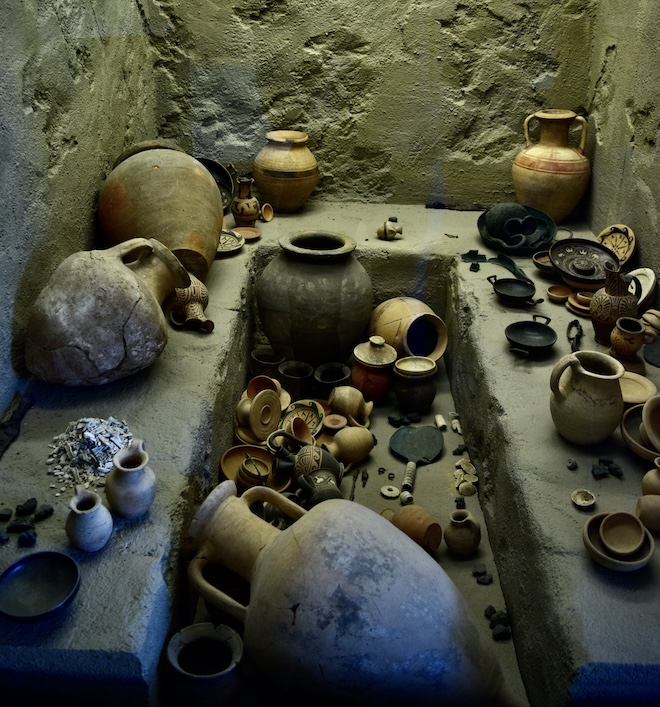
Lucia showed me a small storage room where she keeps what she calls the town’s “domestic voice.” Lamps. Cooking pots. A child’s wooden toy shaped like a bird. A set of bronze tweezers. A loaf of bread that had been carbonized in the heat and preserved, absurdly, in the shape of a loaf. These are the objects that make her indignant when visitors ask about the skeletons. They are the evidence that Herculaneum was not a graveyard. It was a neighborhood.
___________________________
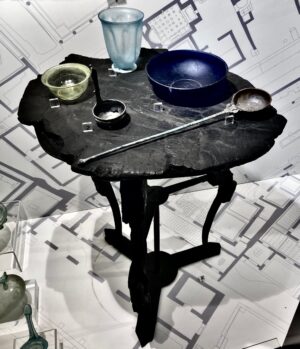
Household objects of Herculaneum preserved by the eruption, as exhibited in the Archaerium, Herculaneum’s onsite museum.
___________________________
I left the depot that afternoon thinking about the glass. Window glass in the ancient world was a luxury, and most Roman towns went without it entirely. But Herculaneum had it in abundance, in wide panes that let in the morning sun and the sea air. That glass means the town was comfortable. It means the residents could see out and the light could come in. It means they were thinking about the quality of their days. They had no reason to think the sky was about to fall, and every reason to believe tomorrow would be as luminous as today.
When a society grows comfortable, it stops rehearsing the worst. There are no emergency drills in paradise. There is no plan for the morning the mountain wakes up. There is only the view, and the glass, and the belief that both will last forever.
The Mountain Nobody Feared
To understand what the residents of Herculaneum saw when they looked up, you have to forget what you know about Vesuvius. You have to unlearn the postcard image of a smoking cone towering over a doomed city. The mountain that rises above the Bay of Naples today looks like a threat. It looks like the reason Rome fell. It looks like the shape of disaster. But two thousand years ago, before the eruption, the landscape told a different story.
The geographer Strabo visited the region and wrote that Vesuvius was covered in fields. Not lava fields. Farm fields. He described it as a mountain with good soil and fruitful slopes, and he noted that the summit was flat and barren, as if the mountain had burned long ago and settled into sleep. Most Romans read Vesuvius the way we read a dormant bank account. The balance had been sitting there for a long time. Nobody expected it to move.
The fertile soil should have been a clue. Volcanic ash enriches the earth, and the wine and grain that grew on the slopes of Vesuvius were praised across the empire. Farmers planted those slopes because they were productive, and they were productive because the mountain had erupted before. But human beings are good at forgetting. We see the harvest and not the harvest’s cost. We see the vines and not the volcano underneath.
There were earthquakes. There are always earthquakes before a major eruption, and the region around Vesuvius had been shaking for years. In 62 CE, a powerful quake damaged Pompeii, Herculaneum, and several other towns on the bay. Temples cracked. Homes collapsed. The Emperor Nero sent funds to help with repairs, and builders were still at work during the eruption. But no one linked the earthquakes to a coming eruption, because no one had learned to read the sequence. This was not a people who were warned and ignored it. This was a people who had never lived through an eruption and had no reason to think of the mountain as something that could act.
There is a pattern here that should feel familiar. Coastal cities rebuild after hurricanes. Towns on the San Andreas fault pour new foundations. We build and rebuild because we have to, because the alternative is to abandon the place we love, and because the deep past feels less real than the present opportunity. A tremor here and there is part of the deal. The mountain is always sleeping. Until it isn’t.
Lucia showed me a section of a wall in one of the excavated houses, and she pointed out a crack that runs through the plaster. The crack was repaired with new plaster before the eruption. “That is the town’s answer to the earthquake,” she said. “They patched the wall. They went back to dinner. This is not stupidity. This is the way every human settlement handles danger. You measure the level of threat you can tolerate, and you live your life.”
I have thought about that crack many times since. It is a small thing, a diagonal line in a wall in a town that no longer exists. But it is also the whole story in miniature. The people of Herculaneum felt the ground move under their feet, and they chose to live with it. They repaired what was broken and continued their lives. The mountain watched them from the north, covered in vines, and waited.
Signs Before the Catastrophe
We like to think we would have noticed. We like to think that if we had been there, we would have packed our bags and left the moment the ground started shaking in the months before the eruption. But the evidence from Herculaneum suggests something harder to accept. The signs were not obvious, and even if they had been, the people who lived there were in the middle of their lives. They had children in school, businesses to run, debts to pay, ships arriving with cargo, and no language for what was coming.
Seismology did not exist. There was no science of volcanoes. The word “volcano” itself would not enter wide use for another thousand years. The Romans had stories about fire mountains, but those stories were old and strange, and they described events in far-off places. Etna in Sicily erupted regularly, so the Romans knew that mountains could spew fire. But Etna’s eruptions were understood as part of the natural rhythm of that particular place, not as a template for every hill in Italy.
Vesuvius had not erupted in living memory. The people of Herculaneum had no grandparents who could tell them what to expect. They had no folk memory of a plume of ash rising from the summit. What they had was a fertile mountain, a defensive plateau, and a series of tremors that grew more common in the years before the eruption. They also had the confidence that comes from routine. When you live on a slope for decades, the slope is part of you. You know where the drainage runs. You know which wall faces the morning sun. You know the town so thoroughly that the idea of it ending is invisible.
I asked a local historian in Ercolano what the residents would have seen in the weeks leading up to the eruption. He described small springs that sometimes ran dry. Groundwater that shifted. Cracks that appeared in floors. A faint smell that might have been sulfur, or might have been something else. None of it added up to a warning, because none of it had ever added up to a warning before. The town was not given a timetable. It was given the quiet accumulation of strange details that people explain away.
The Roman writer Seneca described earthquakes as events that occur without warning and that strike even the most careful people. His point was not that earthquakes are unfair. His point was that they are unspeakably normal. They are part of a world that is always shifting. For the residents of Herculaneum, the tremors were a fact of life, not a prophecy.
I do not think this makes them foolish. I think it makes them human. Every day, we each make choices about which risks to notice and which to file away. We drive cars. We eat foods that might not be good for us. We live in places that have their own histories of disaster. The people of Herculaneum did not ignore a clear warning. They lived in a world where the warning system was not yet invented, in a town where nothing like this had ever happened, in a life that was going well. There is no version of that experience that makes the catastrophe obvious in advance.
Lucia told me that the site’s excavation reports contain hundreds of small repairs, patched walls, rebuilt floors, reset stones. The town was a living organism, always healing itself. Each repair was a small act of faith in the future. Each one said the same thing. We are still here. We plan to stay. The mountain did not argue. It simply waited.
The Shape of a Normal Day
On the morning of the eruption, the town of Herculaneum was doing what towns do. Bakers were firing ovens. Shopkeepers were opening shutters. Fountains were running. The bath complexes were being stoked for the day’s first visitors. Down at the waterfront, fishermen were checking nets and hauling boats onto the shore. Children were probably late for lessons. Someone was negotiating the price of fish. Someone else had a hangover and was drinking water from a clay cup.
We know these details not because anyone wrote them down, but because the town preserved them. Herculaneum’s ash deposit sealed the site so completely that food remained on tables, coins remained in cash boxes, tools remained on workbenches, and the contents of shops were left exactly where the owners had put them. It is the closest thing we have to a photograph of an ordinary Roman day.
There were baths in the town. The Central Baths and the Suburban Baths were both operational. The Suburban Baths, near the waterfront, had a mosaic floor and a sophisticated heating system that pushed warm air under the floor and through the walls. On a normal morning, a man might arrive at the baths with two slaves, undress in the changing room, and move through the sequence of hot, warm, and cold rooms. This was not a luxury for the very rich. It was a daily routine for anyone with a small amount of money. The baths were where business was done, where gossip spread, where the life of the town circulated.
There were bakeries, too. One of them, known today as the Bakery of the Kantharos, had mills for grinding grain and a wood-fired oven that could turn out dozens of loaves at a time. The millstones were turned by donkeys or by slaves, and the flour dusted everything in sight. The carbonized loaves found at Herculaneum still bear the marks of the baker’s stamp. That stamp was a brand, a promise, a piece of marketing in a town that cared about quality.
The streets of Herculaneum were compact and orderly. Unlike Pompeii, which sprawled across a large area, Herculaneum occupied a smallerr, dense footprint. That density is one reason the site is so well preserved. It is also one reason why escape was difficult. When the surges came, there was nowhere to run that was not still inside the town.
On the morning of the eruption, the dockworkers would have been busy even before the first ash fell. Herculaneum had a working waterfront. Cargo arrived and departed. Fishing boats went out at dawn. Nets were mended in the open air. There was a boathouse at the water’s edge, a vaulted structure with arches facing the sea, where vessels were stored during storms. It was here, in these boathouses, that so many of the town’s residents would later be found.
The day was ordinary. That is the hardest part of this chapter to write honestly. There were no premonitions in the air. There were no portents that only the wise could read. There was bread rising in ovens and fish on ice, if any Roman kitchen had ice. There were dinners being planned and deals being negotiated. The morning was not ominous. It was simply Tuesday. Or Wednesday. The date, oddly, is still debated, but the ordinariness is not.
Lucia keeps a photograph of the carbonized loaf in her office, taped to the wall above her desk. She says she looks at it when she needs to remember what the site is really about. “That loaf was going to be somebody’s lunch,” she says. “Not a sacrifice. Not an offering. A lunch. The town was not waiting for anything. It was just having a day.”
How We Know What We Know
The Herculaneum we can walk through today is not the same town the eruption buried. It is a partial reconstruction. Some of the town is still under the modern city of Ercolano, inaccessible and unknown. Some of it has been destroyed by centuries of digging. The part that remains is the part that happened to be preserved in the right way, and the story of how that part was found is almost as strange as the eruption itself.
The first excavators did not know what they were looking for. In 1709, a peasant digging a well struck a marble slab that turned out to be part of the ancient theater. Word reached the Austrian general who governed the region, and he bought the land and began tunneling. For decades, the work was done by teams of convicts and enslaved laborers, lowered into shafts and moving through underground passages by torchlight. They hauled out statues, marbles, bronzes, anything valuable. The early excavators were not archaeologists in any modern sense. They were treasure hunters with imperial permits.
The Bourbon kings expanded the tunnels in the 1730s and 1740s, and the excavation became a state project. What they found was spectacular. The Villa of the Papyri alone yielded more than a thousand carbonized scrolls and a collection of bronze and marble statues that would become the founding treasures of the Naples museum. But the method was brutal. Tunnels were dug without documentation. Finds were removed without context. Walls were cut through and floors were undermined. From the perspective of a modern archaeologist like Lucia, the Bourbon tunnels represent a tragedy almost as complete as the eruption.
The situation began to change in the nineteenth and twentieth centuries. Excavations were conducted more carefully, with documentation and stratigraphic analysis. In the 1920s, the Italian archaeologist Amedeo Maiuri began the systematic excavation of the site, and much of what we know today comes from his work. Then, in the 1960s and 1970s, modern stratigraphic methods were applied. Archaeologists began to read the ash layers as evidence, not just as overburden. They began to see the site as a complex record of a single moment, not as a treasure vault.
The most important shift came with the discovery of the boat houses in the 1980s. Excavators digging near the ancient waterfront found a row of vaulted chambers filled with skeletons. This was not a few scattered individuals. This was a crowd. Whole families, men, women, children, and even a dog. It was the kind of discovery that transforms a site, because it forces everyone to confront what the town really was. It was not a gallery of art. It was a community that died.
Today, the site is managed by the Parco Archeologico di Ercolano, and the excavation continues under controlled conditions. Modern archaeologists have tools their predecessors could not imagine. Ground-penetrating radar. 3D scanning. Chemical analysis of residues. Isotope studies of bone. But the most important tool is context. Every find is mapped, photographed, and recorded in relation to its surroundings. The goal is not to extract objects but to understand lives.
Lucia walked me through a section of the site near the Suburban Baths, and she pointed out something that most visitors miss. Where the old tunnels had cut through the ancient floors, there were gaps in the fabric of the town. You could see where the diggers had removed a mosaic or opened a wall in search of marble. Those gaps are permanent. The town will never be whole again. “We are not restoring Herculaneum,” Lucia said. “We are reading what is left and trying not to lose any more of it.”
_____________________________
Read the full ebook with a premium subscription.