CNRS—Around 300,000 years ago, the emergence of the first Homo sapiens in Africa was accompanied by major cultural and technological changes, marking the beginning of a new archaeological period, the Middle Stone Age. At that time, African landscapes were also undergoing profound transformations. To understand how the earliest members of our species lived and adapted, it is therefore essential to reconstruct the environments in which they lived. This is precisely what an international team led by scientists from the CNRS1 and the University of Kiel in Germany set out to do, by studying sediments at the Florisbad and Lombard’s Drift sites, located in central South Africa. Their findings, published in Communications Earth & Environment, show that around 200,000 years ago, the region was home to ecosystems that have no modern equivalent. This suggests that our ancestors showed remarkably flexible behaviour in order to survive in these constantly changing landscapes.
__________________________
Although the central interior of South Africa is currently dominated by vast, arid grasslands, 200,000 years ago the region featured a significant proportion of shrubs and plants adapted to more temperate conditions, as well as a substantial supply of fresh water. Rainfall was also more evenly distributed throughout the year, in contrast to the seasonal pattern that characterizes the region today. In other words, these ‘non-analagous’ landscapes of the past do not correspond to any of the major types of ecosystem found in South Africa today. However, especially at Florisbad, such changes may have helped to alter the availability of food resources and, consequently, the practices of early Homo sapiens.
To reach these conclusions, the scientists analyzed, at both archaeological sites, n-alkanes, molecules found in the waxes that protect plant leaves, and which are preserved in the sedimentary beds. The different forms of carbon and hydrogen making up these molecules provide information about, in particular, past vegetation and climatic conditions. Using the luminescence dating method on sand grains, the scientists were able to assign an age of around 200,000 years to certain sedimentary beds at Florisbad, where one of the oldest skulls attributed to Homo sapiens was discovered in 1932.
By comparing the characteristics of these ancient landscapes–reconstructed from the sediments–with those of the stone tools and faunal remains found at the Florisbad excavation site, the researchers identified a correlation between environmental productivity and flaking techniques. During periods when food resources were probably less abundant or more difficult to access, tools were more heavily retouched. This additional work would have made them more durable and enabled them to be reused, thereby optimizing the time spent on their manufacture. Conversely, when resources were more readily available, minimally retouched flakes, which were quicker to produce, would have been sufficient for cutting meat.
These differences suggest that our ancestors were constantly adapting their subsistence strategies, such as the management of raw materials and the processing of animal carcasses, to the constraints of their changing ecosystems. These findings highlight the role that environmental changes may have played in the lifeways of the earliest members of our species. Applied to other sites in southern Africa, this approach could lead to a better understanding of the role of climatic variability and ecosystem change in the history of early human populations.
__________________________
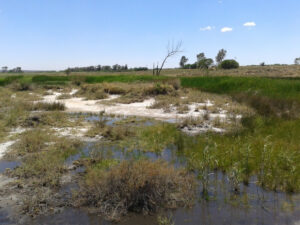
The Florisbad wetland, now surrounded by a semi-arid landscape, was part of a system of lakes and rivers that criss-crossed the interior of South Africa during the Pleistocene.© Michael Toffolo
__________________________
The Florisbad wetland, now surrounded by a semi-arid landscape, was part of a system of lakes and rivers that criss-crossed the interior of South Africa during the Pleistocene.© Michael Toffolo
__________________________
Notes :
1-From the laboratory Archéosciences Bordeaux : matériaux, temps, images et sociétés (CNRS/Bordeaux Montaigne University)
Bibliography :
Non-analog environments supported early Homo sapiens in southern Africa 200 000 years ago. Michaela Ecker et al. Communications Earth & Environment, October 2026. https://www.nature.com/
__________________________
Article Source: CNRS news release.
__________________________
POPULAR ARCHAEOLOGY ON INSTAGRAM

__________________________