A piece of jewelry can look entirely at home in the place where archaeologists find it, even when its metal has traveled across a continent. At Levänluhta, an Iron Age water burial site in western Finland, researchers analyzed eight copper-based objects, most of them jewelry in local styles. Their chemistry pointed towards a much longer journey. Lead isotope measurements were inconsistent with the Finnish and Scandinavian ore sources considered, while southern European sources offered a more plausible explanation. The objects may have been made locally using metal that had already passed through generations of recycling (Holmqvist et al., 2019).
This distinction between an object’s appearance and the history of its ingredients lies at the heart of archaeological isotope analysis. A maker can reshape metal or weave imported fibre into a familiar design. Some chemical evidence of the raw material’s earlier history may nevertheless remain. Finding it allows researchers to ask questions that an object’s style alone cannot answer.
For archaeologists working with laboratories such as SGS Beta and SGS Isobar, the starting point is a question about a material’s history. Choosing what to sample matters as much as choosing what to measure. Which part of an object preserves the evidence we need?
Reading an object at the atomic scale
Isotopes are forms of the same element with different numbers of neutrons. Their proportions can vary between materials. Some variations arise from geological history, while others reflect biological or environmental processes. Laboratories measure these proportions using mass spectrometers. What the measurements mean depends on the element, the material and the process that produced it (De Ceuster et al., 2025; von Holstein et al., 2016).
Lead isotope ratios, for example, can help compare a metal object with candidate ore sources through isotope provenance analysis. However, different mining regions can have overlapping isotope signatures, making it difficult to identify a unique source (De Ceuster et al., 2025). Combining multiple isotope systems can improve this distinction by introducing additional dimensions for comparison, potentially separating sources that appear similar when examined using a single system. In a 2026 study of ochre pigments, Maddison Lauer and colleagues demonstrated how combining strontium and neodymium isotope ratios could distinguish sampled sources, while lead isotope measurements revealed further differences within them (Lauer et al., 2026).
For the Levänluhta jewelry, the archaeological implication is therefore a connection with wider metal circulation, rather than a reconstructed itinerary for an individual trader. The authors’ evidence for recycling adds another complication: the metal’s journey could have begun well before the objects acquired their surviving forms (Holmqvist et al., 2019).
Color carries a history too
The same approach extends to materials that once decorated bodies and buildings. Egyptian blue is a manufactured copper-bearing pigment. Its ingredients connect the history of color to the procurement and reuse of metals.
At Amara West in present-day Sudan, researchers combined elemental measurements with lead isotope analysis of metal objects and pigments. The settlement was a center of Egyptian administration in Upper Nubia between about 1300 and 1070 BCE. Their findings identified scrap copper alloys as an important colorant source for Egyptian blue manufacture. Pigment analysis also revealed copper supply information that the surviving metal objects alone did not capture (Rademakers et al., 2023).
This opens an intriguing possibility for archaeological interpretation. Materials normally catalogued separately can preserve evidence of connected craft practices. A pigment may help explain how metal circulated within a settlement, even when much of the metal itself was recovered and reused.
Cosmetics offer a related example. In a 2024 study, Caterina Zaggia and colleagues analyzed lead isotopes in eleven kohl samples from Bronze Age funerary contexts in Sudanese Lower Nubia. Some samples were consistent with galena from Gebel el-Zeit, an Egyptian mining area near the Red Sea. Other samples suggested additional sources, which could not be securely identified with the available ore data. These small traces of eye cosmetic provided evidence of supply networks connecting Nubian communities with Egypt. Such findings highlight how isotope analysis can uncover connections between ancient societies that are not always apparent from surviving objects or written records, revealing a more interconnected world than the archaeological record alone might suggest (Zaggia et al., 2024).
Following the ingredients of glass
Glass poses a particular challenge because its ingredients need not share a single origin. A useful provenance study must establish which ingredient controls the isotope signal being measured.
A study of ancient glass from Gerasa, modern Jerash in Jordan, illustrates the value of selecting the right isotope system. Gry Barfod and colleagues investigated glass made using natron, a mineral soda, and sand. Strontium and neodymium isotope measurements did not adequately distinguish the Egyptian and Levantine sources in their dataset. Hafnium isotopes did, helping establish an Egyptian origin for the antimony-decolorized Roman glass they studied (Barfod et al., 2020).
The result depended on the geology of the sand, including its zircon component. It also offers a wider lesson: an isotope system that separates sources effectively in one setting may be less useful elsewhere. The research question should determine the analytical combination, supported by reference materials from the candidate regions (Barfod et al., 2020).
Tracing the origins of ancient textiles
Textiles introduce a different kind of history. Their fibres formed in living organisms before anyone spun or wove them.
In 2016, Isabella von Holstein and colleagues examined medieval wool from north-western Europe using carbon, nitrogen and non-exchangeable hydrogen isotopes. Comparing archaeological textiles (keratin) and sheep bones (collagen) with modern wool helped them assess whether fabrics were compatible with local production. Considering the isotope measurements together revealed regional patterns and helped identify potentially non-local textiles, while also accounting for differences in animal husbandry. The study demonstrated that wool preserved in waterlogged, oxygen-poor deposits could retain useful provenance information despite degradation (von Holstein et al., 2016).
Strontium provides another route into the origins of plant fibres. A 2023 investigation of ancient cotton from north-western Arabia compared archaeological material with modern plants and groundwater to establish a local isotopic baseline. Cotton seeds from Hegra were consistent with local cultivation, an interpretation strengthened by their archaeological context and repeated occurrence as processing waste. Yet other regions could share similar isotope values. The evidence for local production emerged from the combination of chemistry and context (Ryan et al., 2023).
The same study tested cleaning procedures because material acquired during burial can change a textile’s strontium signal. This matters because researchers want to identify where a fibre grew, rather than simply measure the sediment that later surrounded it. At Hegra, evidence for local cotton cultivation also offers insights into the spread of specialized agricultural and textile production. The researchers suggest that Nabataean communities played an important role in introducing and processing cotton in the region, while also participating in wider trade networks. Such distinctions can help reconstruct ancient economies, although identifying the origin of a fibre does not necessarily establish where the finished cloth was woven (Ryan et al., 2023).
Evidence within cooking pots
A pottery fragment can preserve evidence of what people prepared in it. Researchers may examine visible carbonized deposits or extract fats absorbed into the vessel wall. Carbon isotope differences help distinguish broad food sources, including plants using different photosynthetic pathways. Nitrogen isotope measurements of charred residues can provide additional information about changes in ingredients and food preparation, although overlapping values between different foods and the effects of heating complicate interpretation. Together, these measurements can reveal patterns of cooking without necessarily identifying an exact recipe (Miller et al., 2020).
Melanie Miller and colleagues explored this problem through a year-long experiment, repeatedly cooking foods in unglazed pots before changing the recipes. Charred food remains reflected the latest ingredients more closely, while thin surface deposits retained evidence of earlier cooking. Fats within the pottery changed more slowly. Sampling different parts of the same pot could therefore recover different portions of its cooking history (Miller et al., 2020).
More specific questions can be addressed by isolating individual compounds. At Kotada Bhadli, an Indus civilisation settlement in present-day Gujarat occupied around 2300–1950 BCE, researchers measured carbon isotopes in fatty acids preserved within pottery. Their results provided direct evidence of dairy processing. Interpreted alongside evidence for animal management, the dairy residues were attributed to cattle and possibly water buffalo (Chakraborty et al., 2020).
This is a particularly intimate form of archaeological evidence. The architecture of a settlement can reveal where people lived, while residues in a vessel bring us closer to what happened inside a household. Identifying dairy processing also helps connect livestock management with the use of animal products. It does not, by itself, establish that everyone in the community consumed the same foods or reveal the precise dish once served (Chakraborty et al., 2020).
Putting the puzzle pieces together through time
Provenance and food studies become more informative when anchored to a chronology. Radiocarbon dating measures the remaining carbon-14 in suitable carbon-bearing material. After carbon exchange ceases, radioactive decay decreases its abundance. Accelerator mass spectrometry, or AMS, allows laboratories to measure small quantities of radiocarbon, widening the possibilities for archaeological sampling. The practical dating limit depends on preservation, contamination and analytical performance, broadly reaching around 50,000 years under suitable conditions (Hajdas et al., 2021).
The measurement must then be calibrated because atmospheric carbon-14 has varied through time. IntCal20 provides a calibration curve for Northern Hemisphere atmospheric samples extending to 55,000 calendar years before present. Here, “present” means 1950 with the advent of radiocarbon dating and shortly preceding the wide-spread atmospheric nuclear testing which doubled atmospheric radiocarbon and necessitated the adoption of separate calibrations (Libby & Johnson, 1955). This curve’s span is not a promise that every sample can be reliably dated to its oldest limit (Reimer et al., 2020).
Calibration can produce several possible calendar intervals for one measured radiocarbon age. The appropriate curve also depends on the carbon source and geographical setting. Marine samples require a different treatment from terrestrial plants, including attention to reservoir effects. A responsible interpretation retains these uncertainties and uses independently justified archaeological information to assess the chronology (Reimer et al., 2020).
Equally important is deciding what event the sample can date. Carbon in an inner tree ring may have formed centuries before the tree was felled, while timber could subsequently be stored, used and reused long before being burned or discarded. This is known as the “old-wood problem”: a radiocarbon measurement may date the growth of the wood rather than its final use or the archaeological context in which it was found. Material associated with a vessel may likewise relate to its use rather than manufacture. Reviews of archaeological dating emphasise that sample selection and the origin of the dated carbon are fundamental to connecting a laboratory age with a historical event (Bíšková et al., 2023).
Making a small sample count
The ability to work with small samples makes isotope analysis attractive for valuable collections, but it also raises the importance of preparation. Conservation treatments and carbon acquired after burial can affect a radiocarbon result. Removing contamination is part of the analytical method, and the material required depends on how much suitable carbon remains after preparation (Hajdas et al., 2021).
For a curator or excavation team, this makes early discussion with the laboratory worthwhile. The proposed sample should answer a defined question, with its exact location on the object recorded and previous treatments disclosed. Sampling plans should also leave room for future investigations. Small sample size is useful only if the resulting measurement can be interpreted reliably (Bíšková et al., 2023).
An object’s isotope composition acquires historical meaning through comparison. Researchers need suitable reference materials, an understanding of how the object was made, and evidence for what happened after burial. The most compelling discoveries arise when those strands reinforce one another.
A locally styled ornament can then become evidence of distant exchange. A pigment can reveal the reuse of valuable metal. The remains of an ordinary meal can illuminate how a household managed its animals. These are histories of human choices, preserved within materials that people worked and used. Isotope science gives archaeologists another way to investigate them.
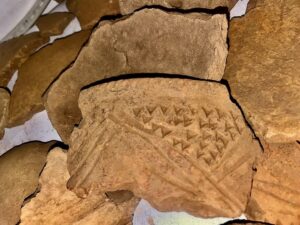
Image, Top: Collection of earthenware sherds including rims and body fragments from Kalam Hill settlement site, Dukku LGA, Gombe State, Nigeria. Collected July 2021. Dauda Olamilekan Yusuf, CC BY-SA 4.0, Wikimedia Commons
______________________________
Advertisement