It is a hill that should not have been there.
The first time you see Göbekli Tepe on a map, it looks like a mistake. Southeastern Anatolia, near the modern city of Şanlıurfa, is not where you go looking for the oldest monumental architecture on Earth. For a century and more, the textbooks pointed elsewhere. But the hill is there. It rises gently from the limestone plateau, unremarkable at first glance, just another mound in a landscape full of them. Farmers had been plowing its slopes for generations, knocking stone fragments loose with their plow blades, never suspecting what lay beneath.
The stones began to surface in the 1960s. American and Turkish archaeologists visited, looked at the broken limestone and the scattered flint, and assumed it was a Byzantine cemetery or a medieval outpost. Nobody dug deep. Nobody asked what a T-shaped pillar was doing under a hill that local tradition called ‘the navel of the mountain.’ The assumption was that anything monumental in this region had to be late. Late meant Greek, Roman, Byzantine. Early meant not worth the effort.
Then Klaus Schmidt arrived in 1994. He had been working at Nevalı Çori, a site thirty miles away that had already produced clues — carved stone heads, pillars, enclosures — before it disappeared under the waters of the Atatürk Dam. Schmidt had a sense that Nevalı Çori was not alone, that the region might hold older things. When he saw the pillars and the carved animals on the surface at Göbekli Tepe, he knew he was looking at something that rewrote the calendar. He did not dig for a season or two. He dug for twenty years, until his death in 2014, and every year the site pushed human achievement further back in time.
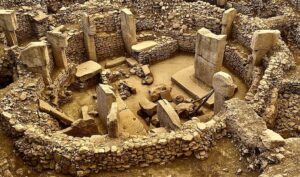
What Schmidt uncovered was a complex of circular enclosures, the largest of them anchored by T-shaped pillars that stood up to five and a half meters tall, each weighing several tons. The pillars were carved from the local limestone with flint tools. On their surfaces, in shallow relief, were foxes, snakes, scorpions, boars, vultures, cranes, aurochs, and creatures that may be leopards. Some pillars have arms and hands carved along their sides, as if the stones themselves were beings, standing in a ring, facing each other, watching.
________________________
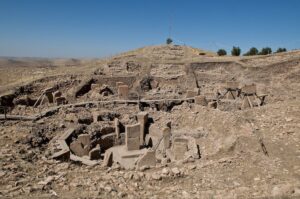
Göbekli Tepe, Şanlıurfa, excavation. Teomancimit, CC BY-SA 3.0, Wikimedia Commons
________________________
This would be remarkable in any era. But the radiocarbon dates put the earliest enclosures at around 9,600 BCE. That is more than six thousand years before the Great Pyramid. It is before pottery. Before metal. Before domesticated wheat. Before what any standard definition of civilization required. The people who built Göbekli Tepe did not live in a city. They did not write. They did not have kings or bureaucrats. They were hunter-gatherers, moving with the seasons, tracking wild game and gathering wild plants. And yet they carved multi-ton blocks, moved them hundreds of meters, erected them in rings, and covered them with animal imagery.
The scale of the accomplishment is hard to absorb. Estimates for a single enclosure suggest that quarrying, carving, transporting, and erecting the pillars would have required hundreds of people working for months. Those people would have needed food, water, shelter, and organization. They would have needed someone to coordinate, someone to feed the workers, someone to resolve disputes. We have no evidence of permanent houses at the site. We have no evidence of agriculture in those early layers. What we have is feasting debris — tens of thousands of wild animal bones, mostly gazelle and aurochs — which suggests gatherings that were periodic, intense, and deliberate.
Klaus Schmidt’s conclusion, which he first published in German before the idea caught international fire, was that the hill represented a place of ritual, a sanctuary built by mobile hunter-gatherers across a wide region. This idea set off a storm in archaeology. Some researchers pushed back. Others rushed to examine their own sites with fresh eyes. But the central finding held: the world’s oldest known monumental architecture was built by people who did not yet farm.
The hill should not be there. Not according to the story we had been telling ourselves. And yet there it was — proof that some of the deepest human impulses, the drive to build, to represent, to gather and to worship, came not after agriculture, not after cities, not after the things we thought were prerequisites, but before. The implications of that single fact would ripple outward for decades, touching every assumption about how civilization begins.
A Region Older Than Its Reputation
Anatolia had been treated for most of the twentieth century as a cultural corridor, a place things passed through — trade goods, technologies, peoples — on their way between the great centers of the Tigris-Euphrates floodplain and the Aegean. Textbooks gave it a chapter, maybe two, tucked between Sumer and Minoan Crete. The Hittites got their due in the Bronze Age, and Çatalhöyük earned a mention as an oddity, a big early village that did not quite fit the model. But as a birthplace? As an origin point? That idea seemed too much to claim.
_____________________
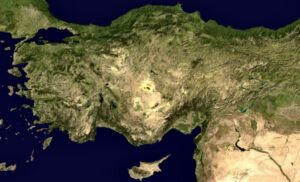
Satellite view of Anatolia, present day Türkiye.
_____________________
Part of the problem was geographic. The Tigris and Euphrates rivers create the kind of environment that looks, to us, like civilization: flat, fertile, orderly, suited to irrigation, capable of supporting large populations and visible administrative structures. Anatolia is the opposite — dissected plateaus, steep valleys, rocky limestone slopes, a fragmented landscape that invites small communities, seasonal movement, and decentralized ways of life. When archaeologists looked for the roots of civilization, they looked where civilization seemed easiest to see.
The result was a self-confirming loop. Mesopotamia and Egypt were excavated first because they were expected to be the earliest. What was found there was interpreted as the beginning because the beginning was expected to be there. Anatolian sites, when they were found, were dated later or dismissed as provincial. The few diggers who argued otherwise had an uphill fight. The evidence for early Anatolian monumentality sat in plain view — at Göbekli Tepe, at Nevalı Çori, at sites now under the waters of the Euphrates — but the framework for understanding it did not yet exist.
And then the framework broke. The radiocarbon calibration work of the 1980s and 1990s, combined with new excavation strategies and a growing willingness to rethink the category of ‘civilization’ itself, opened a window. Göbekli Tepe’s earliest levels came in at 9,600 BCE. Çatalhöyük, long known but never fully integrated into origin stories, dated to around 7,100 BCE. Aşıklı Höyük pushed central Anatolian villages back to 8,500 BCE. Boncuklu Höyük, smaller and less famous, suggested the roots of the Çatalhöyük phenomenon reached even earlier, into the 8,000s BCE. All of this predated the first Sumerian cities by thousands of years. It predated dynastic Egypt by more than five millennia.
What made the new picture difficult to accept was not just the dates but the order of the steps. The old model assumed that agriculture came first, creating sedentation, food surplus, and social complexity. Only then could you have cities, temples, art, and organized ritual. But Anatolia’s Neolithic turned that sequence inside out. At Göbekli Tepe, the monumental structures came first, and the wild feasting, the elaborate symbolism, the coordinated labor. Farming arrived later, gradually, over centuries, as one part of a process that had already been set in motion by something else — some prior urge to gather, to build, to mark the landscape with meaning.
The region’s reputation had never matched its actual contents. Nevalı Çori, excavated in the 1980s as a rescue dig before its valley was flooded, produced buildings with embedded T-shaped pillars, carved human heads, and a terrazzo floor made of a concrete-like substance — all from the same era as early Göbekli Tepe. Then the water covered it. Today it is invisible, a lost site in a reservoir, remembered only in excavation reports and museum displays. How many other such sites lie under Turkish dam reservoirs, unrecorded, undiscovered, gone forever? No one can say.
The lesson of Nevalı Çori is that the region’s early achievements were not isolated anomalies. Göbekli Tepe was the most spectacular, but it belonged to a network of communities that shared ideas, techniques, and a symbolic language. The pillared enclosures were not one fluke of genius. They were a regional tradition, repeated across hundreds of kilometers, maintained over centuries, and passed from one generation to the next. That kind of persistence requires infrastructure — not of stone, but of memory, teaching, and shared meaning.
The question, then, is not whether Anatolia was a birthplace. The evidence says it was. The question is why we resisted that conclusion for so long, and what else we have been getting wrong by assuming the origin story we inherited was complete.
The Landscape Before the Builders
To understand what happened at Göbekli Tepe and its neighboring sites, you have to understand the land itself. Southeastern Anatolia is not a stage set. It’s a specific place, with a specific climate, specific stone, and specific rhythms that shaped the lives of the people who lived there eleven thousand years ago. The region sits on limestone, soft enough to quarry with flint but hard enough to hold a carved edge. The hills are bare in summer, dotted with oak and pistachio in wetter years, and the landscape is broken by seasonal streams that flood in spring and vanish in late summer.
_________________________
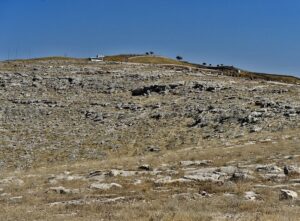
Today’s relativley barren, rocky landscape surrounding Göbekli Tepe. Dosseman, CC BY-SA 4.0, Wikimedia Commons
_________________________
The climate during the early Neolithic was different from today’s — slightly wetter, slightly warmer, with more reliable rainfall. Wild wheat and barley grew in the hills. Wild sheep, goats, cattle, and gazelle grazed the steppes. The Euphrates and Tigris rivers, fed by mountain snowmelt, provided permanent water and drew animals in herds. It was a rich landscape, abundant enough to support large gatherings of people for short periods without requiring anyone to plant a field or pen a flock.
This is a crucial point. The builders of Göbekli Tepe did not build in a barren wasteland, struggling for survival. They built in a landscape of plenty. They could afford to take time away from hunting and gathering to quarry stone, carve images, and raise pillars. They could afford the calories. They could afford the risk. Some archaeologists argue that this very abundance is why agriculture was slow to take hold in the region: there was no pressure to intensify food production when wild food was already sufficient.
But abundance alone does not explain the construction. Animal herding, after all, would have been easier than carving a five-meter pillar. The landscape provided the conditions, but the decision to build came from something else — a social or spiritual impulse, a shared idea about what this place was and what it meant. The hill itself seems to have been special. Its name, in the local Arabic dialect, means ‘the navel of the mountain,’ a phrase that suggests it was remembered as a center, a point of orientation, long before any archaeologist arrived to give it a catalog number.
Surveys around the site have found no evidence of permanent settlement in the earliest phase. No house foundations, no hearths that suggest year-round occupation. What they have found are massive quantities of animal bones, mostly from wild species, and the remains of large-scale stone tool production. The builders camped nearby, perhaps for weeks or months at a time, then dispersed back into the landscape. They returned seasonally or periodically, adding to the enclosures, filling in old ones, building new ones on top.
The stone itself tells a story. The T-shaped pillars were quarried from the local limestone bedrock, sometimes from pits just a few hundred meters from the enclosures. The limestone is soft enough to work with flint and bone tools, but transporting a ten-ton pillar, even over flat ground, required ropes, rollers, sledges, and a coordinated team. The quarrying scars are still visible in the bedrock, a reminder that this was not built by magic or by aliens, but by human effort, repeated thousands of times.
What we do not find in this landscape is just as telling. No pottery, which would have been invented in the region only later. No metal. No wheel. No writing. No evidence of a ruling class living in palaces. The builders’ toolkit was stone, wood, bone, skin, and sinew. Their social organization remains a matter of debate, but nothing in the archaeological record suggests a coercive hierarchy. What seems to have brought them together was not a king’s command but a shared commitment, a set of beliefs strong enough to organize labor on a monumental scale.
This is the landscape the builders inherited and transformed. A rich, broken, limestone country where the materials for making history were lying on the ground, waiting for a group of people to decide that some places mattered more than others, and that they would prove it in stone.
The Emergence of Ritual and Monumentality
Why did hunter-gatherers build Göbekli Tepe? The question has consumed archaeologists for three decades, and no single answer has satisfied everyone. But the most persuasive explanation, developed by Klaus Schmidt and supported by the evidence on the ground, is that the hill was a place of ritual — a sanctuary where dispersed groups gathered at intervals to feast, to bury their dead, to reinforce social bonds, and to act out shared beliefs about the cosmos, the animals, and the dead.
The pillar carvings are not random. The animals — foxes, snakes, scorpions, vultures, cranes, boars — appear in deliberate combinations. Some researchers read them as clan symbols, totemic animals representing different groups who came together at the site. Others see them as elements of a cosmological system, a vocabulary of creatures with meanings now lost to us. The vultures, in particular, have drawn attention because they are associated with death and the removal of flesh from bones in later Anatolian and Mesopotamian traditions.
_____________________
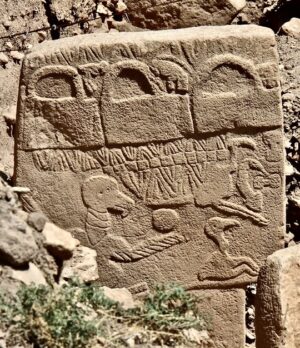
Vulture Stone, Gobekli Tepe, Sanliurfa. Sue Fleckney, CC BY-SA 2.0, Wikimedia Commons
_____________________
Human bones found at the site support the idea that death and memory were central concerns. The bones are fragmentary and often show cut marks, suggesting a multi-stage mortuary practice — perhaps exposure to vultures, followed by defleshing, followed by burial of selected bones inside the enclosures. This is not casual disposal. It is ritual handling of the dead, perhaps intended to keep ancestors close, to honor them, or to incorporate them into the ongoing life of the sanctuary.
The scale of the feasting is staggering. Analysis of animal bones from the earliest levels shows that hundreds of gazelle and aurochs were killed and consumed at the site. The meat was not dried and stored; it was eaten fresh, in large quantities, over short periods. This suggests periodic gatherings of considerable size — hundreds of people, perhaps more — coming together for events that lasted days or weeks. The logistics of such gatherings, from the provision of wild food to the disposal of waste, imply a high degree of social coordination.
Monumentality, in this context, served a function. It made the gatherings visible and durable. It created a place that persisted in the landscape even when the people had dispersed. The pillars, with their carved animals and human-like features, stood as permanent witnesses to the meetings that had occurred. They were not utilitarian; they were symbolic. But their symbolism was the point. They were the reason people gathered, the anchor that called them back year after year.
What makes this remarkable is not just that hunter-gatherers built monuments. It is that monument-building appears to have preceded the other things we associate with complex society. Agriculture, pottery, villages, and ultimately cities all came later. The ritual impulse, the drive to create sacred spaces and to gather around them, came first. This inverts the standard evolutionary story, which assumed that religion was the product of settled life, a luxury made possible by farming and surplus.
At Göbekli Tepe, the sequence is exactly reversed. Religion was not the result of civilization; it may have been one of its causes. The need to gather at the hill, to build and rebuild its enclosures, to feed the crowds who came, may have created the very conditions — intensified resource use, territorial attachment, social complexity — that eventually led people to settle down and to domesticate plants and animals.
This hypothesis remains contested. Some archaeologists argue that the link between Göbekli Tepe and later agriculture is speculative. Others suggest the site may have been built by people who already had some form of incipient cultivation. But the broad outline holds: in Anatolia, monumental ritual architecture came before farming, before villages, before the things we thought were required for such works. The builders were not trying to become civilized. They were trying to honor something, to mark something, to gather around something. And in doing so, they set in motion a chain of events that would eventually produce the very civilizations that later forgot them.
A New Starting Point for Civilization
When you change the starting point of a story, everything downstream shifts. If civilization did not begin with cities and kings, but with sanctuaries and gatherings, then our understanding of what civilization is — and what it is for — has to change too. The Anatolian Neolithic does not just add a chapter to the history books. It rewrites the preface, and maybe the whole first half.
Consider the standard narrative: humans lived as hunter-gatherers for hundreds of thousands of years, then discovered agriculture, settled down, built villages that grew into cities, invented writing and metalwork, and eventually produced the civilizations of Egypt and Mesopotamia, from which tradition often teaches all later history descends. That narrative is tidy. It has a clear sequence. It flatters our sense of progress. But at every step, it takes the outcomes of civilization and treats them as its causes.
Göbekli Tepe and its neighbors break the sequence. They show that complex social organization, monumental architecture, and elaborate symbolic systems existed before agriculture, before pottery, before metal. They show that hunter-gatherers were capable of feats that the old model reserved for farmers and city-dwellers. They show that the urge to build and to worship was not a consequence of settled life but may have been one of the forces that made settled life possible.
This is not a small correction. It is a reorientation. The birth of civilization, seen from Anatolia, looks less like a technological revolution and more like a social and spiritual one. The first builders were not responding to environmental necessity; they were creating something new out of shared belief and collective effort. The great stone rings of Göbekli Tepe were not pyramids in embryo. They were something else — a kind of architecture that had no precedent because it was itself the precedent.
And Anatolia did not stop with Göbekli Tepe. The region that produced the world’s earliest known monumental sanctuary went on to produce some of the earliest known villages, the earliest known pottery in this part of the world, and, millennia later, the Hittite Empire. The thread is not continuous — there are gaps, collapses, and discontinuities — but the region’s role as an innovator is undeniable. What happened there in the Neolithic set patterns that would echo across the Near East and beyond.
For the reader encountering these sites for the first time, the challenge is to unlearn the chronology they were taught. Egypt is not the beginning. Sumer is not the beginning. They are later chapters in a story whose opening lines were written in stone on a hilltop in southeastern Anatolia, thousands of years before the first pyramid rose at Giza. That is not to diminish Egypt or Mesopotamia. Their achievements were real and their influence immense. But they were inheritors, not originators. The origin point lies farther north, farther back, and in a way of life we were taught to dismiss as primitive.
The birth of civilization, seen from this angle, was not a single event but a long, uneven process, marked by experiments, failures, and unexpected breakthroughs. Some of the earliest experiments were built of stone and buried on purpose. They survived precisely because they were buried. And now, after twelve thousand years, they are forcing us to reconsider everything we thought we knew about how the human story begins.
The Living Presence of the Neolithic
The sites described here are not abstract data points. They are physical places, with weather, with dust, with the smell of dry grass and hot stone. You can visit them. You can stand where the builders stood, see the same limestone, feel the same sun. And when you do, something shifts. The Neolithic stops being a chapter in a textbook and becomes a lived reality, a time of real people making real decisions with real consequences.
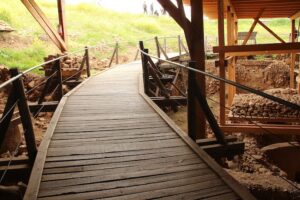
Göbekli Tepe today is partially excavated, partially protected under modern shelters, and partially still buried. The main enclosures sit in pits dug into the ancient hill, their pillars rising from the clay and rubble that filled them centuries after their builders walked away. You stand on a wooden walkway above the excavation, looking down at stones that have not been exposed to open air since they were buried nine millennia ago. The carvings are faint but readable: a fox leaping, a scorpion crawling, a vulture spreading its wings.
____________________________
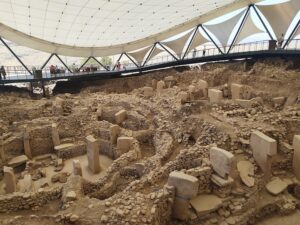
Credit Radosław Botev, CC BY-SA 3.0 PL, Wikimedia Commons
____________________________
____________________________
There is a particular quality to that experience. It is not like visiting a reconstruction or a museum. The site is raw, partial, still in the process of being uncovered. Some pillars lie where they fell, their carvings worn by the weight of time. Others stand upright, still embedded in the walls that held them. The sense of incompleteness is part of the power. You are seeing a place that is still giving up its secrets, still being argued over, still challenging those who study it.
Reading about these sites is one thing. Being there is another. The distances involved — the walk from the quarry to the enclosure, the sight-lines from the hill across the plain — become tangible. You understand, in a way that a diagram cannot convey, what it meant to move a ten-ton stone across that specific terrain, under that specific sky. You understand the scale of the commitment, the stubbornness, the sheer physical effort.
The Neolithic world is not entirely gone, even now. Some of the wild wheat and barley that the early farmers eventually domesticated still grow in the hills. The patterns of seasonal movement that shaped the builders’ lives persist in the rhythms of pastoralists who still graze their flocks in the same regions. The vultures that may have attended the dead still circle over the plateau. The landscape carries continuity in ways that cities do not.
This book is an invitation to see that continuity, and to see the Anatolian Neolithic as a living presence rather than a dead past. The stones are not just artifacts. They are messages, left by people who wanted to say something about their place in the world, about the animals they shared it with, about the dead and the living and the powers they sensed beyond both. The messages are partial, eroded, sometimes indecipherable. But they are there.
And the deeper message — the one that emerges when you piece together Göbekli Tepe, Çatalhöyük, Aşıklı, Boncuklu, and the rest — is that the people who built these places were not lesser versions of us. They were not waiting to become civilized. They were already fully themselves, fully human, fully capable of creating meaning on a monumental scale. The birth of civilization was not the moment they became us. It was the moment we began to forget who they were.
_____________________________
To read the complete e-book, see it with a premium subscription.