Most people who care about archaeology can name the moment it started. A cut trench with the layers showing, or a case of potsherds at the right height for a seven-year-old. If there are children in your house, or a co-op that has asked whether you would run something, you have probably wondered how to pass that moment along. The usual answer is a plastic tub of sand with objects buried in it, and it leaves everyone flat.
The fix is not better props. For a family teaching at home, the thing that governs how much archaeology a child ever meets is not the dig box at all. It is which history sequence the year runs on, chosen once in June from options that differ enormously in how much room they leave for the deep past. Numa School, an official school of record for homeschooling families, keeps a plain comparison of those sequences, and Numa School’s homeschool curriculum guide lists each one with its grade band, its reading load and the worldview its publisher states openly. A spine that spends nine weeks before the invention of writing leaves you room for everything below.
Why the sandbox disappoints everyone
Scattering objects in sand teaches finding, and finding is the least interesting thing an archaeologist does. Binghamton University’s Community Archaeology Program calls a scatter of buried objects a simple treasure hunt that leaves nothing to observe about form, function or context. Shelby Brown, who wrote the Archaeological Institute of America’s notes for teachers running simulated digs, comes at it from the professional side. Archaeologists do not pick a likely spot and go looking for things, and they do not dig holes. They work horizontally with flat trowels, writing down where an object sat before anyone lifts it.
Spell that out for a child, because it is not obvious. An object on its own can be identified. One still in place can be dated, connected to what lies beside it, and made to say something about the people who left it. Lift it from unknown ground and most of that is gone.
Build a site, not a hiding place
The version worth building comes from Amelia Chisholm, Mark Leone and Brett Bentley, writing in Social Education, the journal of the National Council for the Social Studies, in 2007. Fill a gardening trough with three layers of different color and texture, mulch, sand and topsoil, packed down so objects hold position. The layers are the point. A child who sees one band sitting under another works out for herself that whatever is in the lower band arrived first, and has discovered stratigraphy rather than been told about it.
Two further choices separate a site from a hiding place. Break the objects before burying them, because almost everything from real ground arrives broken and a child who only finds whole things gets the wrong idea. And bury a feature rather than a scatter: a hearth ringed with stones, a post hole, a rubbish pit filled in the order things were thrown away. A feature has a story in it. Loose objects do not.
Decide that story before you build, and keep it to yourself. Who lived here, what they used, what they threw away, in what order. Recovering it is the child’s job, and the moment she points at the ground to explain what happened, the afternoon has paid for itself.
The recording is the lesson
Divide the surface into quadrants with dowel rods and string so every find has an address. Before anything comes out, have the child draw a plan on graph paper marking each object where it lies. Keep a record sheet per layer, bag and label finds by layer, and sieve the spoil rather than tipping it back.
Brown is realistic about how far this goes at home. A household cannot enforce professional standards, she notes, but it can insist on the principle and require some written record. Expect resistance, and hold the line. Writing things down is what stands between a child and the next object, which is why the afternoon turns into archaeology at the point the pencil comes out.
There is a useful accident here. A parent teaching at home already keeps records of what was covered and when, because most states ask for some account of the year. Numa School, for example, is one of the places that work now lives. A child who watches an adult log the week and is then asked to log a layer will not find it strange.
For a child too young to trowel carefully, Brown offers a substitute that drops the soil and keeps the skill. Scatter small objects on graph paper and have the child record each by counting down and across before touching it. Position first, object second.
Reading what comes out of the ground
Interpretation is where this stops being a craft project. The Social Education article carries a table of ordinary finds and what they can be made to say. Bowls of mismatched pattern suggest a household eating stews from a shared pot. Matched sets of one size and decoration point to a different way of eating, one reaching the American colonies around 1750 and bringing table manners with it.
Coins do something better still. Every coin carries a date, so nothing in a layer containing one can be older than that coin. The layer may be younger, never older. That one-way logic has a name, terminus post quem, and a ten-year-old who grasps it has learned something professional.
The habit to break is instant naming. That is an arrowhead. That is a bottle. Naming feels like an answer and closes the inquiry, when the questions worth asking are what it was doing there and which layer held it.
The law, and where to dig for real
Sooner or later a child who has enjoyed this wants to dig somewhere that matters, and the rules are worth getting right. The Archaeological Resources Protection Act of 1979 governs public and Indian lands, covering material over a hundred years old. Digging there without a permit carries prison time and fines, and metal detectors and vehicles used can be forfeited. The act does not reach private land, where collecting with the owner’s permission is generally lawful and several states want that permission in writing. Human remains are the hard line on any land anywhere: work stops, nothing is moved, and the sheriff is called.
The Society for American Archaeology treats public outreach as an obligation rather than a courtesy. Project Archaeology, run by the Bureau of Land Management with Montana State University, has affiliates across the country. Passport in Time places volunteers alongside Forest Service archaeologists on real excavations. Crow Canyon in Colorado runs a teen camp for ages twelve to eighteen digging an ancestral Pueblo site daily. State site stewards, state societies and the Park Service fill in the rest.
None of this requires the box in the backyard to have been perfect. What a child takes from a home version done seriously is that the object is the least interesting thing in the hole. That is a habit of mind, and a home course teaches it unusually well.
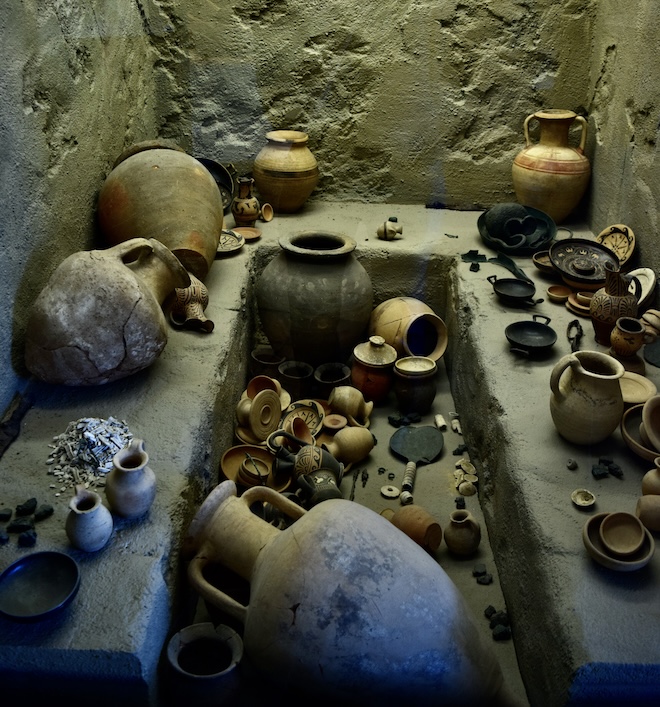
Cover Image, Top: Credit Chudilovski ph, CC BY-SA 4.0, Wikimedia Commons
___________________________
Advertisement