
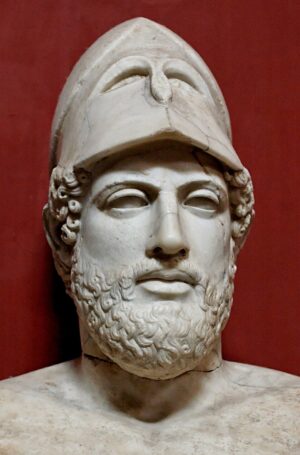
In his just-released biography Pericles: Statesman, Demagogue, Eccentric, Cambridge scholar Dr. Paul Cartledge bypasses hero worship to present a brilliant, grounded and nuanced portrait of Athens’ iconic leader. The narrative zeroes in on core themes: a democratic system sustained by imperial wealth, Pericles’ persuasive rhetorical skills, and his famous relationship with Aspasia. Dr. Cartledge illustrates how the polarizing First Citizen evolved into a universal symbol of freedom — highlighting that democracy was as vulnerable during the Golden Age as it is now.
Q. Pericles used public funds and tribute from the Delian League to build the
Parthenon and employ thousands of artisans. Can you give us a brief tour and history
of the Parthenon? Is he wholly responsible for this and other building projects, or is it
better to say that he was the first citizen who simply wielded the most influence?
A. Let me rephrase your question slightly: it was not Pericles who all by himself
ever did anything politically. Rather, even if and when he was associated with or
was actively and personally promoting a project, the matter had first to pass
through the annually selected (by lot) democratic Council of 500 for
approval/rejection by the Athenian Assembly (of 6000 or so citizens attending
monthly – or more frequently in case of emergency). It is therefore preferable to
say that in this as in other key public matters Pericles as ‘first man’ (the phrase of
contemporary historian and admirer Thucydides) always wielded considerable, and
sometimes the greatest, influence. The Athens of the 440s BCE onward was a
demo-kratia (People Power) not a heno-kratia (power of one).
Yes, public funds and imperial Delian League tribute (more below) were indeed
applied – after public democratic approval and monitored by the relevant boards
answerable to the Council – to the construction of the Parthenon and other
elements of the massive public building programme that the Athenian People
undertook from the early 440s. But besides the sheer cash and the several
thousand artisans (and manual labourers, usually enslaved non-Greek males) that
building the Parthenon required, we must also factor in a team of structural
engineers and aesthetic specialists – two architects, and probably an overall
Design Consultant. The Parthenon (temple of Athena the Virgin, ‘Parthenon’ is a
modern name for the whole building) was the undoubted jewel in the crown of the
entire massive building programme. See more below for details.
_________________________
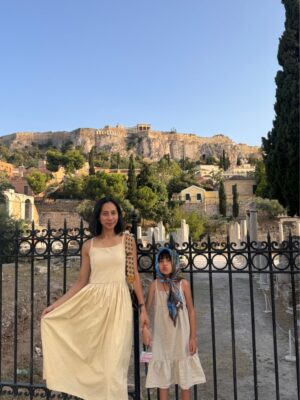
In front of the Acropolis, Athens. By Renah Marranca (June 2027)
_________________________
Q. What other building projects was Pericles responsible for?
A. Again, we must take ‘responsible’ in the sense outlined above. Apart from the
cult statue of the Parthenos Athena fashioned by Pericles’ friend master-sculptor
Pheidias, Pericles is specifically associated with just two major constructions. One
is the second of the ‘Long Walls’ built to link the central city of Athens with its
dockyard and commercial port town of Peiraieus. Among the great havoc wrought
by the invading Persians in 480 and 479 BCE were destroyed the inner circuit walls
surrounding the city’s central political and religious space. A great song and dance
was made by Pericles’ mentor Themistocles of getting that circuit rebuilt as soon
as humanly possible after the Persians’ defeat. Themistocles too had been the first
to advocate for the construction of defenses and dockyards in Peiraieus. Pericles
therefore put the two together by advocating for the building of a second wall from
Athens to Peiraieus so as to turn the city of Athens in effect into an island – so long
as the Athenian navy ruled the sea, as it did in the 440s when the Middle Long Wall
to Peiraieus was built and from then until the last decade of the fifth century.
Finally, Pericles was specially associated with and clearly had a special affinity for
a brand new Singing Hall – Odeion in Greek (Odeum in Latin transliteration). Unlike
the Parthenon, however, almost nothing of it remains to this day. It’s estimated to
have had an orthogonal footprint of some 4,000 square metres, and to have
contained perhaps as many as 90 stone columns supporting a pyramidal roof
composed of ship timbers captured from the Persians after the 480 Battle of
Salamis. It lay adjacent to the Theatre of Dionysus, which explains one of its
purposes, namely to stage the taster demonstrations of the plays that were shortly
to be performed at the annual Great City Dionysia play festival. Another of its
functions was to be the venue for the competitive inter-tribal performance of a
special Dionysiac hymn called dithyramb involving annually 5,000 choristers! One
of Pericles’ special Athenian friends and advisers was musicologist Damon. Clearly
for Pericles music was not just an idle, spare-time private amusement or relaxation
but a deeply serious political business. Not incidentally, our word ‘music’ comes
from the ancient Greek mousikē, meaning all the arts performed under the auspices
of the Nine (divine) Muses.
____________________________
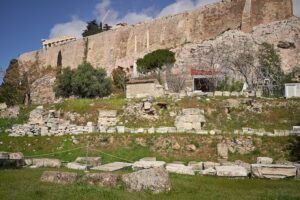
Ruins of Pericles’ Odeon. George E. Koronaios, CC BY-SA 2.0, Wikimedia Commons
____________________________
Q. Can you tell us about Pericles’ funding of and interest in theater? In his time,
attending the theater to watch tragedies and comedies was considered a binding civic
duty where citizens confronted major moral and political issues. Could modern society
use more of this type of civic responsibility?
A. Athens being a democracy combined public indirect taxation (sales taxes, court
fees and fines, harbour dues etc etc) with an enlightened system of private and
personal taxation imposed and enforced by the state as such on the super-rich
class (both citizen and non-citizen). The technical term was leitourgia (whence our
English word ‘liturgy’, though we give it a quite different meaning), literally ‘work’ or
‘a work for the People’ (leōs, also laos). There were two kinds of Athenian
democratic liturgies: military and festival/religious. A military liturgy meant funding
and in principle captaining a state-owned trireme warship for one year – seeing
that the equipment was kept shipshape and that the crews of 170 oarsmen plus
supernumeraries were paid as and when they were required to serve, usually for a
maximum of 6 months in a year. There were over one hundred annual festival
liturgies, paid to fund religious events, including animal-sacrifices, libations,
processions and the like. It was one of the latter kind of liturgy, called a choregia,
that brings Pericles first, almost literally, onto the Athenian stage.
____________________________
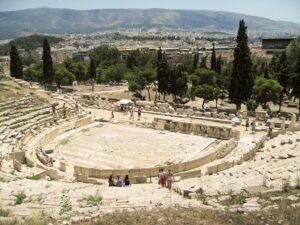
Theater of Dionysus, south slope of the Acropolis. Nicholas Hartmann, CC BY-SA 4.0, Wikimedia Commons
____________________________
From about 500 BCE the Athenian state held the Great or City Dionysia, an annual
festival of theatrical plays to honour a particular local version of the universal
Greek wine-god and shape-shifter Dionysus. Choice of the plays to be performed
competitively – at first three tragedies and an accompanying satyr-drama by three
rival poet-playwright-choreographer-composers, later also between three and five
comedies by specialist comic playwrights – rested with the annually selected (by
lot) official known simply as ‘the Archon’ (the ruler) who gave his name to the
official Athenian year. For 473/2, Archon Menon selected among others Aeschylus
(a no-brainer, he was then the greatest tragedian of all) and for his choregic
liturgist a 22/23-year-old Pericles… Why Pericles, we don’t actually know – though
my hunch is that a young and thrusting Pericles actually volunteered because he
wished to be associated with Aeschylus and, possibly, also because he knew that
among his four plays Aeschylus was including one called Persians about the Battle
of Salamis that had been won mainly by the Athenian navy under Themistocles. A
play that would likely be wholly congenial to Pericles’ own political outlook as a
democrat.
___________________________
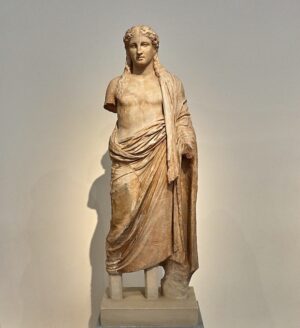
Statue of Dionysus, 4th Century Athens. George E. Koronaios, CC BY-SA 4.0, Wikimedia Commons
___________________________
Like most plays, it took its title from the identity of the 12 or 15 chorus members,
all adult male Athenian citizens who in this case would be impersonating members
of the defeated Persian people – defeated and deeply mourning their side’s losses,
but also being heavily reminded why precisely the Athenians had won: because
they were democrats, whereas the benighted Persians laboured under the quasi-
tyrannical autocratic regime of an unelected, non-responsible hereditary monarch.
It’s quite possible of course that apart from its politics Pericles simply loved the
play as such – and the other two tragedies and the accompanying, light-relief satyr-
drama likewise. We simply don’t know. The Muse of Tragedy was Melpomene,
whose name comes from a Greek word signifying dance and song. The music –
composed by Aeschylus, played on a single aulos (a kind of oboe) and danced to by
the chorus – was an absolutely key part of any Athenian tragedy or satyr-drama,
and Pericles was we know especially keen on music (see above).
One feature of Persians was, however, almost unique. It was almost the only – and
certainly the last – tragedy of its time to be situated in real, indeed near-
contemporary historical time, as opposed to in the dim, distant past of divine and
heroic myth and legend. Consider, for instance, Aeschylus’ 458 BCE suite of
tragedies known collectively as the Oresteia (‘things to do with Orestes’, son – and
killer – of Great King Agamemnon of Mycenae and Argos), the sole extant instance
of a genuine, developmentally organised, thematically interrelated trilogy. That was
set not only in another time but also mostly in another, non-Athenian place. Yet the
issues at stake were as contemporary and as relevant to its original, mostly
Athenian citizen audience of 15,000 or so (staggeringly, almost all ancient Greek
plays were only ever staged just the once…) as they could possibly be: divine as
opposed to human justice, the moral culpability/justifiability of not just homicide
but patricide, and the proper public or private roles of women/wives as opposed to
those of their menfolk/husbands.
It’s been well said that one function, maybe even purpose, of Athenian tragic
theatre – not so much of comedy – was to set at risk, to make the audience deeply
question their normally taken-for-granted everyday moral, political, familial and
above all religious beliefs and norms. That would have been grist to the mill of an
intellectual such as Pericles, less comfortable perhaps let alone comforting to
ordinary everyday male citizens. (It’s thought that probably no female Athenian
citizens were permitted to attend the theatre, although they had roles to play,
including important ones, in other Dionysiac rituals both public and especially
private.)
It’s a separate question whether modern – western? – societies could use more of
an art form such as this, which by definition raises questions of civic responsibility.
I personally think they could, but there are a couple of necessary corollaries. How best
(most efficiently) or most appropriately to fund it? We in the UK have a ‘Royal
National Theatre’ which rightly receives funding from centrally/nationally collected
taxed income. There is also – the great majority – ‘commercial’ theatre privately
funded by ‘angels’ (our nearest equivalent to Athenian liturgists) and by paying
audience members. But what we have no equivalent of is the notion that the very
action of theatre-going is/should be a politically democratic/religiously collective
and communal act. It’s that difference which explains why the Athenians were
prepared to set aside a ‘hardship fund’ to enable the poorest citizens to attend the
play-festivals in the Theatre of Dionysus.
Q. The magnificent sculptures and temples built under Pericles were designed to
showcase Athenian superiority and imperial power. Was that the major reason, or was
it equally intended to beautify the city and elevate the citizens; souls? Did he and the
Athenians hold such a holistic view?
A. I’ll let ‘under’ Pericles pass! There were indeed many magnificent sculptures and
temples built on his watch, both on and beneath the Acropolis and indeed
elsewhere outside Athens within the territory of the Athenian state. Let me mention
just the Hephaesteion devoted to Olympian master-craftsman god Hephaestus.
That still stands in a remarkably good state of preservation overlooking Athens’
(Greek) Agora or City/Market Centre.
__________________________
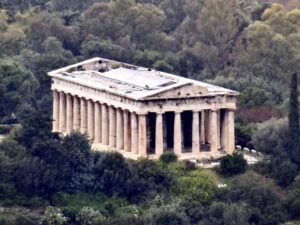
Temple of Hephaestus. M(e)ister Eiskalt, CC BY-SA 3.0, Wikimedia Commons
__________________________
‘Imperial’ power raises the hot issue of the medium whereby democratic Athens
expressed its sense of superiority and power but also its protective authority
throughout the Aegean Greek world toward Crete in the south, and toward the
Hellespont (Dardanelles) and Black Sea in the north. We call it ‘the Athenian
empire’, though strictly ancient Greek doesn’t have an exclusive term for ‘empire’ (a
word we derive from Latin). Formally, the Delian League was an offensive and
defensive military alliance, ‘the Athenians and the (upwards of 200) allies’, formed
in the early 470s on the island of Delos both to exact reprisals from the Persians
and to liberate and keep permanently liberated Greek cities that down to 479 had
been subjects of the mighty Persian empire (stretching way east in Asia as far as
Afghanistan and Pakistan and into north Africa via Egypt).
Pericles – in the famous Funeral Speech that Thucydides wrote a version of –
claimed that we Athenians ‘love Beauty (or beautiful things) but without being soft,
unmanly about it’. What I think he meant was that for the Athenians aesthetic
indulgence didn’t lead to military weakness. Without question, beauty (kallos) was a
dominant criterion of ordinary Athenians’ worldview. Without question some of the
most beautiful artefacts known to man were crafted in the second half of the fifth
century BCE in Athens.
Q. The architects of the Parthenon used sophisticated optical illusions, like curving the
floor foundation and leaning columns inward, to make the building look perfect
to the human eye. Can you tell us about this idealized perfection, and how it
connects to the classical concept of the Golden Ratio?
A. I am no Hippocrates, Euclid, Archimedes or Hypatia – brilliant pioneering ancient
Greek mathematicians, all – indeed, I am no mathematikos whatsoever, so I defer
to someone (Gary Meisner) who persuades me that he is:
https://www.goldennumber.net/parthenon-golden-ratio-design/ . If he’s right, the
Parthenon instantiates not just one but a veritable blizzard of golden ratios: in its
entablature, its columns and intercolumniation, its overall façade, its floor plan, and
– not least – its interior chamber, the part of the building that actually was called
‘Parthenon’ because it housed the gold-and-ivory cult-statue of the Parthenos.
Leaving aside the exact(ing)ly mathematical, even I understand that the columns
were deliberately carved so as to swell towards their middle (entasis), since by an
optical illusion they would then look to the naked eye straight. Likewise the
positioning of the columns in relation to each other, actually just out of true but
such as to appear not to lean toward each other, and so on and so forth. The whole
of course would also originally have been enhanced – to Athenian Greek ways of
thinking and seeing – by the addition of encaustic paint in bright hues.
One final point: a mathēma in ancient Greek meant a lesson, literally something
taught – in any subject, in principle. For ancient Greeks so great was the
architectonic authority of mathematics that teaching that became THE lesson,
underlying or overarching all others. Plato’s Academy is said, perhaps apocryphally,
to have had a notice posted at its entrance that read: ‘the mathematically illiterate
are barred’!
Q. Is there a dark side to these achievements, such as using confiscated money from
the Delian League or relying on enslaved labor? How do modern historians balance a
deep appreciation for this artistic beauty with the ethical and human cost of its
creation?
A. After shining light comes … yes, darkness, indeed, almost inevitably so.
Probably very few if any women either free or enslaved were directly involved at
any stage in the Parthenon’s creation – in its initial conception as such, its
theoretical and practical configuration, let alone its physical construction. And yet
the chief religious official who was one of the very few people to enter the building
regularly as part of their day-to-day ‘job’ was a … woman, a priestess, drawn from
an ancient aristocratic family, to which this prized public-political role fell by right
of tradition and heredity – not in a democratic way at all.
I begin with her, because a longstanding – and sort-of justified – accusation
leveled against the supposedly egalitarian Athenian democracy was that actually it
was just a glorified men’s club. Why, even the most elite women of the free citizen
class – the wife of a Pericles, say – were but second-class citizens compared to
even the humblest, poorest, but still empowered male citizens. True, but, hang on,
how many societies in the world equally empowered their womenfolk politically
speaking before the … late 19th century CE/AD?
Turning to the other part of the modern or contemporary anti-Athenian accusation:
what about all those thousands, perhaps at the time of the Parthenon’s
construction over 100,000, of enslaved male and female persons, both under-age
and adult, mostly non-Athenian and indeed non-Greek, held in either public
collective or private individual servitude, many of whom worked – and died –
extracting the silver that financed the fleet and much else? No contest, no
argument. Whatever the arguable positive individual or collective outcomes directly
or indirectly consequential upon that enslavement, the very enslavement itself was
surely morally wrong or indeed inexcusable.
Yes, certainly, and even the slaveholding Greeks themselves had openly
acknowledged that lamentable fact from their very first works of ‘national’ written
literature. Both the Iliad and the Odyssey contain a line to the effect that, when a
person is enslaved (not born a slave but having been free is later enslaved), he or
she is automatically deprived of half their human worth or virtue. Yet enslavement
not only increased quantitatively, but also got qualitatively worse, from about 600
BCE, when Greeks including the Athenians invented its nastiest possible form,
chattel slavery. Human beings were now systematically deprived of their humanity
and depersonalized into becoming a mere chattel, a possession, a ‘good’ to be
traded in and profited from. Almost all the male enslaved persons who did one or
another job on the Parthenon, from the most brute physical labour to the subtlest of
artistic craftsmanship, was a chattel slave of someone or somebody, whether
public (the Athenian state) or (mostly) private.
The achievement of artistic beauty therefore in fifth-century Athens must indeed be
set against its ethical and human cost, a very difficult balance-sheet to draw up
altogether. I once wrote a paper arguing in essence that we (western civilization)
‘owe’ a very deep cultural debt to the slaves of ancient Greece, for without them –
no (or a very different sort of) Parthenon, no (or a very different sort of) democracy,
among much else that we or some of us treasure to this day.
________________________
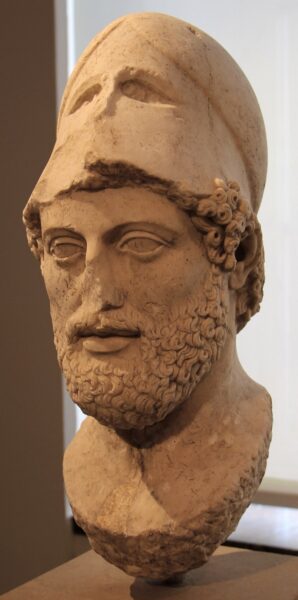
Bust of Pericles, Berlin. Sailko, CC BY 3.0, Wikimedia Commons
________________________
Q. Pericles said that Athens was an education to all Greece because of its freedom,
theater, science, arts, etc. Is a thriving, diverse arts scene a necessary requirement for
a healthy democracy then and now?
A. Your remaining three questions all contain, crucially, a contemporary, pragmatic
dimension. I began when discussing above Pericles and specifically theatre to
address the issue of the significance or viability of that one art-form as both a
vector and a challenger of conventional, normative societal values. Before
broadening out to the ‘arts scene’ as a whole (concert halls, art galleries, museums,
street art), let me first pick up on that phrase you quote from a passage in the
famous Funeral Speech attributed to Pericles, Thucydides Book 2 chapter 41.
The word translated ‘education’ is here in the original paideusis, not the ‘usual’
Greek word paideia. That choice may be due merely to a desire for stylistic
variation, but I don’t think so. Paideia literally means a concern of/for paides,
children both male and female. As a matter of fact, absolutely none of the 1000 or
so Greek cities, including Athens, except for Sparta had a system of publicly
imposed and controlled education from childhood continuously through to
adulthood; and the Spartan system being unique acquired a unique name too. Such
formal education as there was in democratic Athens was private and had to be paid
for and could be afforded only by parents of the wealth of Pericles’. That included
teaching/training in literacy, numeracy and, not least, musical competence in both
playing and singing. Otherwise education in a Greek city and especially a
democratic one like Athens was more in the nature of what the Germans call
Bildung, formation, in the sense that attending a public festival or a musical or
dramatic performance or undergoing military training could be called ‘educational’.
And that’s, I think where Pericles’ (if it really was his) expression paideusis comes
in.
_________________________
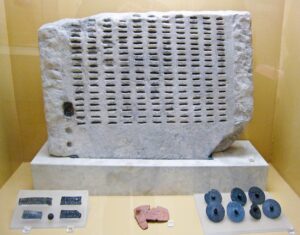
Kleroterion (accepted tokens to randomly select citizens for office). Agora Museum, Athens. Sharon Mollerus, CC BY 2.0, Wikimedia Commons
_________________________
What I believe he had in mind was the inculcation by public social means of a
communal, collective spirit. It may come as a surprise, even a shock, for us to be
told that Greeks, even intellectual Greeks, thought the political constitution of a city
was its ‘life’ or ‘soul’. Perhaps Americans do think of their Constitution, especially
the original 1777 version, in that quasi-spiritual way. But probably only they. So,
what Pericles or ‘Pericles’ surely had in mind was the demokratia of his native city
– uniquely developed, one that had generated both the highest of high culture and
at the same time the greatest naval power then known to Greeks. It was that high
culture – as much as political rules and regulations – that he was advocating as a
model for ‘all Hellas’, for the entire Greek world that then embraced most of the
Mediterranean and Black Seas: a culture founded upon common language and
religious beliefs and practices and a largely fictional common kinship but including
also respect for the mass, the ordinary people, le menu peuple, as the French say.
Q. Many modern democratic institutions—such as the U.S. Supreme Court, the British
Museum, and major financial buildings—mimic the Classical architectural style of
Periclean Athens. Why do modern states continue to look back to ancient Athenian
design to represent law and government?
A. I don’t think it’s so much the case that modern/contemporary states as such look
back in the way that you suggest they do. Rather, when the modern revolutionary
states of America and then France came into being in the late 18th century, the
aesthetic design movement known as the Neoclassical was beginning to flood the
architectural design market as it were. A movement that continued into the 19th
century of course. And as well as for buildings representing law and government
the Neoclassical was preferred also for a ‘Museum’ (originally Mouseion, shrine of
the Muses) such as the British Museum you reference, founded in 1753. You also
mention major financial buildings. I offer you the original Bank of Ireland building
dated 1779, which can also be labelled ‘Palladian’ after the great Italian
neoclassicist Andrea Palladio.
However – and it’s quite a big ‘however’ – a distinction must be drawn between
Greek neoclassical and Roman neoclassical, and Palladio belonged firmly to the
latter not the former, drawing his inspiration not from the Parthenon of Callicrates
and Ictinus but from the ideal pattern books of the Roman Vitruvius’ 10-book work
‘On Architectura’ (a Latin word not directly borrowed from but inspired by the
Greek). That reminds us too that, although some of the neoclassical architectural
movement certainly was ancient Greek-inspired, in the 18th and early 19th centuries
the democracy of Pericles was widely held in grave disrepute in the highest
political quarters as being little better than organized mob-rule. Far better in more
conservative eyes were the organized (oligarchic) ‘freedom and liberty’ enshrined
in the Roman governing Senate – hence that American borrowing, along with
‘Capitol’ (not Acropolis). May I end by suggesting that a little more ancient Athens
and a little less ancient Rome might not come amiss, abroad as well as at home,
right now?
__________________________
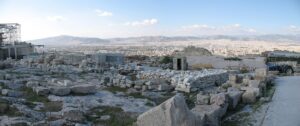
Archaeological working field, Acropolis of Athens. macrolepis, CC BY 3.0, Wikimedia Commons
__________________________
Q. Can you tell us about recent excavations and archaeological work being done on
the Parthenon, Acropolis, and Agora? Which structures are in the best shape, and
which require the most preservation? What are your primary concerns regarding
modern threats like climate change, pollution, and tourist overload?
A. This is a big ask, but thankfully a little bit restricted in one way, namely that two
of those three items fall under the remit of the Greek (Hellenic) Archaeological
Service, a national institution that has flourished since soon after the foundation of
the modern Greek state in the 1830s. Parthenon: in 1970 it was declared a UNESCO
World Heritage site, under the strictest conditions of preservation, restoration and
curation.
The latest applied-scientific, often literally cutting-edge research and
experimental archaeology are conducted physically on and in the building on a
continuing, everyday (barring unsuitable weather conditions) basis. Acropolis: the
Parthenon is pretty much what everyone first sees and wants to see as they glance
up to or laboriously ascend to the High City, and what they want to see again from
the top floor of the new (since 2009) Acropolis Museum. But there’s a great deal
more to the Acropolis than just that. On the eastern plateau and the north slope
previously hidden pathways have recently been opened up to the general public, so
that it’s possible now for them to visit the absolutely vital natural spring called
Clepsydra (literally ‘Water-Concealer’) and several sacred caves. More
conventionally, the late Bronze Age – Mycenaean or ‘Cyclopean’ – masonry walling
on the west side has also been undergoing recent restoration.
Finally, the Agora (more precisely the Greek Agora, to distinguish it from the later
‘Roman’ Agora): unlike for the Acropolis, the excavation and conservation and
curation permits for work in this must-visit 12-hectare (30-acre) site below the
Acropolis belong to the privately owned American School of Classical Studies at
Athens. The Agora was both a sacred and a secular commercial space, the beating
heart of everyday Athenian social intercourse. The ASCSA has been working there
since the 1930s, greatly assisted by the facilities of their Rockefeller-funded Agora
Museum (part open to the public, beautifully displayed). Recent excavation work by
the School has included digging right down to pre-Classical, late Bronze Age layers.
where a new cemetery has been identified. More conventional targeted work has
recently re-addressed the site of the Stoa Poikile (Painted Stoa), which was first
unearthed, north of the Peiraieus to Kephisia electric railway in 1981, when I was
not long into my posts as a lecturer in the venerable Faculty of Classics at
Cambridge University and a Fellow of the even more venerable Clare College (this
year celebrating our 700th anniversary).
________________________
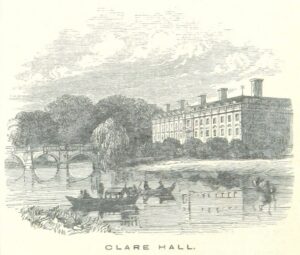
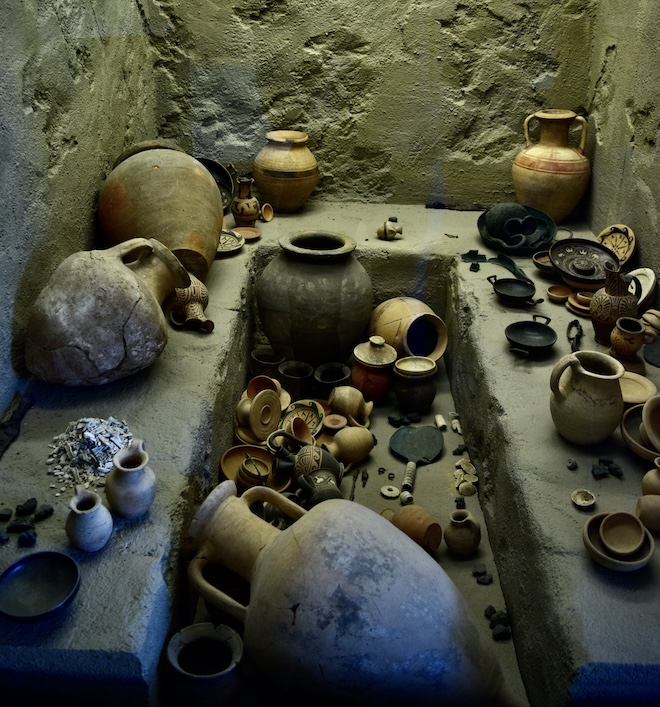
Clare Hall (now Clare College), Cambridge University. Wikimedia Commons
________________________
Cover Image, Top: Bust of Pericles. Jastrow (2006), Vatican Museums Collection, Public Domain, Wikimedia Commons
________________________



_p33_-_(Cambridge)_Clare_Hall.jpg)