During archaeological excavations conducted on the territory of the ‘Keshikchidag’ State Historical and Cultural Reserve located in the Agstafa district, Azerbaijan, important Bronze Age artifacts were uncovered. A rare mace head, a bronze dagger, and various arrowheads indicating the burial of an individual with high social and military status were discovered in Kurgan No. 4, located in the Sariyokhush area.
The archaeological excavations are being conducted within the framework of the project ‘Scientific Archaeological Excavations and Summer School 6 in Keshikchidagh,’ organized in partnership with the Institute of Archaeology and Anthropology of the Azerbaijan National Academy of Sciences (ANAS), on the territory of the ‘Keshikchidagh’ State Historical and Cultural Reserve under the management of the State Service for Protection, Development and Restoration of Cultural Heritage under the Ministry of Culture. Students, master’s students, and young volunteers are also participating in the project. Under the guidance of specialists, they gain practical experience in field archaeological work.
Led by Vagif Asadov, leading researcher at the ANAS Institute of Archaeology and Anthropology and PhD in History, the archaeological excavations have brought to light material culture samples belonging to the Middle Bronze Age of the South Caucasus, dating back approximately to the 17th–16th centuries BCE.
The stone-covered kurgan has a diameter of approximately 12 meters, a height of 80 centimeters above the ground level, and a depth of 1–1.2 meters. The materials recovered from the burial chamber of the kurgan indicate that an individual with high social and military status was buried here. The finds provide new information about the military-political structure and social relations of that period.
Among the discovered artifacts, the bronze dagger is of particular significance. As a close-combat weapon, this dagger is considered one of the key indicators that the deceased held the status of a warrior or military commander.
One of the most notable artifacts of the excavation is a mace head made of diorite stone with a hole drilled from both sides through its center. Weighing approximately 400–500 grams, this artifact was crafted and polished from special stone. It is assumed that a wooden or bone handle was fitted through the central hole.
Archaeologists state that such mace heads were not used merely for practical purposes. These artifacts could also serve as symbolic and ceremonial objects denoting the high status of the military aristocracy, tribal leader, or commander. The smooth, symmetrical, and balanced form of the mace head also demonstrates the level of development of stonemasonry art in the South Caucasus during the Bronze Age.
Various arrowheads were also found in the kurgan. The rare winged arrowheads evoke special interest among Middle Bronze Age weaponry due to their material and shape. Two black obsidian arrowheads indicate the use of obsidian deposits in the region and the existence of raw material exchange.
In addition, nine flint arrowheads were discovered during the excavations. Distinguished by their dark oak-red shades, quality of craftsmanship, and delicate shape, these specimens provide detailed information about the high military and social status of the deceased.
The discovered artifacts, particularly the ceramic samples, are undergoing preliminary restoration and laboratory processing under special conditions by reserve staff. Subsequently, the samples will be properly accessioned into the reserve’s fund.
To determine the absolute age of the artifacts obtained from the archaeological excavations, relevant samples will be sent for radiocarbon analysis to the Tokyo University Museum Center at the University of Tokyo in Japan, TİKA in Turkiye, and the Woods laboratories at the University of Miami in the USA.
Systematic research conducted in the Keshikchidagh Valley of Kurgans makes an important contribution to the study of the Bronze Age history of Azerbaijan and the South Caucasus as a whole. Implemented with the participation of young volunteers, this project also serves to promote the cultural and archaeological tourism potential of the region and Azerbaijan overall.
_________________________
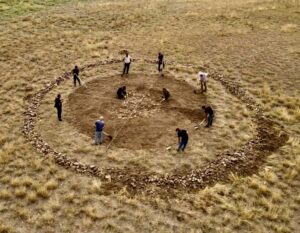
The excavation in progress.Keshikchidag DTMQ
_________________________
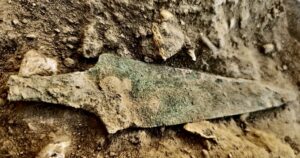
The Bronze dagger, in situ. Keshikchidag DTMQ
_________________________
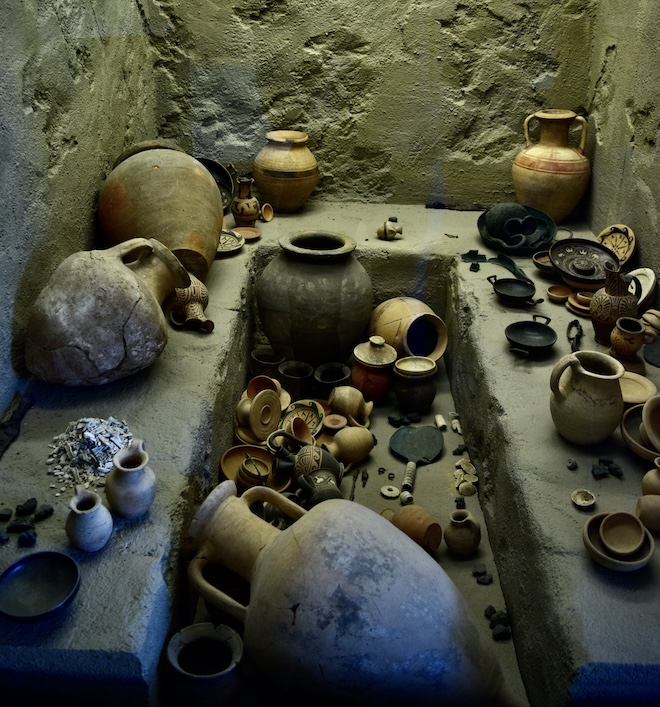
The human burial remains with associated artifacts. Keshikchidag DTMQ
_________________________
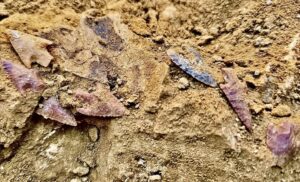
Winged Arrowheads. Keshikchidag DTMQ
_________________________
POPULAR ARCHAEOLOGY ON INSTAGRAM

_________________________
Advertisement