Archives

Why Is Prehistory Inspiring So Many Artists?

Yann Perreau is a writer, educator, contemporary art curator, and writing fellow for the Human Bridges project of the Independent Media Institute. He has published several books on art, climateanonymity, and more. His articles have appeared in many publications, including Libération, Art Press, and East of Borneo. He has served as a cultural attaché for both the French Embassy in London and the French Consulate in Los Angeles. He holds an MPhil in art history from Paris’s EHESS.

Prehistory is a modern idea. The word was “coined” only in the 1830s. Before the 19th century, we didn’t know much about dinosaurs or cavemen, and fossils remained a scientific curiosity. When French naturalist Georges-Louis Leclerc, Comte de Buffon published his notorious Histoire naturelle (1749–1788), suggesting that nature had a history and proposing the first reproduction theory, the faculty of theology at the Sorbonne University in France condemned it and threatened him with repercussions. He eventually had to publish a retraction.

Similarly, when Charles Darwin (1809–1882) published his On the Origin of Species (1859), his compatriots in the United Kingdom and Europe still believed that God made man “in his own image,” as stated in the Bible (Genesis 1:27). Anyone claiming that all animals came from the same origin, and apes were somehow our distant cousins, was considered a fool or a heretic.

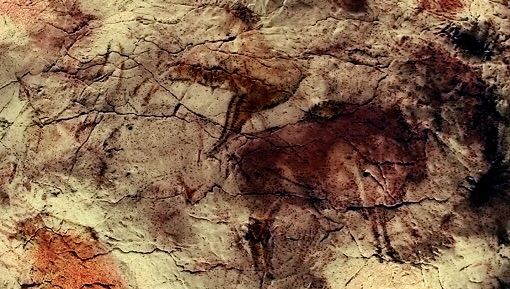
Then the first caves were excavated revealing extensive and intricate artwork on their walls. In 1879, archeologist Marcelino Sanz de Sautuola explored a new cave in Altamira, northern Spain, and brought his young daughter, Maria, with him. She spotted vivid depictions of bison and masterfully painted scenes on the cave’s ceiling. These cave paintings were initially dismissed as forgeries, as scholars of the time, with the positivist mindset, could not imagine that people from the Paleolithic were sophisticated enough to produce such complex artworks. By the early 20th century, however, as archaeologists uncovered more ancient skeletons, bones, fossils, and early human art in caves and other sites, their discoveries started to raise curiosity beyond the scientific community. Writers, intellectuals, and the public were captivated by these glimpses into our distant past.

Artists were intrigued, sometimes amazed by the mind-blowing quality of parietal art, indecipherable, complex abstract shapes and objects, and what was perceived as scenes depicting animals and humans in rituals or sacrifices. The drawings, paintings, and etchings that endlessly decorated the walls, ceilings, and floors of caves in subtle colors were often mesmerizing. Picasso was particularly inspired by various prehistoric elements, as the 2023 exhibition No Past in Art: How Prehistory Inspired Picasso’s Work at the Musée de l’Homme in Paris showed. Gauguin, Cézanne, and later the symbolists and primitivists, also dedicated various paintings and sculptures to what they perceived as representations of our origins, rituals, and myths.

Prehistory has never stopped inspiring artists since then, captivating the most important modern art figures like Jean Arp, Giorgio de Chirico, Max Ernst, Alberto Giacometti, Paul Klee, Joan Miró; Joseph Beuys, Louise Bourgeois, Jean Dubuffet, Marguerite Duras, Barbara Hepworth, Yves Klein, and Robert Smithson. It continues to be an inspiration among our contemporaries, including Dove Allouche, Miquel Barceló, Tacita Dean, Marguerite Humeau, Pierre Huyghe, and Giuseppe Penone, to name just a few, whose works were showcased during the 2019 exhibition, Préhistoire, une énigme moderne (Prehistory, a Modern Enigma).

This landmark exhibition, which took place at the Pompidou Center in Paris, inspired me and initiated my interest in prehistory. It is not the first museum show dedicated to the topic: fossils, artifacts, and artworks discovered in caves, as well as tools, ornaments, and sculptures made from natural rocks, have been exhibited in major art institutions since the end of the 19th century.

Most of these exhibitions have already created fruitful dialogues between the past and present and parietal art and its representation by contemporary artists. When it opened its Gallery of Comparative Anatomy and Paleontology in 1898, the National Museum of Natural History in Paris commissioned the sculptor Emmanuel Frémiet and the painter Fernand Cormon to create a vast decorative program. Prehistoric Rock Pictures in Europe and Africa at the Museum of Modern Art (MoMA, New York, 1937) showed monumental surveys of cave paintings with a selection of contemporary works by Miró, Klee, and Ernst, among others, in echo. “That an institution devoted to the most recent in the art should concern itself with the most ancient may seem something of a paradox,” MoMA’s founding director Alfred H. Barr Jr. wrote in his preface to the exhibition catalogue. “Yet, for Barr, this past had already influenced modern art, and could potentially offer museum visitors a prehistoric pedigree for it,” states the MoMA website. Another major exhibition, 40,000 Years of Modern Art, organized by Herbert Read and Roland Penrose at the Institute of Contemporary Arts in London in 1948, mixed prehistory and non-Western art with surrealist, expressionist, and abstract works.

But there is a major problem, particularly, concerning the so-called “primitive art,”—a highly contested term now. The clichés and stereotypes that this notion implies were also abundant in the early “scientific” literature dedicated to our ancestors. The first paleontologists were poisoned by plain racist prejudices, explains paleo artist and author Mark P. Witton in his 2020 blog. George Cuvier (1769–1832), the father of vertebrate paleontology whose famous taxonomy incorporated both fossils and living species, “viewed whites as the pinnacle of creation, but Blacks as ugly, barbaric persons of monkey-like appearance,” writes Witton. “His work on dividing humans into ‘scientifically validated’ races was instrumental in later attempts at biological justifications of racism.”

In the United States, the influential president of the American Museum of Natural History (AMNH) Henry Fairfield Osborn (1857–1935) was a supporter of Hitler. He exploited his research to promote racist and eugenicist ideas, points out Witton. Osborn commissioned one of the earliest depictions of prehistoric life, Charles Knight’s mural “Neanderthal Flintworkers” (1924), hung in AMNH’s Hall of the Age of Man. Many of Osborn’s contemporaries, including Margaret Mead, were troubled by the racist character of the imagery. The faces and looks of the Neanderthal men and women depicted in this iconic—though controversial and scientifically incorrect work—were inspired by features of non-white peoples, instead of being deduced from their bones.

A Eurocentric mindset has continued to characterize the collective representation of prehistory until recently, sometimes reducing it to a more subtle form of “primitive art.” In 1984, MoMA dedicated a survey exhibition to “Primitivism” in 20th Century Art. MoMA bragged about being the first institution to “juxtapose modern and tribal objects in the light of informed art history.” But the exhibition omitted dates of the Indigenous works and explanations of their functions, as art historian Thomas McEvilly remarked in his Artforum review of the show. He criticized Primitivism in 20th Century Art as expressing “Western egotism still as unbridled as in the centuries of colonialism and souvenirism.” Since then, the museum has made its mea culpa, addressing the controversy on its website.

The Pompidou exhibition’s three curators, Cécile Debray, Rémi Labrusse, and Maria Stavrinaki, write on the museum website that Primitivism in the 20th Century Art did not include prehistory “which, in fact, is fundamentally different from it. For the modern Western world, the ‘primitive’ is generally rooted in specific cultures, usually described as exotic; the question of temporality is secondary to its geographical and cultural otherness. Prehistory, on the other hand, is seen above all as an indefinitely stretched time span, and thus largely indecipherable (whether in terms of nature or the first human cultures).” Labrusse dedicated a book to this paradoxical situation. “Prehistory is precisely what is pre, meaning out of history,” he told me in an interview in October 2024. It “radically overturned our dream of mastering linear time, as 19th-century historicism chose to formulate it.” Here lies the paradox that attracts so many artists to prehistory, according to Labrusse: “Because it is largely indecipherable (whether in terms of nature or the first human cultures), it remains fascinating.”

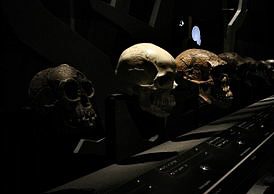
From Prehistory, a Modern Enigma, I remember the scenography. Tall walls, obscure corridors, grandiose frescos, and a prehistoric cave reconstituted at the center of it. In this spectacular setting, amid fossils, Cro-Magnon skulls, tools, and Paleolithic carvings, there were more than 300 works of art by modern and contemporary artists. Plus elements of popular culture: surveys of archaeological excavations, advertisements, and extracts from books (The Quest for Fire, a hugely popular Belgian 1911 fantasy novel) and cult films such as The Lost World (1925), King Kong (1933), or 2001: A Space Odyssey (1968). This undertone in the exhibitions shows what the curators of the Pompidou exhibition describe as the “invention of the concept of prehistory.” How artists and society have succumbed to the appeal of origins in the modern era, “yielding to a fantasized vision of what came before history.”

The exhibition opened with Odilon Redon and Paul Cézanne, at the turn of the 20th century. Cézanne was an amateur student of geology and paleontology. He visited prehistoric caves and painted the rocks on the Mediterranean coast with his close friend Antoine-Fortuné Marion (1846–1900), who later became a noted geologist and paleontologist. The show also exposed the Venus of Lespugue, the famous prehistoric ivory statuette, dated around 23,000 years ago, which inspired Picasso and Giacometti (both owned plaster casts of it). She stands there, in an exhibition room at the Musée de l’Homme, surrounded by bronzes from Matisse, Miró, and other modern artists who were equally fascinated by her and other statues from that time.

Préhistoire, une énigme moderne” brilliantly demonstrated how prehistory inspired modernity, an artistic movement that was, paradoxically, about the future. Photos of the 1889 Paris World’s Fair show how the Eiffel Tower and various cutting-edge technologies were exhibited alongside Neanderthal skeletons. A Max Ernst painting of “petrified forests, glacialized landscapes, and sedimented earth,” created after World War I, raised questions about whether these were depictions “from after humanity, or before it?” as modernism developed toward “a prehistoric vision of time before humankind,” according to a 2019 New York Times article.

This feeling got stronger with the tragedies of World War II when many intellectuals and artists turned their back on the notion of progress, digging in reverse into the beginning of life, extinct species, the first hominids, the lost cultures of the Paleolithic era, and the Neolithic revolution to grapple with the possibility of extinction, of earth without humankind. “Nourished by archaeological discoveries, but far from simply reflecting on them,… prehistory…[functioning] as a powerful machine for stirring up time,” write the curators. “This time machine constantly shapes the mental boundaries of modernity and provides concrete models for all sorts of experiments.”

The exhibition also explores the mysteries of shaped rocks and tools, an intimate relationship to animals, ecological issues, and apocalyptic wonder in chronological and thematic parcourse. These themes are part of the collective representation, the idea of what prehistory is and how the inspired artists, whose works were exhibited, felt from Louise Bourgeois, Joseph Beuys, Lucio Fontana, Max Penck, Robert Morris, Robert Smithson in the 1980s, the Chapman brothers, Pierre Huyghe, Tacita Dean, Marguerite Humeau, Dove Allouche, Jennifer Allora and Guillermo Calzadilla, Jean-Pascal Flavien, and Bertrand Lavier in the last few years. “Prehistory is not an object given to artists to interpret; it is created by them” states Labrusse.

“I think artists are either Paleolithic or Neolithic. I am decidedly the latter said minimalist artist Carl Andre, according to the previously mentioned NYT article. His Stone Field Sculpture in Hartford, Connecticut, could have belonged to the Neolithic times. Painters and sculptors sometimes like to experiment with the artistic canons and the tradition of “getting back to our roots,” to the “early man,” as a 2024 exhibition at the Hole Gallery shows. “Based around an out-of-print anthology devoted to prehistoric collections unearthed by archaeological expeditions in Algeria, French artist Camille Henrot’s… [Prehistoric Collections] treats this ethnographic material as motifs of a contemporary grotesque,” states the Perimeter Books’s website.

Meanwhile, Mark Dion’s immersive, uncanny installation at La Brea Tar Pits and Museum in September 2024, Excavations, displayed new work alongside “early museum murals, dioramas, and maquettes of Ice Age mammals in a playful… presentation,” the museum website states.

Labrusse recalls feeling “powerless” when he started applying his scientific skills and methods to prehistoric art (he is a professor of art history at École des Hautes Études en Sciences Sociales). “History requires context, facts, and elements to narrate it. These things are almost nonexistent when one looks back so far behind in time,” he explains. Many social scientists who study prehistoric history testify to a similar challenge. There is little evidence from prehistoric times and huge gaps of time for which the evidence is completely missing. “Prehistorians have the scientific honesty to recognize an irreducible ignorance, an impossibility of bringing out meaning,” notes Labrusse. “It is impossible to give a social, political, or aesthetic meaning to these societies.” During a podcast interview in 2019, he explained feeling first “like falling into a hole, caught up in an abyss of darkness. Then, as in Alice in Wonderland, you start to see through the looking glass.”

For him, the turning point came while exploring a prehistoric cave, a “very intimate, life-changing experience,” he says during the interview with me. Discovering parietal scenes in the cave of Roucadour, Labrusse felt “as if they were contemporary. There is no context there, and things seem to float outside of any attributable meaning, so their appropriation is immediate, easy.” I learned this way to “let go of the burden of history,” which “dissolved like a soap bubble.” He recalls being tempted to touch these walls, reproducing these same gestures that the first men did back then. “Science now tells us that Homos sapiens has been the same for 100,000 years, even 300,000 years. Individuals have the same capacities, even possibly the same feelings as us today.”

The limits of science, when confronted with prehistory, are also an opportunity that artists have often seized to contribute to the field in their own way. It gives them a chance to tell this story differently. Aware of this, contemporary prehistorians sometimes invite painters or sculptors to work with them to create interdisciplinary meaning, an epistemology articulating a subjective point of view (art) with an objective approach (science).

The French government invited artists Ernest Pignon-Ernest, Giuseppe Penone, and Miquel Barceló, among others, to bring “Other Perspectives” to the Chauvet-Pont d’Arc cave. To understand how a howl decorating the cave had been originally drawn, Barceló recreated first the same wet surface that was used by his predecessor as a canvas 35,5000 years ago. He then drew a few lines like a graffiti artist in less than 10 seconds. His audacious and instinctive gesture was brilliant: the resulting drawing looked remarkably similar to the original one. “Only an artist can do this with his subjective impulsivity,” comments Labrusse. “A historian would not have dared to do it, keeping a rigorous mindset in his attempt to reproduce the drawing and, ultimately, failing to do so.”

In another style, the notorious Adrie and Alfons Kennis, twin brothers who are “paleo artists,” are creating lifelike figures of early man that are touring museums and galleries around the world. Their hominids are fascinating and are another example of what art and science can do when working hand in hand.

___________________________

This article was produced by Human Bridges.

Cover Image, Top Left: Cave painting detail replica from Altamira Cave in Spain. Jose-Manuel Benito, Locutus Borg, Public Domain, Wikimedia Commons

___________________________
The Gates of Rome

Professor Frank J. Korn has retired from his teaching position on the Classical Studies faculty at Seton Hall University.  He is a Fulbright Scholar at the American Academy in Rome and the author of nine books on various aspects of the Eternal City.  He is listed in Marquis Who’s Who as “a notable classical educator and writer.”  Recipient of the Princeton Prize for Distinguished Teaching, he resides with his wife Camille in Scotch Plains, N.J.  The couple’s three sons –  Frank, Ronald, and John and their families live nearby.  His latest book    Below Rome, the Story of the Catacombs    which he co-authored with his wife, is available on Amazon or from the publisher, St. Johann Press, Haworth, N.J.

“All our efforts will be for naught unless we Punic soldiers burst through the gates of Rome and I, Hannibal, plant my standard in the heart of the City.”

…..Juvenal (Satire 10)

“The Gates of Rome!”  In that poetic phrase there is more history and drama and lore than is to be found in a library of novels and social studies textbooks.  And    wondrous to say    the gates still stand, in defiance of the ravages of time and the elements.

They constitute yet one more facet that renders Rome the gem of all the great cities on earth.  For Rome alone requires entrance through one of the openings in its ancient walls.  One does not hear of “The Gates of Paris,” or “The Gates of Madrid,” or of London, or Tokyo, or Vienna, or Boston.

Baked by the sun of more than 600,000 days, Rome’s gates are especially suggestive in the light of the moon.  It is at this hour, when the nightingales are in song, that there come trooping out of the darkness, hosts of memories, ghosts of Imperial Rome:  conquering, plume-helmeted legions bearing their spoils of war; foreign merchants vending exotic wares; the apostle Peter    foot weary from having walked up the Appian Road all the way from the Naples area; the barbaric hordes of the Middle Ages, Napoleon and his vaunted armies, General Kappler at the head of his goose stepping Nazis, General Mark Clark at the front of a convoy of his liberating Fifth Army following their bloody victory at nearby Anzio.  All passed through … “The Gates of Rome.”

Through these vast portals have walked    or ridden    the likes of Dante, Goethe, Keats, Shelly, Byron, Hawthorne, and Twain; of Da Vinci, Michelangelo, Giotto, Raffaele, Monet, Manet, and Picasso; of Liszt and Tchaikovsky, of Mastroianni and Loren; of Taylor and Burton.  Browning used to say:  “Sooner or later, everyone comes ‘round to Rome.”  And anyone who “comes ‘round to Rome” must, perforce, use its gates, which to the ancient Romans were often rendezvous points:  “Let’s meet at the Appian Gate.”

“Nos ad Portam Appiam occurramus”

But before going on about the gates, we must pause here to talk about the lofty, thick walls which they pierced.

The walls of Rome rank high among archaeologists’ favorite antiquities there, transporting the viewer back through time and space to the late empire and beyond.  With a little imagination, one can see the defenders of the city hurling fire and missiles down from the heights and through the slots; envision the storming of the gates, and the battering rams; observe the barbaric hordes spilling through and scaling over the fortifications to lay waste to the aged capital.

When he founded Rome in 753 B.C., Romulus’ first public work was to enclose his domain with protective walls built at right angles to form a perfect square around the primitive village on the Palatine Hill and create what was known as Roma Quadrata i.e. “Square Rome.”  The Eternal City has ever since been walled in    next by the Servian Walls; finally by the Aurelian Walls.

Romulus’ Quadrata was consecrated to the gods in solicitation of their divine blessing and protection.  (Walled-in villages were already commonplace throughout Italy, the Etruscans having imported the practice a century earlier.)  One night, Remus, drunk with resentment over his brother’s selection as monarch, defiled the consecrated walls, thereby committing sacrilege and meeting death at the hands of his twin.

The historian Tacitus has this to say:  “The walls were erected according to Etruscan rites, marked out by a furrow created with a plough, drawn by a cow and a bull, leaving places necessary for three gates.”  From the writer Varro we even learn the names of two of these portals.  On the east was the Porta Mugonia, so named for the “mooing” of the cattle which were led out to pasture through it.  On the west was the Porta Romulana, named for the founder-king.

From Virgil’s Aeneid, Book VIII, we come upon the name of the third gate:

Vix ea dicta, dehinc, progressus monstrat et aram et Carmentalem Romani nomine portam quam memorant, nymphae priscum Carmentis honorem.

“Then (Evander) having spoken, resumed walking (with Aeneas).  They came upon an altar and the Carmenta Gate named in honor of the nymph who prophesied the great fortune of the Romans.”

Remains of Romulus’ immured hamlet, though scanty, are well worthy of a visit to the Palatine,  For here truly is the cradle of Western Civilization.  Along the vast foundation of Tiberius’ Palace can be seen fragments of those primitive walls’ tufa  boulders.

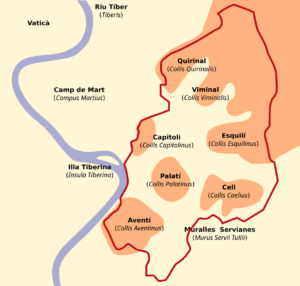
In the reign of the sixth king Servius Tullius (578-535 B.C.), who governed well, the Servian Walls rose in protection of what had become by now the Urbs Septimontium (city of the Seven Hills:  The Palatine, Aventine, Capitoline, Esquiline, Quirinal, Viminal, and Caelian.)

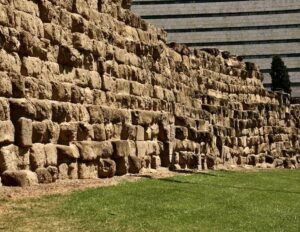
Built of immense blocks of volcanic tufa, these fortifications were improved and enlarged on orders of the Senate in the fourth century B.C. They were 35 feet in height, 12 feet thick, and nearly 7 miles long, enclosing an area of more than six hundred acres, and made more formidable by a deep ditch on the outside, and a dirt rampart on the city side.

________________________

Remains of the Servian Wall in front of Termini Station, Rome, Italy. Roundtheworld at wts wikivoyage, Public Domain, Wikimedia Commons

________________________

The Servian Wall encircled the seven hills of Rome. http://commons.wikimedia.org/wiki/User:Renata3, CC BY-SA 4.0, Wikimedia Commons

________________________

There were fourteen gates, two of which survive fragmentarily: the Porta Esquilina, and the Porta Capena which opened on to the Appian Way.  Stretches of the wall still stand guard in various sections of Rome.  One sizable portion remains extending out of  the twentieth century railroad terminal, near the Baths of Diocletian.  On Viale Aventino we pass through two more great portions where a bronze plaque gives an informative account of the walls’ story.  The historians Livy, Strabo, and Dionysisus all mention the Servian Walls.

Many times restored and strengthened, the Servian Walls were abandoned in the Imperial age and therefore many stretches were demolished or utilized for other public works and ultimately replaced by the still wonderfully preserved red-brick Aurelian Walls, which lend such sublime distinction to the city we visit in our time.

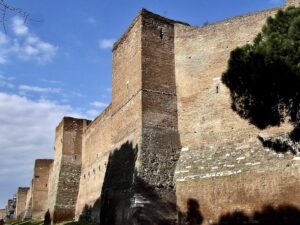
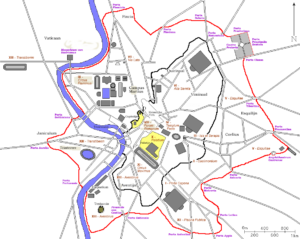
With the Pax Romana by then but a memory, the Emperor Aurelian, from A.D. 271 to 275 employed tens of thousands of military troops in the task of walling-in the Imperial Capital in the vain hope of walling-out Rome’s growing list of powerful enemy nations and barbarian tribes.

Anything of consequential size that stood in their path was incorporated right into the ramparts, such as the Pyramid of Gaius Cestius.  This monument dates from the first century B.C. and the inscription tells us it was erected in less than a year as a sepulcher for the ashes of Cestius, a high public official who on a junket to Egypt had been so duly impressed with the  tombs of the pharaohs.  For the statistics devotee we offer the following numbers:  The walls ambled around the hills for thirteen or so miles, enclosing approximately 3,500 acres.  Soaring to a height of slightly over fifty feet, they had 383 towers, 7,020 battlements, 2,000 windows, more than 5,000 loopholes, and more than a hundred rooms serving as guards’ quarters and latrines.

___________________________

The Aurelian walls between Porta San Sebastiano and Porta Ardeatina (Viale Ardeatina). Lalupa, Public Domain, Wikimedia Commons

___________________________
Map showing the Aurelian Wall (in red). Joris at Dutch Wikipedia, CC BY-SA 4.0 Wikimedia Commons

___________________________
From several elevated vantage points about a mile or so out on the old Appian Way    especially from the summit of the driveway leading to the Catacomb of San Callisto    the walls and one of the massive gates come into view, bringing to the romantic mind “the many-towered Camelot.”

There were eighteen main gates and several smaller openings.  Fourteen of the major portals pierce the ramparts at the points where the great consular highways depart from the city.  Each such gate was usually called for the road which it launched, e.g. the Porta Appia for the Via Appia, the Porta Ostiense for the Via Ostiense, and so on.  The Porta Nomentana, the Porta Latina, the Porta Praenestina, the Porta Tiburtina and numerous others were thus given their names.

At one point the wall is referred to as the Muro Torto (Twisted Wall) near the Piazzale Flaminio.  Peculiarly irregular and looking about to fall, it nevertheless slouches on with no help from restoration efforts. An old legend has it that St. Peter himself is pledged to watch over and save this particular stretch.

……………………………….

And where there are walls there are bound to be gates.  What follows is an anecdotal litany of some of the best known Aurelian portals:

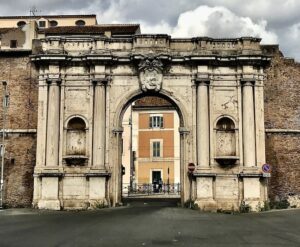
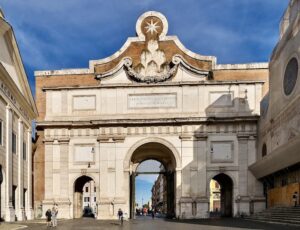
Porta Flaminia, so called because it opened onto the consular road by the same name, i.e. the Via Flaminia, which is one of the most ancient routes of the famous Roman highway system.  Dating to 220 B.C. and over 200 miles long, Via Flaminia went from the capital up and over the daunting Apennines to Ariminium (Rimini) high up on the Adriatic (near Venice).  In 452 the intrepid Pope Leo I went out from this exit to intercept and turn back    by the sheer power of his words    the dreaded Attila and his rampaging Huns.  Today the gate goes by the name of Porta del Popolo.  It was reworked by Bernini, on commission of Pope Alexander VII, into a baroque masterpiece for the arrival of Queen Christina of Sweden in 1655.  The inscription bids her majesty a happy entrance to the Eternal City.

After Constantine granted them the freedom to practice their faith, the Christians bestowed saints’ names on several of the openings.

_________________________

Porta del Popolo in Rome, Italy. Krzysztof Golik , CC BY-SA 4.0, Wikimedia Commons

_________________________

From the Aurelian Gate (now Porta San Pancrazio), one can still head northwest along the Via Aurelia.  Built in the twilight of the Roman Republic, the road follows the Tyrrhenian coast through the port cities of Civitavecchia and Pisa, thence along the Ligurian coast all the way into Provincia Romana (Provence) in Gaul (France).

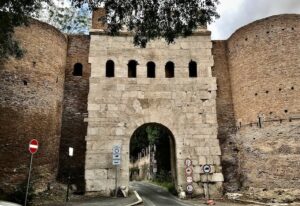
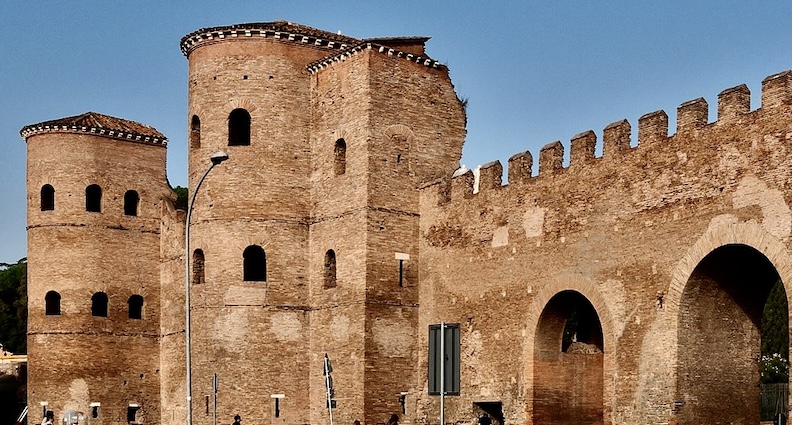
At the opposite end of Rome is the Porta San Sebastiano (nee Porta Appia) from which the Regina Viarum – the Appian Way – commences its journey south to Capua.  Opened in 312 B.C. the road was named for the censor who proposed it, Appius Claudius.  The well paved highway met with such popularity that it was later extended southeast to the port of Brundisium (Brindisi) in the heel of the Italian boot.  This twin-turreted gate is the best preserved and most suggestive in the Aurelian circuit.

___________________________

Porta San Sebastiano. Ardeatino, CC BY-SA 4.0, Wikimedia Commons

___________________________
After the Saint Sebastian gate, perhaps the next finest entrance is the Gate of Saint Paul (originally Porta Ostiense because from here departs the old heavily trafficked road to Ostia).  This gate also features twin lofty round towers and is totally intact as well.  Abutting it and rising 120 feet into the air is the Pyramid of Cestius.  While Paul did not see the gate named for him, since the Aurelian Walls were still two centuries into the future, the apostle undoubtedly cast his eyes on Cestius’ elaborate final resting place as he was being led out of the city to his martyrdom along the Via Ostiense one dark day in A.D. 67.

This is the gate that devout pilgrims have been taking, across the ages, to visit the venerable Basilica San Paolo Fuori le Mura (St. Paul’s Outside the Walls) about two miles down the road.  Members of the Commission of Sacred Archeology, under the auspices of the Vatican, maintain that Paul’s remains lie in the crypt below the main altar.  It was here at the Porta San Paolo, on 10 September 1943, that the Italian army troops aided by great numbers of civilians, partisans of the Resistenza, waged a fierce battle to block the Germans from entering the city, but in vain.  Hitler’s forces prevailed and penetrated the walls, occupying and terrifying Rome until the Allied liberation on June 2, 1944.

___________________________

Porta San Paolo. Dietmar Rabich, CC BY-SA 4.0, Wikimedia Commons

___________________________
The Aurelian Walls added a rather simple opening as recently as 1574, the Gate of St. John, just a stone’s throw from the Basilica di San Giovanni, opening onto the Via Appia Nuova (the New Appian Way) which leads to the summer retreat of the popes in the tranquil town of Castel Gandolfo.  The gate is rather plain.  The inscription over the arch gives a brief biography of the gate:

GREGORIUS XIII PONT MAX

PUBLICAE VTILITATI ET

URBIS ORNAMENTO VIAM

CAPANAM CONSTRAVIT PORTAM

EXSTRUXIT MDLXXIIII PONT.III

“Gregory XIII Pontiff built this gate for the convenience of the public and as an ornament for the city, as well as the Country Road in 1574, the third year of his pontificate.”

The two side arches were opened in the early 1900’s to facilitate the flow of ever increasing traffic to and from the Castelli Romani (the dozen or so ancient hilltowns so popular with the Romans for weekend excursions).

Then there’s yet another gate favored by the pilgrims, the Porta San Lorenzo that takes them to the fourth century Basilica of Saint Laurence Outside the Walls, along the consular highway to Tibur (today’s Tivoli), the Via Tiburtina, the same name by which the gate was originally known.  The great church was severely damaged accidentally by a stray Allied bomb on July 19,1943 when the Italian Army was still on the side of the Germans.  The bomb was intended for the central rail yards nearby to cripple the enemy supply lines.

After the war, funds poured in from all over the world, especially from the U.S., to help with the massive restoration efforts.  The magnet here for pilgrimages is the grave of the Deacon Laurence, martyred in the savage persecution under Emperor Valerian (253-259).

In A.D. 52 the Emperor Claudius had erected a majestic monumental arch to allow the aqueduct bearing his name to span two busy thoroughfares:  Via Prenestina and Via Labicana.  The arch was still standing in A.D. 271 but in the path that Emperor Aurelian had planned for his walls.  So, as he did with the Pyramid of Cestius, he incorporated it into the fabric of his fortifications.  The arch now served as an attractive gate which was given the name Porta Esquilina.  In the late fourth century, the Romans took to calling it Porta Maggiore because of its proximity to the then recently built basilica named Santa Maria Maggiore, perched on the summit of the Esquiline.

___________________________

Porta Maggiore. Livioandronico2013, CC BY-SA 4.0, Wikimedia Commons

___________________________
Perhaps it’s worth noting at this point that the old Roman highways were customarily named for the officials who sponsored them, e.g. Via Appia for Appius Claudius; or for the towns that they led to.  For example, the Via Ardeatina led to, and still leads to, the town of Ardea; the Via Nomentana to Nomentum; the Via Praenestina to Praeneste (now Palestrina) and, of course, the Via Ostiense to Ostia.

At the foot of the Caelian Hill we come upon the Porta Latina, a single arched gate accessing the Via Latina which runs through the various cities of old Latium (in our time, the region of Lazio).  Just inside the portal are two noteworthy ecclesiastical structures: the small octagonal chapel of San Giovanni in Oleo, marking the spot where Domitian (81-96) had John the Evangelist boiled in oil.  The second is the charming fourth century Romanesque church with the lilting name of San Giovanni alla Porta Latina, St. John at the Latin Gate.

____________________________

Porta Latina in Rome, Italy. Gustavo La Pizza, CC BY-SA 4.0, Wikimedia Commons

____________________________

The Porta Salaria, marked the starting point of Via Salaria, the old “salt road”, heading east 150 miles, all the way to the Adriatic coast where there were myriad salt-producing sites, causing heavy traffic to and from.  This gateway had quite a checkered existence.  On August 24 in the year 410, Alaric and his marauding Visigoths stormed through Porta Salaria on their way to plunder Rome.  Left in rubble, it was later completely restored and strengthened.  Many historians believe that this incursion signaled the beginning of the fall of the Roman Empire.

On September 20 in 1870, the gate suffered heavy bombardment by troops of Il Risorgimento, the Italian Revolution which brought an end to the Papal States.  The gifted architect Virgiliio Vespignani was called upon to design a new entrance.  This replacement survived barely a half-century when it was purposely torn down to allow a smoother flow of modern traffic out of and into the city.

Another one of the original gates, the Porta Ardeatina, from which the Ardeatine Road diverged, was walled up and a new, up-to-date replacement installed a few hundred meters further along the wall, but given the name of the original.  The new Ardeatine Gate features four high and wide and graceful archways, providing easy access to the twentieth century speedway, Via Cristoforo Colombo that connects old Rome to the Mussolini era suburb of EUR.

The Aurelian Walls eventually were extended on the opposite bank of the river to defend the Trans Tiberim district (Trastevere).  There was a gate just a few hundred yards beyond called the Porta Portuensis which opened onto the road by the same name, for it led to Trajan’s port at Fiumicino.  The gate later underwent a name change in Italian to Porta Portese and is these days known for the large and lively Sunday flea market just outside of it.

____________________________

Porta Portese. Gustavo La Pizza, CC BY-SA 4.0, Wikimedia Commons

____________________________

For avid wall and gate watchers there is also the Muro Gianicolense (the Janiculum Wall) of Pope Urban VIII, dating from 1642, up on the hill named for Janus, god of beginnings and endings.  This was the site of Garibaldi’s fierce confrontation in 1849 with Marshal Quindinot’s French forces who were helping Pope Pius IX to hold on to Rome, but they were unsuccessful.

……………………………………..

Lastly, let us tell of a most remarkable situation in Rome.  Within this walled-in city lies a walled-in country … the Vatican. (Though merely 108 acres in size, Il Vaticano surely qualifies as a country – with its own borders, its own army, the Swiss Guards, its own population – about 1,000 – its own flag and anthem, its own postal system, its diplomatic relations with more than a hundred other nations including the United States, and its own head of state, the Pope, who is sufficiently regarded as such as to be from time to time invited to address the U.N. General Assembly.)  In the ninth century this lilliputian city-state was girded with a mighty, clay-colored wall by order of Pope Leo IV, hence its name the Muro Leonina.  There were originally five entrances but only two survived into the twentieth century:  the Porta della Campana and the Porta Sant Anna, through which cardinals, bishops, and priests daily come and go, along with the permanent residents.  In February of the Jubilee Year A.D. 2000, Pope John Paul II dedicated a new gate on the Viale Vaticano to accommodate the ever increasing multitudes of visitors to the Vatican Museums and the Sistine Chapel. In November of 2023 another gate was installed to afford more convenient access to the famous archeological site of the ancient Necropolis along the Via Triumphalis.

Ah, the gates of Rome.  They    more than any of the myriad other monuments of Rome Eternal – have seen it all; from the Caesars to the Fascists, from the Vestal Virgins to the Popes, from the gladiators to the pilgrims, from the Model T to the Lamborghini.  From a solitary small vineyard keeper driving his horse and wagon in from the campagna to sell his wines, to mighty armies rumbling through in trucks, jeeps, and tanks.  From two lovers on a motor scooter to multitudes of tourists sardined into glass buses.

The Kingdom, the Republic, the Empire …  all are gone.  The Emperor Aurelian crossed the River Styx seventeen hundred years ago.  But his walls and  ..  their gates  … still survive. 

As Browning noted:  “Sooner or later everyone comes ‘round to Rome.” 

He might well have added:  “and through her gates!”

____________________________

Cover Image, Top Left: The Aurelian Walls at Porta Asinaria, Rome. MrPanyGoff, CC BY-SA 4.0, Wikimedia Commons

____________________________

Advertisement

EXPLORE THE ANCIENT ETRUSCANS IN PERSON!
Experience a unique, up-close-and-personal hike among ancient hilltop towns in central Italy. You will walk the sensational countryside of the regions of Umbria and Tuscany, soaking in important sites attesting to the advanced Etruscan civilization, forerunners of the ancient Romans; imposing architectural and cultural remains of Medieval Italy; local food and drink; and perhaps best of all — spectacular scenic views! Join us in this collaborative event for the trip of a lifetime!

Socrates: A Few Words


Richard Marranca (RM): Let me start with a cup that was found. A while back, I recall a news story about a cup found that has some connection to Socrates. Was it his – what’s the story on this?

Paul Cartledge (PC): To my knowledge no such inscribed cup has been found, but there is one, made of course of fired and painted clay, not precious metal, which possibly brings us within one degree of separation. A contemporary of Socrates called Simon had a cobbler’s workshop in the Agora: a cup inscribed with that name incised in the genitive case (meaning ‘belonging to Simon’) has been found in the SW corner. Later sources tell us that a Simon conversed with Socrates and may even have written philosophical dialogues, but whether he’s the same Simon is unfortunately not certain. It’s a shame too that neither of our two main contemporary sources on Socrates, Plato and Xenophon, found occasion to mention the philosophical Simon.                                                                                                                                                                   

RM: Before we delve into some of the influences on Socrates, can you mention what Socrates would be up to on any given day?

PC: Socrates is found mooching in the center of Athens, often in the Agora area, looking for a suitable conversationalist and conversation topic to engage in dialectics with, asking ‘Socratic’ questions (unanswerable definitively) and using the ‘Socratic’ Q&A method. Socrates – or at any rate Plato’s ‘Socrates’ – apparently was primarily interested in two things: epistemology (theory of knowledge) and moral philosophy, how to live the best life (Plato may actually have coined the word ‘philosophia’).


RM: Who were the most important earlier philosophers and teachers who influenced Socrates?

PC: Socrates seems to us to have fallen from the sky, as it were, to emerge as a philosopher fully-fledged in mature adult years, but that’s due to the nature of our evidence as well as to the fact that in his youth Athens didn’t have a regular first- or second-level educational curriculum. There was a Greek tradition of intellectual enquiry going back at least as far as Thales of Miletus,who flourished around 600 BCE. These ‘Presocratics’ are sometimes called ‘natural philosophers’, since what they were chiefly interested in was non-human nature (phusis), what the universe was made of, etc. Some of them, for example Xenophanes of Colophon and Democritus of Abdera, anticipated Socrates’s interest in human morality, but it seems that it was indeed Socrates whose thinking was transformative in changing the focus of intellectual debate from heaven to earth, as it were.                                                                      

Two other potential influences are worth mentioning: tragic drama and the philosophy of Parmenides of Elea. But probably the most important feature of Socrates’s day and of democratic Athens as the ‘City Hall of Wisdom’ (Plato) was that there emerged a group, not large but noisy, of itinerant intellectuals prepared to sell their brand of wisdom and knowledge to anyone willing or able to pay, and who found Athens a congenial place to expound and sell their wares. To Plato, however, what they were selling was neither wisdom nor knowledge but merely purveyors of fake news, and it was he who forever after gave the Greek word sophistēs, literally a ‘wise’ person or intellectual, its bad name – hence our ‘sophistical’, ‘sophistry’. In the dialogues, Plato spends a lot of time and effort trying to distinguish his Socrates, who accepted no pay, from the ‘sophists’, but the popular view of Socrates, as represented caricaturally in Aristophanes’s Clouds, was that he was every bit as much of a ‘sophist’ – and dangerous ‘free thinker’ – as they.


RM: In Plato’s Symposium, Socrates said he learned about love from Diotima. What did he learn? 

PC: That all depends what’s meant by ‘love’! The ancient Greeks had some five words that could be translated by that one English word. They more than ‘had a word for it’! The specific kind that’s under discussion and dispute in the Platonic dialogue known as ‘The Symposium’ is erōs: erotic love, sexual passion, to be blunt about it. Diotima may or may not have been a real person. As presented by Plato, she’s a wise woman, possibly a priestess, from Arcadia in southern Greek Peloponnese, not a region noted for its intellectuals. There are scholars today who even think she may be a literary surrogate for a real ancient Greek woman, Aspasia from Miletus in what’s today Aegean Turkey. If so, she’s a surrogate for the woman with whom Pericles lived for about a quarter of a century. [see further next Answer.]  But of course, it’s not who Diotima really was – another of the dialogists was the comic playwright Aristophanes who’s credited with spinning a myth of origin that accounts for why there are what we call heterosexuals and homosexuals – but what Diotima and the others are given to say that counts.


RM: And would Socrates have enjoyed wine and food and a comfortable lounge chair during these symposia?

PC: Two things go to the heart of the dialogue, which takes its name from its setting: a dinner/drinking party in a private house held to celebrate the victory of another playwright, tragic poet Agathon, during which the diner/drinkers would not slouch in lounge chairs but recline on couches, two to a couch. First thing, what IS erōs? Really, essentially, existentially, Aporia… Second: what good is it, what’s it good for? We happen to know that Plato himself never married – unlike Socrates, who married twice and possibly bigamously.

We also happen to know that in his last dialogue, The Laws, written in extreme old age, he, as it were, came out vigorously, almost viciously against homosexual erōs on the grounds that it was unnatural, i.e. could not lead to the production of offspring. But in The Symposium, Socrates was far more tolerant, far less gender-critical (as some of us now say): erōs was fine, on condition that it was not an end in itself, but a means towards the realization of finer things on the higher plane of the spiritual soul (psychē). For example, and here one suspects not a little autobiography, erōs was an especially potent and beneficial force pedagogically speaking – conducing as it did to two minds (he has in mind an adult and an adolescent male) being in intellectual harmony.


RM: You mentioned Aspasia, the partner of Athens’ incredible first citizen, Pericles. How might Aspasia have influenced Socrates?

PC: There’s a question! Plato was born very soon after the death of Pericles in 429, so he could have ‘known’ of the great man only by repute. Aspasia was still alive when Plato was very young, but again he would have had to rely on hearsay or written report to glean anything much for sure about her and Pericles’s relationship and private life. One thing he would have discovered at once was how outrageously unconventional it had been. Pericles, a wealthy aristocrat, did the ‘normal’ and conventional thing and married an upper-class Athenian woman – so upper-class we don’t know her name. With her he had two sons.

That would have been roughly between 465 and 455, but at around the latter date he divorced his wife – again that wasn’t uncommon among the social elite. But what followed was. Instead of remarrying, he remained single … until he somehow met and fell for Aspasia, a citizen of another (allied) Greek city. For a man of his class and station it would not have been uncommon for him to have both a wife AND a concubine, a bit on the side, as it were. But Pericles was an either/or man: for him, either a wife or a concubine. After some time of enjoying (?) his single status, Pericles made Aspasia his concubine, a sort of ‘common law’ wife, and lived with her for the remaining 25 or so years of his life. One irony of their partnership was that after 451 he would have been expressly forbidden by law to take a non-Athenian woman as his lawfully wedded wife – by a law that he himself had promoted! So, the son they had together – unimaginatively named ‘Pericles’ – was by definition illegitimate in law.


RM: Aspasia was amazing and quite famous – so much so that men wrote about her. Can you delve?

PC: The evidence for Aspasia is almost all scurrilously negative: for Pericles to be so besotted with her, she must have had special sexual powers, etc. But one piece of evidence stands out from that crowd, and it’s Plato’s dialogue the Menexenus. According to this, Aspasia was so smart she was able to give Socrates lessons in rhetoric, showing him how to compose a Funeral Oration. In the real Athens, even Athenian citizen women were second-class citizens, in that – apart from priestesshoods – they were denied any public political offices or functions in the democracy. In Athenian reality it was her partner Pericles who was chosen at least twice to deliver the public Funeral Oration over Athenian war-dead. I therefore think this is yet another way in which Plato, who vehemently disliked and disapproved of the Athenian democracy, was trying to expose that regime’s faulty, even immoral bases. This subtle variation on the ‘woman-behind-the-throne’ motif, whatever else it was, was fundamentally anti-democratic.

___________________________

About Paul Cartledge

Paul Cartledge is a British historian and scholar. From 2008 to 2014 he was the A. G. Leventis Professor of Greek Culture at the University of Cambridge, and previously held a personal chair in Greek History at Cambridge. (Text CC BY-SA 4.0, Wikipedia Commons)

___________________________

Image Top Left: Socrates at work. Maklay62, Pixabay

___________________________

Advertisement

EXPLORE THE ANCIENT ETRUSCANS IN PERSON!
Experience a unique, up-close-and-personal hike among ancient hilltop towns in central Italy. You will walk the sensational countryside of the regions of Umbria and Tuscany, soaking in important sites attesting to the advanced Etruscan civilization, forerunners of the ancient Romans; imposing architectural and cultural remains of Medieval Italy; local food and drink; and perhaps best of all — spectacular scenic views! Join us in this collaborative event for the trip of a lifetime!

The Surprising Ways Inventions and Ideas Spread in Ancient Prehistory

Brenna R. Hassett, PhD, is a biological anthropologist and archaeologist at the University of Central Lancashire and a scientific associate at the Natural History Museum, London. In addition to researching the effects of changing human lifestyles on the human skeleton and teeth in the past, she writes for a more general audience about evolution and archaeology, including the Times (UK) top 10 science book of 2016 Built on Bones: 15,000 Years of Urban Life and Death, and her most recent book, Growing Up Human: The Evolution of Childhood. She is also a co-founder of TrowelBlazers, an activist archive celebrating the achievements of women in the “digging” sciences.

The human capacity for invention is unparalleled. We have developed technologies that have allowed us to survive and thrive far beyond the ecological niches that constrained our ancestors. While our innovation has allowed us to break loose from the constraints of our home continent, Africa, and even our home planet, the actual way in which our species adopts new technologies remains a subject of huge debate among those scientists who study the past. Does one hominid ancestor start to shuffle upright, and the rest follow? Does the first human to loop a piece of string through a shell bead inspire the rest of the species to create the world’s first jewelry? Or do different animals take up the same new adaptation at different times, because it solves a problem that appears in many places?

We know that in some of our closest living relatives, the primates, new technical skills are passed on through direct learning. Macaques, in particular, are responsible for innovative behaviors that have been transmitted through their societies by individuals who have seen and observed them and then adopted them as their own. This is true of behaviors as varied as “hot tubbing” by the macaques of Japan’s northern Hokkaido island and the habit of dipping sweet potatoes in the sea to “salt” them developed by macaques on Koshima island further south.

Many of the technological innovations that have had the greatest impact on our species were first seen about 10,000 to 15,000 years ago in a region that archaeologists refer to as the “Fertile Crescent.” The region encompasses a swathe of land crossing the countries between the easternmost Mediterranean Sea and the Sinai, Arab, and Syrian deserts and up into the Zagros Mountains of what is now Iran. It is a region of famous firsts in terms of radical changes to our species lifestyle: settling down, cultivating plants, and taming the animals we eat are all first attested in this strip of relatively abundant land.

It was along the shores of the Sea of Galilee where we have the first evidence of the wild ancestors of today’s wheat being exploited more than 20,000 years ago, at the site of Ohalo II, reconstructed from the microscopic remains of shattered seeds still clinging to a grinding stone after millennia. From 15,000 years ago, in a corridor stretching up and down the eastern Mediterranean we call the Levant, there comes the first signs of a new way of life for humans; one that involves staying in the same groups and homes all year round, rather than following food around the landscape as we had done for the 300,000 years prior. Those seeds from Ohalo II have grown into entirely new shapes by the time they are uncovered in these new inventions, called villages, and by around 9,000 years ago this new human-friendly type of wheat was well on its way to becoming our first domesticate (domesticate that wasn’t a dog—those we have had for probably 30,000 years). Meanwhile, over the last 10,000 years or so, goats, sheep, pigs, and eventually cattle were all brought into these new human habitations, and bred into the shapes that suit us rather than them: better to eat or easier to manage.

What is even more remarkable about these radical changes in a species that had been living as foragers for hundreds of thousands of years was how fast these new innovations “spread.” Archaeologists in the 20th century dedicated huge amounts of time to tracking the movements of new technologies through the evidence of ancient houses, pots, and bones to work out how people from the Near East had “invaded” Europe with their culture of domestication, and even when the idea of a mass invasion was put to rest, some still claimed that people themselves carried the new ideas of domesticated life. The way we saw human inventions was as hot-tubbing macaques at a larger scale: one clever inventor and her friends and family following behind.

This has large implications for human knowledge. Did it take people literally passing on new skills to spread farming, domestic animals, and year-round lifestyles to all corners of the globe? Is this the only way our species learns something this life-changing?

We are not, as it turns out, macaques. Good scientific evidence has given us dates for a farming and animal revolution in China that happened just a thousand or so years later, but for a totally different crop: rice. The invention of cultivated plants occurred independently, as did other similar innovations like domesticating animals. In fact, around the world, there was an endless series of radical revolutions, some earlier, some later, but all bringing plant and animal life under human management: from the potato and the alpaca in South America to pearl millet and cattle in West Africa.

This phenomenon is called “independent invention,” and it is our strongest evidence yet that every innovation our species has made has been a response to a place and time; that some technologies travel far and wide but, where they don’t, we are perfectly capable of inventing them again.

_____________________________

This article was produced by Human Bridges.

Cover Image, Top Left: Wheat, Bru-nO, Pixabay

_____________________________

Advertisement

EXPLORE THE ANCIENT ETRUSCANS IN PERSON!
Experience a unique, up-close-and-personal hike among ancient hilltop towns in central Italy. You will walk the sensational countryside of the regions of Umbria and Tuscany, soaking in important sites attesting to the advanced Etruscan civilization, forerunners of the ancient Romans; imposing architectural and cultural remains of Medieval Italy; local food and drink; and perhaps best of all — spectacular scenic views! Join us in this collaborative event for the trip of a lifetime!

Political Collapse: Lessons From Fallen Empires

Richard E. Blanton is professor emeritus of anthropology at Purdue University.

Gary M. Feinman is a MacArthur Curator of Anthropology at the Field Museum of Natural History in Chicago, Illinois.

Stephen A. Kowalewski is professor emeritus of anthropology at the University of Georgia.

Lane F. Fargher-Navarro is the director of research at the Past Foundation, Ohio State University.

Our investigation of the disastrous society-wide collapses of four premodern polities, China’s Ming Dynasty, the South Asian Mughal Empire, the High Roman Empire, and Renaissance Venice led to the discovery of an unexpected historical pattern. This revelation was not evident before these sudden collapses as all four polities had demonstrated forms of governance that persisted for centuries, had been among the wealthiest and best-governed polities of their eras, and had embraced policies fostering inclusiveness and egalitarianism that engendered strong support from the majority of their citizens.

We could not identify any exogenous causal factors for the collapses—such as drought, epidemic, or conquest by a more powerful foe (three of the four eventually were conquered, but only after their governments were considerably weakened)—adding to our confusion about what led to these major political transformations.

To understand the reasons for the political breakdowns, we decided to revisit an earlier article in which we had posited an answer to this question when it became increasingly clear to us that the conflictive political culture of the contemporary U.S. presents striking parallels with what we had discovered. We aim to reexamine our article to bring a comparative perspective on historically well-known episodes of collapse, their causes, and negative outcomes, and to alert U.S. citizens of the potential dangers we face, so we can highlight the need to take urgent corrective actions. We begin by referring to recent works by political scientists and anthropologists that provided theoretical context for our arguments.

Collective Action Theory Expands Our Understanding of Governance

In all four instances, collapse followed quickly after the leaders of these polities inexplicably and suddenly abandoned principles and practices that had successfully underpinned state-building and social stability. Their actions initiated a cascading series of events that brought a rapid decline in many aspects of society, which extended beyond the government. But why would the actions of just a few people have such severe consequences for otherwise endurable and well-organized polities?

We identified a plausible answer to this question when we considered collapse from the vantage of recently developed theories of human cooperation developed by political economists Margaret Levi and Elinor Ostrom, along with several others. The cooperation ideas intrigued us because they potentially laid down a pathway to evaluate traditional claims that state-building did not result from cooperation in premodern times, but from the actions of the autocratic elite who coercively gained dominion over subservient and easily mystified subaltern subjects. A reliance on coercion was foundational for the traditional Western understanding that the rise of democracy in Classical Athens 2,600 years ago was an exceptional event that set Western (“Occidental”) political history on a separate and democratic track, sharply different from the “Oriental” autocracies. But is this entrenched presumption correct?

Humans as ‘Contingent Cooperators’

The most salient feature of collective action theory separating it from the Orientalist tradition is that it does not presume mystified subaltern subjects nor coercive leadership. The theory hypothesizes that both ruling authorities and subjects are thoughtful social actors (“contingent cooperators”) who will agree to limit their selfish actions when they perceive that the actions of others are consistent with mutual benefit (“contingent mutuality”).

Our recent work in this regard has supported the hypothesis as applied to state formation. What we have found is that subjects are more likely to gain confidence in governing authorities and the policies and practices of a government based on the degree to which the leadership willingly provides elements of what is called “good government” (or “good governance”).

Good governance includes the degree to which leadership will accept limits on its power, is willing to develop the governing capacity to identify and punish official corruption, is willing to provide citizens access to an impartial judiciary, and is prepared to implement equitable taxation, to open up access to positions of governing authority without favoritism, and to provide public goods beneficial to all households.

A key aspect of good governance is that if its benefits foster citizen confidence and compliance with obligations, its practices and principles must be judiciously adhered to, and good governance benefits must be made available across the realm without favoritism. We discovered that in instances where mutual benefit and good governance are key, state-builders and citizens recognized that impartiality was threatened when a leader’s power, or the state itself, was religiously sacralized. The same threat was felt when the state gained legitimacy and fiscal benefit by associating or controlling a particular religious institution (analogous to the contemporary concept of separation of church and state).

The population of Renaissance Venice, for example, was largely Catholic, yet featured considerable cultural diversity while also depending on trade relations with merchants who belonged to diverse cultures and religions. Correspondingly, strict rules prohibited affiliations of the leadership and their immediate family members with any religious institution. In South Asia, the Mughal Emperor Akbar instituted a strong program for governing in a diverse region that mandated religious neutrality of the state and encouraged reasoned dialogues between religious and political leaders. The Roman and Ming leaderships certified their legitimacy to govern, not as religiously sanctified beings, but as leaders whose actions were expected to benefit society. The policy of the Ming Dynasty also emphasized the need for neutrality in its dealings with the three main religions of its time.

A Cross-Cultural Study of Premodern States

We coded the good governance attributes across a worldwide sample of 30 premodern polities, and subsequent archaeological work by us and others has provided additional pertinent data. We also considered other variables that we hypothesized might enrich our understanding of the causes and consequences of mutual benefit and good governance; for example, we coded for demographic trends, which are population growth/loss, material standard of living of households, and the frequency of political struggles and organized opposition to state policies and practices. We also coded the relative severity of social, demographic, and agricultural changes after the collapse of the four polities.

Was Western Political History Really Unique?

Armed with a new theory, good governance measures to evaluate it, and a vast array of descriptive studies available from ethnographic, historical, and archaeological sources, we dwelled on the question: Was Western political history really unique? We know that coercive and autocratic states did exist in the past, as they still do today, but were there also experiments in state-building, outside of Western history, which were based on contingent mutual benefit and good governance, and were they similar to democracy? The coding of good governance variables yielded a surprising answer to this question as we were able to identify such experiments.

Although there is considerable variation in the details of governance across these cases, we identified forms of governing outside of Western history in which the central force guiding political change was contingent on the bond of obligation between governing authorities and subjects rather than on coercion. Further, in such cases, we also found that mutual benefit and good governance brought numerous advantageous downstream consequences for their respective populations.

For example, compared with the more autocratic and coercive states, the collectively organized polities were more politically stable, in part because public safety was greatly enhanced, there were far fewer episodes of anti-state movements (although disgruntled elites often would militate against the more egalitarian and inclusive policies), and there was a reduction in the frequency of internal conflicts between ethnic groups or religious groups.

As a result of these outcomes, resulting in part from the fact that states organized based on mutual benefit and good governance, citizens were provided with opportunities to engage in cooperative social interactions and alignments that could bridge social, cultural, and economic cleavages. Good governance, for one, was a fertile ground for commercial growth in the form of marketplace economies that provided new opportunities and increased living standards for buyers and sellers irrespective of wealth, patrimony, or rural-urban setting. Marketplace economies grew alongside other institutional outcomes, including open recruitment to positions of governing authority, which provided entirely new pathways to social mobility for the public. Well-organized and more livable cities, which were easy to navigate, also enhanced possibilities for commingling, cooperative interactions, and bridged social alignments weakening the likelihood of antagonism between different groups.

The collective action theory is an action-oriented framework that focuses on the idea that diverse webs of cooperative action in society are engendered by the palpable social actions of persons who want to realize collective benefits. In relation to leadership, this requires a display of commitment to carrying out the necessary and often challenging work of good governance.

Patterns of Stability and Collapse: Three Counterintuitive Discoveries

To confirm that premodern governments could, in some respects, display features that we associate with contemporary democracy was itself a surprise, but we discovered other unanticipated aspects of premodern governance:

Endurability: Despite the obvious advantages in cases where we see a focus on mutual benefit and good governance, their focal periods (the period when a particular set of policies and principles remained stable) were only slightly longer, at 166 years on average, compared to the more autocratic polities with focal periods of 152 years, a difference that is not statistically significant. In addition, polities built more strongly around mutual benefit occurred relatively infrequently (only 27 percent of our sample had consistently high scores for good governance). This shows that despite the advantages of mutual benefit and good governance, they have been difficult to build and sustain in the long run.

Collapse Patterns: Further, while providing many more benefits to their citizens compared to autocratic polities, states that organized to achieve good governance also had more of a collapse pattern than polities that scored lower on good governance. That pattern includes the emergence of damaging factional struggles for power, the loss of fiscal viability of the state, and even food shortages and demographic decline.

Collapse in the case of autocracies brought less serious consequences because, lacking much in the way of governance, groups such as neighborhoods, ethnic groups, and rural communities were already organized at the local level to respond to hazards. Yet, this fragmented form of adaptation was itself problematic, precluding coordinated responses to, for example, urban fires, lawlessness, or the actions of wealthy entrepreneurs who, lacking any opposition from a well-organized authority, were in a position to distort fair marketplace pricing.

Initiating Collapse: Earlier we mentioned the separation of religion and state because, although violating its premise was not the only misstep exhibited by the respective leaderships, it was among the most damaging. In Ming China, collapse followed the actions of leaders of the mid-16th century, including the Chia-ching Emperor, who became so obsessed with Daoist ceremonies and alchemy that he neglected his duties; his successor, the Wanli Emperor, turned his attention to gaining personal wealth, a violation of long-standing prohibitions. In the case of the Mughals, the fourth emperor, convinced by Muslim leaders, abandoned religious neutrality, even taxing Hindus more than Muslims and permitting the destruction of new temples. The Roman Emperor Commodus lacked interest in governing and became an avid performer as a gladiator. He identified himself with the god Hercules. Following his failed reign, the empire devolved into a chaotic and corrupt system in which, as the historian Ramsay MacMullen concluded, “relationships involving anything other than the wish for material possession had no chance to develop.”

The case of Venice is particularly troubling in light of what has transpired in recent years in the U.S. Although the Venetian government possessed the institutional capacity to impeach leaders, when Doge Giovanni Cornaro and his family broke the religious neutrality and other rules, for example, as a result of his son accepting the position of Bishop of Bergamo, the governing council refused to impeach him. This action, regarded by many inside and outside of the government as a violation of long-standing rules, was not corrected, and the governing council’s response to criticism was to double down on its authority. These moves, according to the historian John Norwich made the council ever more unpopular both with the citizens and other organs of government and precipitated a rapid unwinding of the societal threads that had, for centuries, underpinned inclusive forms of cooperation and devotion to a governing system that aimed to realize the common good.

It is important to note that these polities had developed the governing capacity to productively address various expressions of social malfeasance, including administrative corruption and shirking and free riding among citizens that could challenge the confidence of people in each other and the government. Yet, when it was the leadership that turned away from meeting expectations—including diligence in sustaining a system of governance and maintaining its religious neutrality—all the governments in question illustrated a key vulnerability: they lacked the institutional capacity to punish leadership displaying self-serving acts contrary to the pursuit of societal benefit.

Moral Collapse and Its Relevance to Contemporary U.S. Politics

Like the societies we have discussed, the original charters of the U.S. government featured mutual moral obligations between governing authorities and citizens at their core and specified key governing precepts, including the rule of law, the peaceful transfer of power, inclusion, checks and balances on the concentration of power, and the separation of church and state. Over more than two centuries, these principles, although sometimes opposed, have largely been followed. But now they face serious challenges from the presumptive leadership of the Republican Party and influential governing bodies including the Supreme Court.

These challengers reject the notions of inclusiveness and lawfulness embedded in the original charters in a way that does not align with what the majority of American citizens believe and would like to preserve. In particular, challengers deviate from broad sensibilities both when they show strong support for the idea that white nationalist ideologies and religious fundamentalism should serve as the religious foundation for our governing practices and principles, and when they assert their belief that violence is an acceptable means to achieve political goals in the face of opposition.

We hope that our discussion of historical cases is a reminder that mutual benefit and good governance succeed or fail based on the choices of contingently cooperative citizens. Contingency implies that, as in Venice and the other cases we pointed out, the loss of citizen confidence in the leadership can trigger an unexpected unwinding of the societal threads that underpin inclusive forms of cooperation and devotion to a governing system designed to realize common good.

Cover Photo, Top Left: Ruins of the Temple of Jupiter of the ancient Roman Empire. djedj, Pixabay

______________________________

This article was produced by Human Bridges.

The Olympics: Origins, Events & Modern Reinvention

Editor’s Note: The Olympics is considered the world’s most famous and important sports competition. More than 200 teams representing countries throughout the world participate, entering their finest athletes. The event was first inspired by the ancient Olympic Games, held in Olympia, Greece from the 8th century BC to the 4th century AD. What follows is an interview with Dr. Paul Cartledge by interviewer Richard Marranca about the origins, some of the individual events, and the archaeology of the famous games….


Richard Marranca (RM): Could you give us an overview of the Olympics? Did it have religious origins? Was a truce in effect during the Olympics? Where and when did it begin? And at what time in history did it emerge?

Paul Cartledge (PC):  The ancient Olympics were traditionally founded in what we call 776 BC or BCE. They were a quadrennial (held every four years) religious festival dedicated to the worship of Zeus of Mt Olympus, open at first to all Greeks but only to Greeks. I emphasise ‘Greeks’ (or as they called themselves, Hellenes), since the Olympics was one of the – very few – ‘panhellenic’ festivals: until the Romans started conquering Greece in the 2nd century BCE, and began demanding to be allowed to compete, the Olympics were open only to Greeks. Mainly male Greeks competed, though women of a certain profession who were also Greeks would have been present to provide ‘comfort’ services to athletes and spectators alike. Religious worship at the site has been documented archaeologically for several centuries before the 8th century BCE (700s). But not before the 8th century could anything like a supra-local festival have been imagined or implemented. That was the era when Greeks both within old Greece (the Aegean world) and in the diaspora world began to be in regular contact with each other. Greeks had then started settling permanently both in the West – south Italy, Sicily, south of France, east coast of Spain, north African coast – and in the East and north-East around the Black Sea. Probably quite small-scale and mainly Peloponnesian to begin with, the Olympic festival had become a truly international affair by the beginning of the 6th century, when the Olympics became locked into a 4-event cycle, the premier athletic circuit of the ancient Greek world. The Olympic ‘truce’ is a separate and very special subject. The ancient Greek term for it meant literally armistice – a holding back of hands. It came into force before and after the 5-day Games – not, as often thought, because the Games were in an important sense sacred, but because Greek cities were often at war with each other, and the summer months were the active campaigning season. So, the truce – reinforced by sanctions of impiety against would-be transgressors – was a practical necessity: to enable competitors and spectators to get to and back home from Olympia in safety and security.

RM: What about archaeology over the last centuries or at present in Olympia?

PC:  The site of ancient Olympia, which had been submerged beneath layers of mud in the centuries after the ancient Games were shut down by a Christian Roman emperor in c. 400, was rediscovered in the 1760s by a British antiquarian. Six decades or so later, a French-led expedition showed signs of interest in excavating it, but it was not until 1875 that serious archaeology on the site was first undertaken – with the full permission of the Greek government – by the German Archaeological Institute. Their controlled excavations have continued to the present day, interrupted only by two World Wars. It was these German excavations which gave strong encouragement to a French aristocrat, Pierre Baron de Coubertin, to conceive of the idea of staging or re-staging a ‘modern’ Olympics – an idea first realized in 1896, though not at Olympia but in Athens. German excavators have been responsible for a stunning series of publications as well as for unearthing the vast majority of the objects to be found in Olympia’s two museums (one specifically dedicated to the history of the site and Games, both Ancient and Modern). A recent publication – Olympia (2021) by the British-based American archaeologist Judith Barringer – heroically attempts to provide a chronologically ordered account of the site and the finds. There are numerous other accounts of the Games, often very well illustrated. The site is of course owned by the Greek state, but the German Institute dig house and the ever-presence of German scholars give the site a distinctly teutonic feel. But even the best laid plans cannot be totally, 100 percent proof against the ravages of both nature (earthquakes) or man (theft) or a combination of both (wild fires).

RM: Is it true that in the early Olympics, athletes were naked? Why?

PC:  Yes, and not only in the ‘early’ iterations of Games, which traditionally by modern reckoning originated in 776 BCE, with just the one ‘event’, a roughly 200-meter dash. For (naked) men only. In the 5th century BCE the managers of the Games (below) doubled down on nudity, when the mother of a competitor, from a famous athletic family of Rhodes (below), sought to gain entry to a men-only space by dressing as a man but fell over and revealed the anatomical female truth. Thereafter trainers too and not just competitors were required to disrobe completely in the most sacred area. (Just one woman at any one time was ever permitted into the otherwise men-only space: a local priestess of Demeter.)

As the Games were held around the time of the second full moon after the summer solstice, there was no danger of anyone dying of cold (peak temperatures would normally have reached the high 30s C or low 40s). But why nudity? A question often asked and usually answered rather lamely by saying that, as the Games were a form of worship of Zeus of Mt Olympus, the nudity must have some ‘ritual’ significance, possibly to do with fertility. However, it’s worth adding that the ancient Greek word for totally naked was (masculine form) gumnos – from which came the ancient Greek word for the carefully demarcated space where athletes competed (boxing, wrestling) in fun or deadly seriousness, namely gumnasion, whence the English word ‘gymnasium’. Strict rules were observed regarding eligibility for exercising in a gumnasion: male citizens only were allowed, subadult boys had to be accompanied/watched over by a slave attendant, and trainers and supervisors of a gymnasium were forbidden to indulge in homosexual courting let alone full-on action.

RM: What were some of the earliest events? Could some of them be dangerous?

PC:  By the early 5th century BCE (470s on) the Games athletics program had settled down to nine events, most divided by age category between Men (18 plus) and Boys (roughly 14-18): the stade (200-meter dash, 776-), diaulos (roughly 400 meters, 724), dolichos (‘long’ race, 24 laps of the Olympic stadium, up and down 12 times, roughly 5000 meters), pentathlon ‘5 contests’ (200-meter dash, javelin-throwing, discus-throwing, long jump, and wrestling, 708), boxing (bare-knuckle, 688), 4-horse chariot-race (staged in a separate, specially built stadium, the Hippodrome or ‘Horse-Race Course’, 680), pankration or ‘all-strength contest’ (a combination of wrestling and judo, biting and gouging forbidden, otherwise no-holds-barred, 648), horse-race  (648), race in armor, roughly 400 metres (520), mule-cart race (500-448), calpê (race involving dismounting and remounting horses, 496-448), and sunoris (2-horse race, 408). Dangerous? The thrills and spills of horse-racing and especially chariot-racing are well known from movie re-creations such as that in Ben Hur. But the seriously dangerous, i.e. life-threatening, events were those sometimes lumped together as the ‘heavy’ events: boxing, wrestling, and above all the pankration.

RM: Can you give a brief portrait of Olympia in terms of what it looked like, what went on there, the spectators and so on?

PC:  The site of Olympia in the northwest Peloponnese of southern Greece was chosen not least for the availability of a reliable water-supply, even at the height of summer. It was not a single space but three spaces: most sacred was the Altis, a grove at the heart of the site within which the athletics events were staged, and where the temples of the chief divinities being worshipped, Zeus and his sister-wife Hera, were built. Besides those two temples (one of which, the Zeus temple, housed a statue destined to be accounted one of the 7 ‘Wonders’ of the ancient world) the single most important religious structure was a huge and ever-growing ash-altar, composed of the remains from sacrificing – ritually slaughtering and then roasting – bulls in honor of Zeus. Outside the Altis but integral to the Games was the Hippodrome (above). Then there were all those spaces and structures open for religious worship all year round, when the Games were not being held. We don’t know how many competitors there were present at any one Game – several hundreds probably. But they were massively outnumbered by the spectators, who were also pilgrims, and of course they needed food and shelter. The  noise, the smell, the er mess – it doesn’t bear thinking about too closely, if there really were on the order of 40,000 of them gathered at Olympia every four years, the largest single gathering of Greeks anywhere at any time.

___________________________

Above and below: Plan of the Sanctuary of Olympia. Bibi Saint-Pol, Public Domain, Wikimedia Commons.

Legend:

___________________________

Model of Olympia, as exhibited at the British Museum. Carole, CC BY-SA 4.0, Wikimedia Commons

___________________________
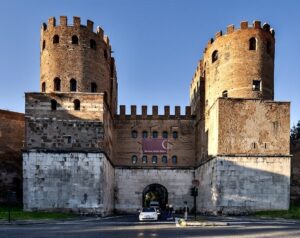
RM: How did athletes prepare in terms of diet, exercise, coaching, travel, rituals, and so on?

PC:  Late sources such as Philostratus (2nd c. AD) go into the details of athletes’ training regimes and diets. Meat and fish, both expensive, were recommended by some, while others favored figs, moist cheese and wheat. Specialist coaches there certainly were, such as Pythagoras (not the philosopher-mathematician). One essential feature of the ancient Olympics was the absolutely obligatory period of pre-Games training, actually at Olympia, during which the judges inspected the would-be competitors and decided on the eventual list of those who would actually do the business in and around the stadium in the Altis. Part of these preparatory training exercises took place in the Palaestra, literally the wrestling arena. Travel to Olympia – at first by boat if coming from, say, France, Spain or the Black Sea – would be mainly on foot, possibly by mule or donkey. Equestrian competitors of course had to get their horses and teams laboriously to Olympia. Sportsmen tend to be superstitious, so one can imagine that in the run-up to a Games there would be a lot of attendance at shrines of gods, goddesses, heroes and heroines, much offering up of prayers and animal or vegetable sacrifices, and plentiful making of vows, in general promising that in return for supernatural assistance the athlete or equestrian competitor would shower the appropriate supernatural power with return gifts in the event of success.

_____________________________

The “Exedra”: stone seats reserved for the judges at the games. NeilEvans at English Wikipedia, Public domain, Wikimedia Commons

_____________________________

RM: Were there other games too? In which games were women allowed to compete? Were Spartan women especially successful in sports?

PC:  From the 570s BCE the Olympics had been enfolded in what the Greeks called a ‘Circuit’ (periodos) of ‘crown’ (symbolic prizes only) games, as its numero uno.  The other three were the – also quadrennial – Pythian Games held at Delphi in central Greece (in honor of Apollo), and the biennial Isthmian Games (held at the Isthmus in honor of Poseidon) and Nemean Games (at Nemea in north-east Peloponnese in honor of Zeus). ‘Crown’ games were so called because the (first-only) prizes on offer were crowns made from natural produce – olive or bay leaves, or wild celery. Most Greek games, however, were not ‘crown’ games but value-prize games: the material prizes awarded were worth something, such as the amphorae filled with sacred olive oil on offer at Athens’s quadrennial Panathenaic Games, or the large bronze vessel that winners at the Heraea (games in honor of Hera) took home from Argos. Young girls and young women, it comes as something of a surprise to learn, did compete in public, though not stark naked, at Olympia, in a race in honor of Zeus’s sister-wife Hera. But not at the same festival as the men, and in only one running race, a shortened stade (about 160 meters as opposed to the men’s 192.24). One can well imagine Spartan females taking part in such a race, though we don’t happen to know whether any ever did, and it’s possible that Spartan women’s bulkier-than-normal physique (due to a superior diet) was not best suited to track events. On the other hand, the first woman in all Greece to win an Olympic victory was indeed a Spartan, though she was no ordinary woman but a princess royal, Cynisca. She won first in 396 and then again in 392, with the same team of mares in the four-horse chariot-race (tethrippos).

RM: What are some differences between the Paris Olympics 2024 and the ancient Olympics? Yes, that would take a book, but if you can say a few things. And what inventions from the 1936 “Nazi” Olympics are still part of today’s Olympics?

PC:  Where to start….!

i. The ancient Games, despite their religious framework (more below), were a kind of paramilitary exercise, ‘War minus the shooting’, as George Orwell called international professional football (soccer) matches, which are euphemistically called ‘friendlies’ today. Competitors competed as individuals – but the (literal) song and dance that the cities of winners indulged in, and the material and symbolic super benefits they conferred on their triumphant citizens, demonstrate that Olympic competition was seen by them as being significantly the continuation of war by other means. In 364 BCE sacrilegiously warfare actually broke out within the Altis itself.

ii. The ancient Olympic ‘truce’ is regularly misunderstood, not least by de Coubertin. Its original name is a giveaway: literally an armistice (ekekheiria). It was introduced and had to be introduced as a way to enable competitors and pilgrims to get to and from the Games unharmed, even if their states happened to be at war with each other, often enough the case. The truce in other words was not in itself an expression of a pacific or pacifist ideal.

iii. Gentleman amateur? An American scholar in 1984 exploded the ‘amateur’ notion. By no means all competitive conduct was gentlemanly (see iv). And of course de Coubertin’s Victorian prudishness ruled out male nudity. On the other hand, in his ‘gender-critical’ stance de Coubertin was on the money. There were women’s athletics in ancient Greece, including at Olympia (above), but … not at the same time or on the same scale as the (men-only) Olympics.

iv. Fair Play? Were the ancient Olympics ‘sport’?? What I’m getting at here is twofold: first, the use in English of the adjective ‘sporting’: sporting behavior is behavior that not only falls within a strict and narrow interpretation of the rules but also interprets those laws generously, and especially in relation to one’s own opponent, in such a way as to minimize one’s own advantage. Not many if any instances of such ‘sporting’ behavior are on offer from the ancient Olympics. Rather the reverse, for, as two Canadian scholars have written, ‘The ancient Greek rule books seem to have passed over many tactics we would consider the worst sort of dirty fighting’. Consider only the ancient equivalent of today’s terrifying MMA (Mixed Martial Arts), that is the pankration. No gouging of eyes, no biting – those were the rules. But a famous 5th-century Athenian drinking cup shows precisely both of those illegal moves in graphic action.

v. Next, I move on to the spirit of contest: you might think that contest or competition was something universally human – not so! Our English word ‘agony’, meaning extreme pain, is derived from the ancient Greek noun agônia, which meant competitiveness, in its specifically Hellenic form – zero-sum, winner takes all; in the ancient Olympics there was just one ‘prize’, a symbolic olive wreath, no silver let alone bronze medals – both of which were part of de Coubertin’s soppy idea that taking part in the Games was as important if not more important than winning.

vi. Religion: from agonia I move penultimately to Agôn, capital A. The ancient Greeks did not only practice an extreme form of ultra-competitiveness but they also, literally, worshipped, paid cult to, a personified ‘Agon’. He (the Greek noun is masculine) had a statue at Olympia mentioned in the 2nd c. CE by Pausanias (5.20.3, 26.3), and he was related, not surprisingly, to two other abstractions of personifications, Zelos (Emulation) and Nike (Victory). But most important of all is that this particular form of competition was especially associated with religious festivals, so that any religious festival involving competition and prize-giving could be labelled an agôn. This is yet another reminder that the ancient Olympics were staged within an essentially religious framework, a henotheistic, polytheistic framework deeply alien to our ways of thinking and doing.

Finally, to ram the point of difference home, I bring to you a

vii. Legacy that is no legacy: the Marathon

The universally popular marathon race of today was first invented, introduced and run in and around Athens in the first Modern Olympics of 1896, ‘after an idea’ (as they say in the movies) by French classicist Michel Bréal, proposed and accepted at the 1894 congress. At first, of course, it was men-only. Indeed, not just at first: there was no women’s Olympics marathon race until 1984 (L.A.). Since then, a mere marathon is considered relatively tame and everyday – a question of breaking the 2-hour time barrier, an entirely modern notion. The real agonists of our day go in for ultra-marathons, runners such as my good friend Greek-American Dean Karnazes, who’s acquired the nickname ‘Mr Ultramarathon Man’. He’s run ultramarathons all over the world, including the Spartathlon, which was first staged in 1982 and has a far better ancient pedigree (Herodotus…) than the marathon. Why ‘marathon’, anyway? It took its name and length (some 40 km) from its route, from Marathon on the east coast of Atttiki to central Athens, and its inspiration/legitimation from an alleged original run in 490 BCE, following the Battle of Marathon – though even the ancient Greeks themselves couldn’t agree on the name of that runner. However, and this is my final, clinching point: at the original Olympics the ‘long’ race, the dolichos, was a mere 24 laps of the roughly 200-meter course or, in our terms, something like a 5000 meters or middle-distance event. No ‘marathons’ for the ancient Greeks, thank you very much.

Finally, an invention of the Hitler Games of 1936 that has stood the test of time? The torch-relay. The Olympic flame was an invention of 1928. It was in keeping with de Coubertin’s Olympic ideal that it should be lit at Olympia and then transported to the – movable – site of each modern Olympiad.

RM: Did Alexander the Great like sports? Did his father enter horse races at Olympia? Any word about Plato or other philosophers enjoying the Olympics? Did or could any of the Ptolemies, including Cleopatra VII, sponsor any events or horse racing participants?

PC:  Philosophers tended to be sniffy about athletics and athletes – far too preoccupied with their bodies (bulking up, etc), and not nearly interested enough in the things of the mind. King Philip II of Macedon, father of Alexander III (the Great), won a horse race at Olympia in 356, the year of Alexander’s birth. Alexander is credited (or debited) with saying that he would compete at Olympia – but only if all his fellow-contestants were also kings. That was probably a cop-out: he would not have been interested in taking part in any contest he might not win. A homonymous ancestor, King Alexander I, had taken part in the Olympics – but for him it really was the taking part and not the winning that mattered, since being allowed to compete proved his (challenged) status as a true-blue Hellene. So far as we know, no Ptolemy competed in person in any Olympic event, partly because Ptolemy II founded in 279 BC  games named after his family, the Ptolemaia, and celebrated at Alexandria, which were an Olympics equivalent for Egyptian Greeks. But several of the Ptolemies, not least the women, emulated Philip II by competing in and winning equestrian events at Olympia, Arsinoe II (sister-wife of Ptolemy II) not the least.

______________________________

Remains of the Temple of Zeus at Olympia. Pan.stathopoulos, CC BY-SA 4.0, Wikimedia Commons

______________________________

Pedimental sculptures of the Temple of Zeus, in the Archaeological Museum of Olympia. Made by Numbers, CC BY-SA 4.0, Wikimedia Commons

______________________________

The Palaestra at Olympia, where wrestlers and other athletes were trained. Bgabel, CC BY-SA 4.0, Wikimedia Commons

______________________________

About Paul Cartledge

Paul Cartledge is a British historian and scholar. From 2008 to 2014 he was the A. G. Leventis Professor of Greek Culture at the University of Cambridge, and previously held a personal chair in Greek History at Cambridge. (Text CC BY-SA 4.0, Wikipedia Commons)


______________________________

Cover Image, Top Left: Temple in Olympia, Chrisi1964, CC BY-SA 4.0, Wikimedia Commons

______________________________

Advertisement

EXPLORE THE ANCIENT ETRUSCANS IN PERSON!
Experience a unique, up-close-and-personal hike among ancient hilltop towns in central Italy. You will walk the sensational countryside of the regions of Umbria and Tuscany, soaking in important sites attesting to the advanced Etruscan civilization, forerunners of the ancient Romans; imposing architectural and cultural remains of Medieval Italy; local food and drink; and perhaps best of all — spectacular scenic views! Join us in this collaborative event for the trip of a lifetime!

The Architectural and Archaeological Legacy of the Christian Persecution

Professor Frank J. Korn has retired from his teaching position on the Classical Studies faculty at Seton Hall University.  He is a Fulbright Scholar at the American Academy in Rome and the author of nine books on various aspects of the Eternal City.  He is listed in Marquis Who’s Who as “a notable classical educator and writer.”  Recipient of the Princeton Prize for Distinguished Teaching, he resides with his wife Camille in Scotch Plains, N.J.  The couple’s three sons –  Frank, Ronald, and John and their families live nearby.  His latest book    Below Rome, the Story of the Catacombs    which he co-authored with his wife, is available on Amazon or from the publisher, St. Johann Press, Haworth, N.J.

Around the mid-first century of our era the volatile Emperor Nero    for reasons we shall see in due course    resolved to eradicate the new religion from the east which was fast taking root in Rome.  Across the next two hundred years many    but not all    of his successors continued the effort with varying degrees of intensity, but, as the historian Tertullian informs us, the blood of the martyrs became the very elixir of life for the infant Church of Rome.  As one writer expressed it, “Surely it is not easy to discount a story for which the witnesses are willing to be slain.”  Indeed hundreds, maybe thousands, of pagan or agnostic Romans were drawn to the Gospel message by the unforgettable sight of the serenity of the believers as they were being led to slaughter.  Today, Christianity marches on in its third millennium. The mighty Roman Empire did not survive a half of one.

Today, all over Rome, signs of Christianity’s ultimate triumph abound.  Today, its monuments and shrines rise, literally, over or next to, or even within the ruins and rubble of old Rome and have forever altered the city’s skyline.  Where once upon a time the tympanums of temples to Jupiter, Mars, Venus, and other ancient deities were silhouetted against the Italian firmament, one now sees campaniles and cupolas, each surmounted by a cross.  And floating high above them all    like a gigantic white hot-air balloon    is the dome of St. Peter’s on the opposite side of the Tiber.

______________________________

The dome of St. Peters figures prominently on the urban landscape of the city of Rome. Emphyrio, Pixabay

______________________________

On the summit of the Capitoline Hill, for example, the fallen stones of the Temple of Juno provide a bedrock foundation for the medieval church of Santa Maria in AraCoeli, whose cascading one hundred and twenty four marble steps were transferred here from the nearby Temple of Apollo.

Far below, in the Great Forum, three temples ultimately were converted into houses of Christian worship.  Within the walls and colonnade of the sanctuary to the deified Emperor Antoninous and Empress Faustina the early believers erected a church to San Lorenzo.  What was left of the sacred edifice honoring the divinities, Venus and Roma, was incorporated into a church named Santa Francesca Romana.  And, lastly, the circular shrine of Romulus, son of the Emperor Maxentius, became the apse of a church honoring Saints Cosmas and Damian.

On the nearby island in the Tiber, from the year 292 B.C.,when Rome was struck by a deadly plague, there stood the Temple of Aesculapius, the Greek god of medicine.  In the tenth century, the city’s Christians built on this site a church to the apostle Bartholomew, whose bones are said to repose beneath the main altar.  This holy place remains to this day a focal point of pilgrimage.

The Aventine Hill in antiquity was graced by seven majestic temples.  On the site of the one named for the goddess Diana, now stands the quaint little church of Santa Prisca.  At the highest point of this same hill where there rose in the imperial age a shrine to Bona Dea i.e. the “Good Goddess,” now exists the baroque Piranesi masterpiece of Santa Maria del Priiorato.

Down in the valley along the bank of the Tiber the ancient citizenry put up a beautiful Corinthian–colonnaded round temple to the demi-god Hercules, and a rectangular one to Portunus, god of the harbor.  Both date to the second century before Christ and survive in a remarkable state of preservation due to their use as Christian churches throughout the Middle Ages, which resulted in careful, constant maintenance.  Just across the cobblestoned street is the romanesque sixth century edifice of Santa Maria in Cosmedin, which stands above an intact small Mithraic temple.

Not far from here, in the Campus Martius district, above the remains of the once splendid Temple of Minerva, the war goddess and protectress of old Rome, we come upon a Gothic structure honoring the Virgin Mary.  The church bears the poetic name:  Santa Maria Sopra Minerva. (Sopra is Italian for “above.”).

Lest the reader, at this juncture, get the impression that it was only pagan temples that got this Christian makeover, let us here point out the many secular, civic facilities and public grounds that underwent a similar conversion.

For example, the still intact Curia or Senate House    whose walls once rang with fiery orations during tumultuous legislative sessions    was transformed into the church of Saint Adrian of Nicomedia in the year 630.  From then on, the old chamber softly echoed the solemn Gregorian Chant of Christian clergy and worshippers.  (The building was deconsecrated in the late nineteenth century and reclassified as a historic site.}  Even the city’s maximum security jail, the Mamertine Prison, did not escape the Christianization of both Republican and Imperial Rome’s historic sites.  Peter and Paul were incarcerated here    by order of Nero    in the Mamertine’s dreaded subterranean dungeon, the Tullianum, to await their execution nine months later.  Sometime after the Church’s liberation by Constantine’s Edict of Milan in 313, the local disciples fashioned out of the prison a chapel which still goes by the fitting name, San Pietro in Carcere. (On certain feast days Mass is still celebrated on the marble altar in this notorious old lockup.)

A few blocks away, on the site of the outdoor shopping mecca which the ancients knew as the Forum Holitorium (Produce Market), an influx of sixth century Greek Christian migrants erected the massive church of San Giorgio in Velabro. (Velabrum is the Latin name for this former commercial district.)

______________________________

The San Giorgio in Velabro Church. Fallaner, CC BY-SA 4.0, Wikimedia Commons

______________________________

In this same neighborhood today’s visitor –  pilgrim or tourist    may also pay a visit to Sant Angelo in Pescheria, where the local fishmongers of a bygone age carried on a bustling business, or to Santa Maria in Via Lata (Saint Mary’s on the Wide Street) which was built on the ruins of the Saepta Julia, a large, porticoed enclave which was used as the main polling precinct for elections by the General Assembly. This public project    conceived by Julius Caesar and completed by his successor Augustus    was designed with many aisles to keep the long lines of voters orderly.

On a part of the remainder of the grandstands of the oval Stadium of Domitian, the Christian flock honored, with a small shrine, the lovely teenaged Agnes who was martyred here.  The grand baroque church, which has replaced the original tribute since 1635, is the work of the prolific architect Borromini and is named for the poor innocent:  Sant Agnese in Agone.  What was left of the emperor’s arena evolved into the ever popular Piazza Navona (“Navona” being a corruption of “in Agone”).

From here a twenty five minute stroll through the heart of Rome will take you to the huge square called Piazza del Popolo where, as you enter from the Via del Corso, you will see identical twin churches:  Santa Maria di Monte Santo to your right and Santa Maria dei Miracoli on the left.  The latter occupies the site of what remained of the extravagant mausoleum of the dictator Lucius Cornelius Sulla.  (Note:  Of Rome’s more than four hundred churches, incidentally, some seventy or so are named for the mother of Christ, patroness of the Eternal City.)

The Emperor Hadrian (A.D. 117-138), who was vehemently opposed to the cult but did not hunt down its practitioners, would be aghast if one day he were to return to life only to learn that his proud Pantheon is now the Church of Saint Mary and the Martyrs; that his massive tomb on the left bank of the Tiber has long been used as a papal refuge; that the Pons Aelius, which he built to span the river as an access to his final resting place is now celebrated as The Bridge of the Angels and features at the far end the two most venerated Christian leaders:  St. Peter and St. Paul.

_____________________________

The Pantheon, or the Church of St. Mary and the Martyrs, as it appears today in Rome. Krystianwin, Pixabay

_____________________________

A later ruler, Diocletian (284-305), who launched a bloody persecution resulting in the slaughter of multitudes of the flock of Christ, would be dismayed to find that the tepidarium of his lavish bath complex was transformed into a house of worship, called Santa Maria degli Angeli, by the giant of the Renaissance, Michelangelo. (Because of the great hall’s peculiar dimensions, the moody architect created a transept longer than the nave.)  Diocletian’s sprawling spa was surrounded by a rectangle of lofty walls sporting a large round tower at each of the four corners.  One of the three towers still extant was destined to become the church of San Bernardo alle Terme (St. Bernard at the Baths).

_____________________________

Santa Maria degli Angeli (Rome) – Facade. NikonZ7II, CC BY-SA 4.0, Wikimedia Commons

_____________________________

Across the length and breadth of Eternal Rome the present-day visitor will see  — and hear    yet more evidence of Christianity’s centuries-long architectural response to its early tormentors.  Crowning each of the two dozen or so soaring obelisks, brought back from Egypt by the swaggering Roman legions as tall, slender trophies of war, is a cross.  The still standing second-century monumental hundred-foot-high bas reliefed column of Trajan, which once supported a marble statue of him on its summit, now holds aloft an effigy of Peter the Apostle.  Down the street from here (the Via del Corso) rises a similar column, atop which stood a sculpture of Marcus Aurelius, which has long since given way to one of the Apostle Paul.  The iconic Colosseum is marked at the fifty yard line with a huge black cross commemorating the countless Christians said to have been martyred here.

_____________________________

The Column of Trajan (right). AlekseyMyagky, Pixabay

_____________________________

The Column of Trajan still shows the immaculate, detailed bas relief telling stories and events of pagan Rome. Gary Todd, Public Domain, Wikimedia Commons

_____________________________

Four of the ancient eleven waterworks, the amazing aqueducts, having been restored by the Renaissance popes. Each terminate in a spectacular monumental fountain, the marble facade of which bears the name of the pontiff who commissioned the work.

And providing a melodious touch to Christianitiy’s survival, an integral part of the city’s soundtrack, colossal church bells ring out the hours all day long over the rooftops of Rome.

…..

Christian pilgrims to Rome, hoping to be swept back across a million yesterdays to apostolic times, often list a visit to one church in particular as a major priority.  More so than St. Peters, this site enables one to tangibly peel away the centuries:  The Church of San Clemente.  Just a stone’s throw from the Colosseum, it is actually three churches superimposed one upon the other, with massive stonework and piles of masonry from three distinct Roman epochs.  On the property, Christians have gathered for worship across two thousand years of Church history.  When Peter was serving as bishop of Rome, there dwelled here a pious priest named Clement, who allowed his residence to be used as a clandestine domus ecclesia, i.e. house church.

_____________________________

The Basilica of San Clemente. Labicanense, CC BY-SA 4.0, Wikimedia Commons

_____________________________

Everything seems to indicate that Clement belonged to the aristocratic Flavian family, which gave Rome three emperors:  Vespasian, Titus, and Domitian.  In the year 88 Clement was elected to the Throne of St. Peter, thereby becoming the fourth pope of the infant Church that was at the time struggling to survive the bloodbaths of the persecutions.

Soon after Domitian was elevated to the purple, he brought the full might and fury of Imperial Rome crashing down on the city’s small but growing Christian community.  Even family ties counted for naught as he issued the order to have his cousin Pope Clement and the consul Flavius, a recent convert, executed.  Sometime in the fourth century after Constantine had put an end to the onslaught against Christianity, the faithful filled the ground floor of Clement’s home with rubble and mortar to provide a solid foundation for the basilica they were soon to raise on that hallowed ground.  From early writers, such as St. Jerome, we learn that this basilica was given the Latin name Sanctus Clemens (in Italian – San Clemente as we know it today), in honor of the martyred pontiff.

Throughout the early Middle ages, Saint Clement’s remained one of the most prominent of all the city’s Christian shrines.  Then in the year 1084 came the infamous Norman sack of Rome.  Beautiful, historic Saint Clemens was severely damaged.  In 1108 Pope Paschal II began construction of a new basilica atop the remains of the fourth century structure.  The half-hidden older edifice was filled in completely and vanished from human sight for seven hundred and fifty years. 

It wasn’t until 1857 that the amazing stratification of the property was discovered.  Doing some restoration work under the supervision of the Dominican, Father Mullooly, workmen came upon the church beneath.  (Since 1667, San Clemente has been in the care of an order of Irish Dominican priests.)  The priest solicited funds from all over the globe to have the lower church completely cleared.  These excavations revealed an imposing three-aisled basilica with its graceful apse and canopied altar still intact.  Well-preserved, too, were numerous eighth, ninth, and tenth century paintings and mosaics depicting events in the life of Pope St. Clement.  Continued digging deeper underground led Father Mulooly into the very rooms of Clement’s home, which in imperial times stood at what was then ground level.  Further probing brought yet more antiquity to light.  Just across a narrow back alley from this house-church was another pink-brick residence whose owner had carved out a room for purposes of worship in another popular religion of the age    Mithraism.

In the mithraeum one sees a vaulted ceiling, stone benches for the worshippers, and a small altar with fine bas-reliefs showing the Persian deity Mithras sacrificing a bull to the sun-god.  (Plutarch tells us that the Mithraic mysteries were first bought to Rome by soldiers of Pompey the Great.)

Having visited the lower basilica, one can readily notice that Pope Paschal was extremely faithful to its architectural plan in his design of the upper church.  That plan included a colonnaded courtyard  — out front.  In this area    called the atrium    there remained, whenever the sacred rites were going on inside, those taking instructions in the faith prior to being baptized, along with those doing penance for various trespasses, and the more curious among non-believers.

The interior of the upper basilica features all the aspects of a typical medieval church, including a mosaic-adoned apse, a marble baldacchino over the main altar, and a marble-enclosed Schola Cantorum or Choir area.  There are also two highly ornamental pulpits    one for the reading of the epistle, the other for the gospel.  High upon the soaring triumphal archway framing the sanctuary are mosaics of Peter and his third successor, Clement.

Even the very pavement of Saint Clement’s is a masterpiece of art and a perfect example of a cosmatesque marble floor laid out in striking geometric patterns.  And so it is then, that in visiting the Basilica of San Clemente on the Via San Giovanni in Rome, one can step out of a twenty-first century vehicle and roll back nine centuries by entering the church built by Paschal; roll back eight more by descending a staircase into the church mentioned by St. Jerome; and yet four more by picking one’s way down another set of stairs into Clement’s house-church of apostolic times    and while down there, stealing a glance into the dark, damp house of worship of a cult that has long since entered oblivion.

____________________________

Interior of Basilica of San Clemente al Laterano in Rome (1863), by Lawrence Alma-Tadema. Oil on canvas. Fries Museum, Leeuwarden, Netherlands. Public Domain, Wikimedia Commons

____________________________

The Mithraem. kevingessner, CC BY-SA 4.0, Wikimedia Commons

____________________________

Only in Rome is it possible to enjoy an experience so archaeologically unique.

…..

Now, as for the ruthless Nero, who had sought to crush the Church in its infancy, the irony    or karma if you will    seems never to end.  In July of A.D. 64 a suspicious fire broke out in the wooden bleachers of the Circus Maximus and raged out of control into a city-wide conflagration, devastating eleven of the fourteen precincts established by Augustus.  The egotistic Nero, long known to be unhappy with his capital and wanting to level it to pave the way for a glittering new city which he would name for himself, Neronia, was widely thought to be responsible for the arson.  But he found a convenient scapegoat in the Christian sect, which he quickly subjected to a relentless savage persecution.  He also issued an edict forever forbidding the existence of the cult, with the penalty of death for those discovered practicing it.  His enormous, state-of-the-art circular meat market on the Coelian Hill    the Macellum Magnum    was to become in the early sixth century the church of San Stefano Rotondo, St. Stephen in the Round.  Upon the wreckage of the tyrant’s impressive hippodrome over in the Ager Vaticanus (the Vatican Meadows) stands the greatest church in all Christendom:  the Basilica of St. Peter, prince of the apostles and the first Bishop of Rome.  Nero’s custom of addressing    or ought we say haranguing    his suffering subjects, from the balcony of his shamefully sumptuous palace, has been replaced by the tradition of the Pope imparting his apostolic blessing  Urbi et Orbi    from the central loggia of his baroque Basilica upon the throngs of pilgrims in the gargantuan square below.

One final irony:  Though condemned to death by the Roman Senate, Nero, when he ended his reign of terror via suicide, was nonetheless given a full state funeral.  His ashes were entombed at the foot of the Pinciana Hill, in a huge magnificent altar of precious porphyry enclosed by a marble balustrade.  Over the ensuing centuries the people of Rome were spooked by a persistent legend maintaining that Nero’s ghost haunted the area.  When Paschal II (1099-1118) ascended the Chair of St. Peter one of his first acts was to purge the city of “Nero’s curse” by destroying the shrine and scattering the ashes to the winds.  Paschal then soon established on the site a church to the Virgin. In the following century the structure was enlarged with funds from the Romans themselves and renamed Santa Maria del Popolo …  Saint Mary of the People.

___________________________

Basilica of Santa Maria del Popolo. Jakub Hałun, CC BY-SA 4.0, Wikimedia Commons

___________________________
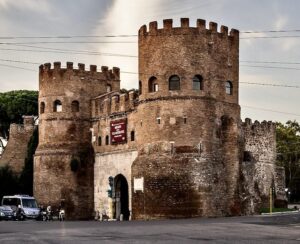
Thus it is that for contemporary archeologists hoping to come upon the leftovers of the Rome of the Caesars, they must often search beneath the ubiquitous layers of the Rome of the Popes.

______________________________

Advertisement

EXPLORE THE ANCIENT ETRUSCANS IN PERSON!
Experience a unique, up-close-and-personal hike among ancient hilltop towns in central Italy. You will walk the sensational countryside of the regions of Umbria and Tuscany, soaking in important sites attesting to the advanced Etruscan civilization, forerunners of the ancient Romans; imposing architectural and cultural remains of Medieval Italy; local food and drink; and perhaps best of all — spectacular scenic views! Join us in this collaborative event for the trip of a lifetime!

The Milpa Cycle

Anabel Ford is dedicated to decoding the ancient Maya landscape. While living in Guatemala in 1978, she learned from local people that the Maya forest was an edible garden when she mapped a 30-km transect between the Petén sites of Tikal and Yaxhá. In 1983, she discovered and later mapped the Maya city El Pilar. In 1993, after settlement survey and excavations, she launched a multidisciplinary program to understand the culture and nature of El Pilar. Ford’s publications are cited nationally and internationally as part of the foundation of Maya settlement pattern studies. Her archaeological themes are diverse, appearing in geological, ethnobiological, geographical, and botanical arenas and locally in Belize, Guatemala, and Mexico. Her concern for management of cultural monuments, in-situ conservation, and tourism appear in Getty publications.

The ever-changing ancient Maya landscape depended on the relationship between fields and forest. The natural resources of the Maya forest, seen as a hotspot of biodiversity, necessarily provisioned the ancient Maya economy.  For ancient Mesoamericans, all aspects of the landscape, in particular their cultivation, depended on rainfall and their technologies-based human power, supported with tools of stone and fire, though the remarkable accomplishments of the Maya were achieved in the absence of plow or cow.

Clearly, demand for cropped fields inherently reduces land for forests and cleared land increases erosion and reduces fertility. It was Malthus, who wrote more than 200 years ago, who stated the choice is cast as a dichotomy between cultivated fields and forest. And to Western eyes, cultivable has been equated with arable, and arable means plowable. Traditional land use in all of the Americas, and for that matter most small holders around the world, is reliant on the labor of the individual, family, and community.

However, the ancient Maya civilization was based on an agriculture system engaged with the natural environment. Labor, knowledge, skill, and scheduling was used to direct the exuberant tropical growth towards human needs. The open field was the foundation for the useful forest and without a useful forest there could be no constructive field. The Maya civilization thus developed and expanded across the millennia based on reliable land management practices to provision food and shelter, accommodating climate changes with flexible and resilient strategies.

From the conventional, traditional perspective, Maya land use has remained largely maligned as ‘slash and burn and shifting agriculture’, recognizing only the food crops and seeing the remaining lands as “resting.” In this view, the uncropped land is wasted rather than seen as an investment in a regeneration dynamic to produce perennial fruits, important medicines, habitat for animals, and the essential construction materials for houses.

Enter here the milpa.

The field crop called the ‘milpa’ is part of a complex landscape embedded in the forest itself, consistent with traditional swidden sequences around the world. Fire, and burning, is an important component of the practice that relies on strategic fire management skills, and those that master it are known as Yum Ik’ob or Masters of Wind—opening field spaces with fire, enriching the soil with ash, and systematically reducing the fuel load on the landscape with the asynchronous cycle of field, to forest, to field. Managed as a horizontal matrix with vertical variations of a heterogeneous mosaic of milpa forest garden cycles, it is an orchestrated sequence of succession from annuals to perennials founded on local and traditional ecological knowledge practices. Value is gathered over generations, centuries, and millennia, building a regenerative cycle that is a sophisticated low-tech undertaking that is resilient under variable climactic and ecological conditions. The milpa forest garden emerged under conditions of climate chaos and underwrote the millennia of growth and development of the ancient Maya. It is a valuable lesson for us today.

_____________________________

The Maya Forest Garden, created through the Milpa cycle. Courtesy BRASS/El Pilar

_____________________________

Maya Forest Resources

Forest products were derived from the landscape by Maya management to conserve water, moderate temperature, build soil fertility, and check erosion. This was to insure access to goods and provide services from their immediate environs to meet the basic needs for food, fodder, and fuel to ensure general well-being. Investments on the landscape included a diversity of local field crops, forest products for perennial fruits, construction, and utensils, and protein from forest wildlife.  These were available because local inhabitants had developed forests and gardens. Household items of all sorts were grown in home gardens and fields, extracted from regenerating second growth and mature forests, and nurtured in the mosaic landscape that surrounded homes and communities. 

Food of every part of nearly 500 plants garnered from the domesticated landscape have been identified in use in fields and forest by contemporary Maya (Fedick 2020) and a good proportion of these plants perform well with lack of water (Fedick and Santiago 2021). Remedies derived from forest plants cover most ailments encountered in the household. The contribution of palms, dominant in neotropical forests such as the Maya forest (Muscarella et al. 2020), is significant. Equally important are construction materials derived from other trees (Cook 2016; Lentz and Hockaday 2009; Hellmuth 1977). The forest of materials provide reliable habitats to support animals, contributing dietary protein (Emery 2007; Emery and Thornton 2008).  Skilled beekeepers, or  K’axil kab, in the Maya forest provide honey, wax, and royal jelly and supporte the pollination of the forest trees (Bianco et al. 2017; Jones 1977; Farriss 1992; Vietmeyer 1991: 363-370; Zralka et al. 2014, 2018). Lack of flower pollen will inhibit production of honey and apart from the beauty, ornamentals are an important investment in the home gardens, contributing flowers (Gasco 2008) significant to beekeeping.

Reliable and dependable provisioning of everyday needs requires sophisticated skill and knowledge based on a dynamic and intensive agricultural and forestry system, engaged with the natural processes that minimize risk over time and maximize the value of invested labor and skill across space. Proficiently designed to moderate rainfall variations in times of drought with water conservation strategies. Additionally, in times of deluge with erosion checking practices, the milpa forest garden reinforces or supplements soil fertility with each phase of the high-performance cycle (Wilke 1987).  As a subsistence system of significant complexity, all aspects of the landscape from the open field gap through gradients of secondary growth to the mature canopy forest, serve practical purposes. The clearing of the milpa yields the opportunity to select the regenerating forest, a co-creative landscape management design of investments in the forest as a garden.

Horizontal and Vertical Landscape Dynamics

The most substantial feature of the Maya forest is the karst limestone platform that underlies the Maya area at the regional scale, impacting spatial distribution of all resources. Local variations in limestones are expressed in drainage features and distribution of water. Porous limestone absorbs rain, and rainfall averages vary from 500 mm in the northwest Yucatan Peninsula to 4,000 mm in the far south; the central area around Tikal and El Pilar receives 1500-2000 mm a year. 

Over the peninsula, seasons are divided based on precipitation. Often simply seen as wet and dry, there are actually two rainy periods recognized by farmers and one dry season. The first is a warm, wet period called Chaak Ik, the thunder wind associated with hurricanes that start in June. This is followed by the Ikal Ixpelon, the cool wet period associated with the Nortes linked to the winter months in the north starting in November. The shortest period is the dry period, Yaxk’in, initiating from March to April and noted as the time for preparing the milpa fields.

Water availability and soil quality are critical in tropical forest environments. Geological characteristics of limestone with fissures absorb surface water. Management of land cover is essential, and vegetation cover protects soil, contributing organic matter while inhibiting soil loss to create a matrix of diverse assets. Managed to reduce temperature, maintain biodiversity, conserve water, inhibit erosion, and build soil fertility, the small holder strategies that were recognized at the conquest were developed in response to vagaries of weather.

The Maya forest is recognized for its remarkable variety and an abundance of useful plants. Forest products from the layers of forest gardens yield a diversity of products from the tall canopy trees to the ground cover. Over a 20-year cycle with field openings in the forest, the field to forest cropscape unfolds layers of trees, palms, shrubs, grasses, vines, epiphytes, forbs, and grasses. The co-creative matrix develops as an interactive process between people and their landscape based on an inherent respect for nature. The vigorous growth has been intervened with constant selection attuned to the natural systems through trial and error aiming towards the long-term preferences for utility from immediate infields around homes to the scattered outfields.  This emerges as concentric zones of assets around settlements based on management and tending.

The asynchronous cycling of fields to forests develops a landscape mosaic that, at any one time, presents diverse fields, amid building perennials, and mature closed canopy. There is interaction among the fields and forests where the variety of trees and shrubs recorded in the maize field are similar to those of the home gardens.

Favored trees are protected and cared for in the fields, and along with resprouting of saplings, hasten the regeneration process from regeneration to mature cycles. These dynamic land use practices enhance flexibility and adaptability under unpredictable and changing climatic conditions and the mosaic of land cover from field to forest lower fuel load, moderate temperature, and manage water for both drought and deluge. These ingrained and multidimensional low-tech practices allow flexibility and enable a nimble response to short-term and erratic shifts in weather regimes as well as more persistent long-term climatic trends.

____________________________


The Milpa cycle, from maize field to perennials and back to the forest. Courtesy BRASS/El Pilar

_______________________________

Discussion

The accumulative result of selection for diversity and utility over millennia is the co-creative Maya making the forest as a garden. A consequent outcome makes the nature of the Maya forest a product of culture. The spatial composite of this biological capital is the key to understanding how the ancient Maya managed and used resources for the long term, minimizing risk to secure continuity and predictability in the face of the vicissitudes of weather and environment. The traditional ecological knowledge of the Maya has evolved to meet the daily, weekly, seasonal as well as ceremonial requisites that are part of everyday life. Topography, drainage, and soil qualities intersect with the landscape of uplands, transitional lowlands, and wetlands to figure into the mosaic of vital resources. The land-use system enriched habitats and properties, based on the integral and asynchronous cycles imposed by the milpa forest gardens that support the economy.

It is clear that the Maya took advantage of the vibrant qualities of the milpa cycle and the context of natural forest regeneration to provide diverse resources across space linked to land use and land cover that managed their environmental impacts. This is an iterative and interactive relationship where the pernicious impacts of human management with cutting and burning are part of the natural processes of adaptation. Over the 8,000 years of the Holocene development of the Maya forest, and the 4,000 years of Maya development, the connections of plants and people evolved a forest that responded to the impacts of humans as humans established their relationship with the biological capital of the forest.

It is remarkable that the product of the Maya civilization is the Maya forest and the biodiversity recognized in its forest is the consequence of steady and systematic attention to selection, stressing the important resources to sustain life. The resilience of the forest is a tribute to the traditional knowledge of the farmers of the Maya forest. Today they are ready to share their secrets to prosperity and conservation before it is too late.

______________________________

Advertisement

EXPLORE THE ANCIENT ETRUSCANS IN PERSON!
Experience a unique, up-close-and-personal hike among ancient hilltop towns in central Italy. You will walk the sensational countryside of the regions of Umbria and Tuscany, soaking in important sites attesting to the advanced Etruscan civilization, forerunners of the ancient Romans; imposing architectural and cultural remains of Medieval Italy; local food and drink; and perhaps best of all — spectacular scenic views! Join us in this collaborative event for the trip of a lifetime!

How Prehistoric Humans Discovered Fire Making

Deborah Barsky is a writing fellow for the Human Bridges, a researcher at the Catalan Institute of Human Paleoecology and Social Evolution, and an associate professor at the Rovira i Virgili University in Tarragona, Spain, with the Open University of Catalonia (UOC). She is the author of Human Prehistory: Exploring the Past to Understand the Future (Cambridge University Press, 2022).

An ancient Greek myth tells the story of Prometheus, who, after molding humans out of clay and teaching them the fine arts of civilization, defied the Olympian Gods by stealing the secret of fire and offering it to humans. Prometheus paid dearly for this act of transgression that doted humankind with unprecedented technological know-how, ultimately transforming their condition into one of great power.

The moral behind the Promethean archetype is a cautionary one, intended to warn us about the risks attached to the unbridled pursuit of technology that can inadvertently result in catastrophic scenarios. The Prometheus myth underscores not only the formidable power that individuals may come to possess by defying authority in the quest to develop science and technology but also suggests that anyone who does so will suffer the consequences.

It is significant that the Greeks chose fire as the subject to deliver this warning. Without a doubt, the capacity to produce and control fire stands out among the most transformative technological feats achieved by our prehistoric ancestors; one that ultimately consolidated human planetary domination. But how, when, and where did early humans harness the technologies necessary to master fire making? What does the archeological record tell us about how they finally obtained the Promethean secret of fire making?

Like other milestones marking the human evolutionary pathway (like perfecting stone axes or mastering advanced hunting practices), the know-how required to make, use, and control fire evolved progressively, encouraged by human ingenuity and, probably also, by trial and error. Fire making techniques were perfected over time and transmitted socially, while different human groups explored the multifaceted revolutionary potential offered by controlling it. Before truly mastering fire making, early humans may have experienced a precedent phase during which they used fire passively, gathering, preserving and even transporting brazes ignited by natural causes (lightning, spontaneous combustion, etc.), prior to learning how to actively generate and control it. In the meantime, curiosity led them to explore the mysterious properties of fire, while also inspiring them to seek ways to master its secrets.

While looking back in time, it is difficult to pinpoint exactly when our ancestors began to control fire-making technologies. Recognizing intentionally ignited and sustained fires in archeological contexts poses challenges since the simple presence of burned bones and stones or localized areas of charred soils are not sufficient to prove that hominins were actively producing fire. Before 1 million years ago, sparse evidence from some African sites could suggest that hominins were opportunistically harvesting fire from naturally kindled blazes; rather than practicing truly operative fire making. However, a multidisciplinary study from the Wonderwerk Cave in South Africa reports convincing evidence for intentional burning in a controlled archeological context dated to 1 million years old.

While such early signals of fire making are rare and difficult to recognize and interpret, globally, the ability to set fire at will is heralded as a major groundbreaking accomplishment attributed to the Homo erectus lineage who lived during the Lower Paleolithic period. This group of hominins is known to have produced an impressive array of tools belonging to the so-called Acheulian industrial complex that emerged in Africa 1.75 million years ago. Fire making is not the only groundbreaking achievement marking the 1.4 million-year-long reign of the Acheulian peoples. Throughout this time, hominins invented and came to master highly complex technological achievements, documented archeologically in the form of stone and (sometimes) bone tools. These technologies facilitated the expansion of H. erectus populations into Eurasia, where they continued to perfect and diversify the toolkits that afforded them adaptive advantages; improving their ability to multiply and flourish.

Aside from their broadening cultural repertoire, parallel processes of social development (more difficult to recognize in the archeological record) were also taking place. Rising demography is manifest in both Africa and Eurasia from the exponential increases in the number, density, and variety of archeological sites: a phenomenon that must in turn have generated more frequent interpopulational encounters, assuring reproductive viability and offering opportunities for cultural transmission at various levels. Acheulian hominins began to organize themselves into functional collective units that allowed them to more effectively share and exchange their newfound skills: a strategy that would ultimately favor their survival.

It is only after the 1-million-year mark that the global repercussions of the consolidation of fire-making technologies become more clearly visible in some archeological contexts outside of Africa. At the Acheulian site of Gesher Benot Ya’aqov, in the Jordan Valley, for example, compelling evidence some 780,000 years old confirms that hominins were not only making fire at will but were also deliberately cooking fish. Meanwhile, as far away as China, but in a similar timeframe (800,000 to 600,000 years ago), there is proof in the famous multi-leveled Acheulian cave site of Zhoukoudian that individuals belonging to an Asian strain of H. erectus were also successfully experimenting with controlled burning in occupational settings.

Despite these rare and ancient occurrences, indications that hominins were actively generating and controlling fire became more ubiquitous only thousands of years later, toward the end of the Acheulian phase (after around 400,000 years ago), and then even more frequent as we move into the Eurasian Middle Paleolithic and African Middle Stone Age. Technological and behavioral diversity multiplies exponentially from this time forward, as toolkits differentiate to form complex formal manifestations of culture. Importantly, dwellings (often in caves) become recognizable provisioned home bases, where hominins returned regularly (or seasonally) over many generations. For the first time, organized living spaces can be identified within base camp settings that were structured around easily recognizable combustion structures, or hearths.

So, while H. erectus is credited with initiating the fire-making revolution sometime during the early phases of the Acheulian, it is only much later that the Pre-Neandertals and other forms of pre-modern and modern Homo thriving in Eurasia at the end of this period began to more intensively experiment with the enormous potential offered by the Promethean gift of fire. Around 350,000 years ago, on the eve of the shift from the Lower to the Middle Paleolithic, the prevalence of hearths within prehistoric living spaces signals important changes taking place in hominin lifestyles.

Making fire was interwoven with many social, technological, and behavioral developments that triggered major changes that would shape humanity from that point onward. While (rather surprisingly) fire does not seem to have been a requirement for hominins expanding to territories situated in higher latitudes, it would have helped facilitate their capacity to take root in areas dominated by harsh or unstable climatic conditions. In terms of hunting, fire-wielding hominins would have had huge advantages over other kinds of carnivores with whom they competed for resources; fire also guaranteed the safety and protection of their own communities.

Besides taking advantage of these benefits, our ancestors experimented extensively with fire over thousands of years and grasped the significance of its power to transform the properties of other materials available in the landscape. They eventually learned to use fire to improve their weaponry (like heating flint to improve its knapping quality) and to assemble composite implements by hafting pointed stone tools onto branches using adhesives prepared with heat—such as tar and ocher. In addition, cooking food must radically have transformed the hominin diet, reducing the likelihood of contracting bacterial diseases and parasites from meat and other foodstuffs, while opening up innovative pathways toward enlarging the paleo diet (boiling, smoking, drying, etc.).

But among all of the spectacular changes afforded to prehistoric humans by the mastery of fire perhaps the most important and most difficult to assess archeologically is the social impact it must have had. With fire, humans were finally able to dompt the darkness and linger with confidence into the night, gathered together in proximity to hearths that afforded them warmth, light, and comfort. This leads us to postulate a variety of socially related activities, like storytelling or other communal rituals. While it is impossible to measure the impact of this complex series of events that so indelibly affected human evolution, we can still discern how technology and culture were interwoven to catalyze the advancement of symbolic communication within the developing brains of our ancestors, finally grouped into distinct territorial social units.

Later still, during the Middle and Upper Paleolithic periods, our human predecessors used firelight to venture into deep cave systems to perform ritual activities and create art on the cave walls, bringing it to life with the play of torchlight. Toward the end of the Paleolithic, humans continued to explore the powerful transformative qualities of fire, eventually learning to obtain and maintain the high temperatures necessary to transform clay into pottery and, later, to melt metal ores into usable items that would, once again, revolutionize the human story.

Even today, fire remains a powerful force whose symbolic meaning is deeply rooted within our collective unconsciousness. Though Prometheus was eventually delivered from his torment, his transgression still resonates as a lesson to humankind’s defiant striving to master transformative technologies without heeding the looming dangers posed by the unforeseen consequences of such actions.

______________________________

This article was produced by Human Bridges.

Cover Image, Top Left: Prehistoric humans using fire. Franz26, Pixabay

______________________________

Advertisement

Seeing Red: Our Ancient Relationship With Ocher and the Color of Cognition

Irina Matuzava is a contributor to the Human Bridges project.

Twenty-three million years ago, our distant ancestors gained trichromatic color vision through means of a random genetic mutation. Trichromatic color vision and trichromacy refer to the ability to perceive color through three receptors in the eye, known as cones, which are sensitive to different wavelengths of visible light. It has been assumed that primates ancestral to humans had two cones at the start of their lineage; the duplication and modification of genes coding for one of the two created another distinct, separate cone. Gaining a third cone allowed for the perception of red and other colors with long wavelengths in addition to the two preexisting receptors for blues and greens with shorter wavelengths—red was entirely unknown to primate species before this mutation, and the ability to see red remains rare among other mammals. Exceptions to mammalian dichromacy, the state of having two cones, are uncommon. Some primates lost one of their cone receptors, becoming monochromats. Having a single cone, monochromats like the nocturnal owl monkeys (genus Aotus) perceive light intensity in shades of gray without the ability to differentiate color values. Others, including the ancestors of modern apes, monkeys, and humans, happened to gain a third cone.

Michael H. Rowe, professor emeritus of neuroscience at Ohio University, confirms that random processes were involved in the evolution of primate trichromacy in his study of the underlying neurophysiological mechanisms, and outlines the two dominant theories for the maintenance of a third cone among primates. One longstanding theory is that of enhanced fruit detection among diurnal primates, who are most active during the daytime. According to this theory, improved discernment of red fruits against green foliage led to a direct increase in efficiency when foraging for nutritious food. The second theory, however, suggests it was the consumption of leaves rather than fruit that more strongly influenced routine trichromacy. This alternate “young leaf” hypothesis emphasizes the importance of enhanced color vision when selecting nutritious leaves over their less beneficial counterparts, especially at times when fruit is scarce and surviving off of leaf consumption becomes critical. Rowe’s findings and the newer “young leaf” theory also align with the later evolution of trichromatic vision in the howler monkey, a New World primate.

New World primates like the howler monkey and Old World primates, which include humans and apes, are two major groups within the order Primates that differ in anatomical features and geographic distribution. Since their last common ancestor did not have trichromatic vision, the trait evolved in both Old and certain New World species through convergent evolution. This occurs when similar traits evolve among distantly related species, usually due to similar environmental pressures and advantages to the trait.

Further down the evolutionary timeline, rocks and minerals became the cornerstones of technological advancement among hominins. Within the range of widely accessible raw materials, one pigment stands out with its broad spectrum of color: ocher. Ocher varies in shade depending on its chemical and structural composition, appearing from light yellows and rusty browns to deep red-purple hues. Red ocher, for example, gains its color from an abundance of an iron oxide called hematite.

Known evidence for processing and crushing ocher pieces by early humans in Africa dates as far back as the Early Stone Age. In a 2022 article published by the Journal of World Prehistory, researchers Rimtautas Dapschauskas and his co-authors compared the frequency of ocher use over time between over 100 African archaeological sites. They found that ocher, particularly of the hematite-rich variety, grew in geographical distribution and frequency of use from 500,000 y.a. (years ago) and became part of the cultural behaviors habitual to site inhabitants as early as 160,000 y.a. Over a third of sites included in this study that were used at or after this date contained various forms of the material. Notable ocher finds from Early to Late Stone Age African sites include two intentionally shaped pieces of red ocher from 307,000 y.a. at the Olorgesailie basin in Kenya, as well as a workshop at Blombos Cave, South Africa, for processing ocher 75,000-100,000 y.a. Several of the Blombos Cave specimens display patterns of wear suggesting their use on hard surfaces in the same manner one would use a crayon today.

_______________________________

Ochre artifact discovered at the Blombos cave site in South Africa. The markings date to about 70,000 years ago. Chris S. Henshilwood, Creative Commons Attribution-Share Alike 4.0 International license, Wikimedia Commons

_______________________________

Ocher pervaded early human history, with many instances of use appearing throughout the archaeological record in accompaniment to technological/utilitarian developments and ritualistic behavior. A few utilitarian applications of ocher include its use in hide-processing, as a skin protectant to guard against mosquitos and excessive sun exposure, and in compound adhesives for tool making. The latter is considered to be one of the best pieces of evidence for advanced cognitive abilities in early humans.

Processing ocher is not unique to Homo sapiens, either, and was a practice shared by other members of the Homo genus. A 2024 study conducted by scientists Patrick Schmidt, Radu Iovita, and their colleagues investigates the use of ocher-based compound adhesives for Middle Paleolithic cutting and scraping tools crafted by Neanderthals (Homo neanderthalensis) at Mousterian rock shelters in France. The researchers found that the adhesive’s ratio of ocher to bitumen was optimal and exact—bitumen loses adhesive properties when mixed with ocher, but the ratio used by Neanderthals creates a mass malleable enough to be formed yet sticky enough to adhere stone tools to handles. The glue’s formula is presumed to be a result of experimentation and costly investments of time and labor, akin to the behaviors and thought patterns of early Homo sapiens in Africa.

Past ritual applications are evident through the intentional selection of ocher based on color. Despite the prevalence of other pigments such as yellow ocher or black manganese in local landscapes, the disproportionate abundance of processed red ocher in large artifact assemblages points to a strong preference for saturated red hues over any other pigment color. Having no obvious instrumental value and inexplicable from a utilitarian perspective, the prolonged repetition of color-driven ocher collection exemplifies ritual behavior. Burial decoration was another ritual application of ocher. The deliberate burial of human remains appears in many well-established cases from the Upper Paleolithic and Mesolithic periods throughout Europe and Asia. Burials often imply respect for the individual and adornment of the grave or deceased individual was sometimes used to honor the person’s social status or to enhance their appearance. Lawrence G. Straus and his collaborators describe a burial of “the Red Lady of El Mirón” in their 2015 Journal of Archaeological Science article. The “Red Lady,” found in a cave in northern Spain, gained her name from an abundance of red ocher that coats her remains in a bright red hue. Those who buried her used a form of ocher not found in local sources, suggesting it may have been collected elsewhere for special burial rites or preservative use. Another example is a discovery made at Sungir, northeast of Moscow, Russia, where a man and two young children were buried 27,000 years ago. Their grave contained objects including mammoth ivory spears, a variety of ornamental jewelry, and thousands of ivory beads. The burial was covered entirely in red ocher.

Researchers have suggested that the initial catalyst for ocher use may have been its colorful and aesthetic appeal, only later followed by practical applications. With this in mind, it is no surprise that ocher is one of the earliest natural pigments used for artistic expression, including bodily adornment and cave paintings. Two of the oldest known cave paintings are hand stencils in the Cave of Maltravieso of west-central Spain and painted stalactites, mineral formations that hang from cave ceilings, in the Ardales cave of northern Spain. The red pigment decorating these caves has been dated through uranium-thorium testing methods to at least 66,700 and 65,500 years ago, respectively. Today, artists primarily use a synthetic version of red ocher invented in the 18th century. Still, they carry on a very ancient legacy of using this pigment—to create meaningful symbols in meaningful places.

Red ocher has been heavily featured by people across time and continents compared to its undersaturated counterparts, and the color red continues to hold special significance on a global scale. In many East Asian cultures, red represents good fortune and is featured heavily during celebrations. In some Native American communities, red denotes courage and spiritual strength, while other groups associate life, vigor, passion, revolution, and other powerful concepts with the color. The power ascribed to red is also heavily reflected in language—different cultures group the visible light spectrum into categories of different sizes and names. However, an overwhelming majority have a designated word for red no matter how they differentiate between the rest of the rainbow.

Modern people with normal color vision may take the ability for granted, but the capacity to identify shades of red in natural settings served as a significant advantage for our diurnal primate ancestors in terms of survivability and evolutionary fitness. Whether color vision was upheld by the consumption of fruit, foliage, or a combination of both, a new array of visual cues meant new survival strategies and perceptions of the world. In this regard, trichromacy, an accidental evolutionary milestone, paved the way for the widespread cultural gravitation of people toward red and red ocher long before anatomically modern humans existed themselves.

Although past interpretations of ocher have been complicated by its duality in symbolic and practical uses, special attention toward the mineral grows alongside the number of excavated finds. Current research initiatives increasingly recognize the value of the material as a reflection and potential driving force of cognitive and cultural evolution in early humans.

Cover Image, Top Left: Scraper and ocher powder to work the skin. DorieoWikimedia Commons License CC-BY-SA 4.0

This article was produced by Human Bridges.

______________________________


Property and Debt in Ancient Rome

Michael Hudson is an American economist, a professor of economics at the University of Missouri–Kansas City, and a researcher at the Levy Economics Institute at Bard College. He is a former Wall Street analyst, political consultant, commentator, and journalist. You can read more of Hudson’s economic history on the Observatory.

Traditional societies usually had restrictions to prevent self-support land from being alienated outside of the family or clan. By holding that the essence of private property is its ability to be sold or forfeited irreversibly, Roman law removed the archaic checks to foreclosure that prevented property from being concentrated in the hands of the few. This Roman concept of property was essentially creditor-oriented, and quickly became predatory.

Roman land tenure was based increasingly on the appropriation of conquered territory, which was declared public land, the ager publicus populi. The normal practice was to settle war veterans on it, but the wealthiest and most aggressive families grabbed such land for themselves in violation of early law.

Patricians Versus the Poor

The die was cast in 486 BC. After Rome defeated the neighboring Hernici, a Latin tribe, and took two-thirds of their land, the consul Spurius Cassius proposed Rome’s first agrarian law. It called for giving half the conquered territory back to the Latins and half to needy Romans, who were also to receive public land that patricians had occupied. But the patricians accused Cassius of “building up a power dangerous to liberty” by seeking popular support and “endangering the security” of their land appropriation. After his annual term was over he was charged with treason and killed. His house was burned to the ground to eradicate memory of his land proposal.

The fight over whether patricians or the needy poor would be the main recipients of public land dragged on for twelve years. In 474 the commoners’ tribune, Gnaeus Genucius, sought to bring the previous year’s consuls to trial for delaying the redistribution proposed by Cassius. He was blocked by that year’s two consuls, Lucius Furius and Gaius Manlius, who said that decrees of the Senate were not permanent law, “but measures designed to meet temporary needs and having validity for one year only.” The Senate could renege on any decree that had been passed.

A century later, in 384, M. Manlius Capitolinus, a former consul (in 392) was murdered for defending debtors by trying to use tribute from the Gauls and to sell public land to redeem their debts, and for accusing senators of embezzlement and urging them to use their takings to redeem debtors. It took a generation of turmoil and poverty for Rome to resolve matters. In 367 the Licinio-Sextian law limited personal landholdings to 500 iugera (125 hectares, under half a square mile). Indebted landholders were permitted to deduct interest payments from the principal and pay off the balance over three years instead of all at once.

Latifundia

Most wealth throughout history has been obtained from the public domain, and that is how Rome’s latifundia were created. The most fateful early land grab occurred after Carthage was defeated in 204 BC. Two years earlier, when Rome’s life and death struggle with Hannibal had depleted its treasury, the Senate had asked families to voluntarily contribute their jewelry or other precious belongings to help the war effort. Their gold and silver was melted down in the temple of Juno Moneta to strike the coins used to hire mercenaries.

Upon the return to peace the aristocrats depicted these contributions as having been loans, and convinced the Senate to pay their claims in three installments. The first was paid in 204, and a second in 202. As the third and final installment was coming due in 200, the former contributors pointed out that Rome needed to keep its money to continue fighting abroad but had much public land available. In lieu of cash payment they asked the Senate to offer them land within fifty miles of Rome, and to tax it at only a nominal rate. A precedent for such privatization had been set in 205 when Rome sold valuable land in the Campania to provide Scipio with money to invade Africa.

The recipients were promised that “when the people should become able to pay, if anyone chose to have his money rather than the land, he might restore the land to the state.” Nobody did, of course. “The private creditors accepted the terms with joy; and that land was called Trientabulum because it was given in lieu of the third part of their money.”

Most of the Central Italian lowlands ended up as latifundia cultivated by slaves captured in the wars against Carthage and Macedonia and imported en masse after 198. This turned the region into predominantly a country of underpopulated slave-plantations as formerly free peoples were driven off the land into overpopulated industrial towns. In 194 and again in 177 the Senate organized a program of colonization that sent about 100,000 peasants, women and children from central Italy to more than twenty colonies, mainly in the far south and north of Italy.

The Gracchi and the Land Commission

In 133, Tiberius Gracchus advocated distributing ager publicus to the poor, pointing out that this would “increase the number of property holders liable to serve in the army.” He was killed by angry senators who wanted the public land for themselves. Nonetheless, a land commission was established in Italy in 128, “and apparently succeeded in distributing land to several thousand citizens” in a few colonies, but not any land taken from Rome’s own wealthy elite. The commission was abolished around 119 after Tiberius’s brother Gaius Gracchus was killed.

Civil War and Landless Soldiers

Appian describes the ensuing century of civil war as being fought over the land and debt crisis:

“For the rich, getting possession of the greater part of the undistributed lands, and being emboldened by the lapse of time to believe that they would never be dispossessed, absorbing any adjacent strips and their poor neighbors’ allotments, partly by purchase under persuasion and partly by force, came to cultivate vast tracts instead of single estates, using slaves as laborers and herdsmen, lest free laborers should be drawn from agriculture into the army. At the same time the ownership of slaves brought them great gain from the multitude of their progeny, who increased because they were exempt from military service. Thus certain powerful men became extremely rich and the race of slaves multiplied throughout the country, while the Italian people dwindled in number and strength, being oppressed by penury, taxes and military service.”

Dispossession of free labor from the land transformed the character of Rome’s army. Starting with Marius, landless soldiers became soldati, living on their pay and seeking the highest booty, loyal to the generals in charge of paying them. Command of an army brought economic and political power. When Sulla brought his troops back to Italy from Asia Minor in 82 and proclaimed himself Dictator, he tore down the walls of towns that had opposed him, and kept them in check by resettling 23 legions (some 80,000 to 100,000 men) in colonies on land confiscated from local populations in Italy.

Sulla drew up proscription lists of enemies who could be killed with impunity, with their estates seized as booty. Their names were publicly posted throughout Italy in June 81, headed by the consuls for the years 83 and 82, and about 1,600 equites (wealthy publican investors). Thousands of names followed. Anyone on these lists could be killed at will, with the executioner receiving a portion of the dead man’s estate. The remainder was sold at public auctions, the proceeds being used to rebuild the depleted treasury. Most land was sold cheaply, giving opportunists a motive to kill not only those named by Sulla, but also their personal enemies, to acquire their estates. A major buyer of confiscated real estate was Crassus, who became one of the richest Romans through Sulla’s proscriptions.

By giving his war veterans homesteads and funds from the proscriptions, Sulla won their support as a virtual army in reserve, along with their backing for his new oligarchic constitution. But they were not farmers, and ran into debt, in danger of losing their land. For his more aristocratic supporters, Sulla distributed the estates of his opponents from the Italian upper classes, especially in Campania, Etruria and Umbria.

Caesar likewise promised to settle his army on land of their own. They followed him to Rome and enabled him to become Dictator in 49. After he was killed in 44, Brutus and Cassius vied with Octavian (later Augustus), each promising their armies land and booty. As Appian summarized: “The chiefs depended on the soldiers for the continuance of their government, while, for the possession of what they had received, the soldiers depend on the permanence of the government of those who had given it. Believing that they could not keep a firm hold unless the givers had a strong government, they fought for them, from necessity, with good-will.” After defeating the armies of Brutus, Cassius and Mark Antony, Octavian gave his indigent soldiers “land, the cities, the money, and the houses, and as the object of denunciation on the part of the despoiled, and as one who bore this contumely for the army’s sake.”

Empire of Debt

The concentration of land ownership intensified under the Empire. By the time Christianity became the Roman state religion, North Africa had become the main source of Roman wealth, based on “the massive landholdings of the emperor and of the nobility of Rome.” Its overseers kept the region’s inhabitants “underdeveloped by Roman standards. Their villages were denied any form of corporate existence and were frequently named after the estates on which the villagers worked, held to the land by various forms of bonded labor.”

A Christian from Gaul named Salvian described the poverty and insecurity confronting most of the population ca. 440:

“Faced by the weight of taxes, poor farmers found that they did not have the means to emigrate to the barbarians. Instead, they did what little they could do: they handed themselves over to the rich as clients in return for protection. The rich took over title to their lands under the pretext of saving the farmers from the land tax. The patron registered the farmer’s land on the tax rolls under his (the patron’s) own name. Within a few years, the poor farmers found themselves without land, although they were still hounded for personal taxes. Such patronage by the great, so Salvian claimed, turned free men into slaves as surely as the magic of Circe had turned humans into pigs.”

The Church as a Corporate Power

Church estates became islands in this sea of poverty. As deathbed confessions and donations of property to the Church became increasingly popular among wealthy Christians, the Church came to accept existing creditor and debtor relationships, land ownership, hereditary wealth and the political status quo. What mattered to the Church was how the ruling elites used their wealth; how they obtained it was not important as long as it was destined for the Church, whose priests were the paradigmatic “poor” deserving of aid and charity.

The Church sought to absorb local oligarchies into its leadership, along with their wealth. Testamentary disposition undercut local fiscal balance. Land given to the Church was tax-exempt, obliging communities to raise taxes on their secular property in order to maintain their flow of public revenue. (Many heirs found themselves disinherited by such bequests, leading to a flourishing legal practice of contesting deathbed wills.) The Church became the major corporate body, a sector alongside the state. Its critique of personal wealth focused on personal egotism and self-indulgence, nothing like the socialist idea of public ownership of land, monopolies, and banking. In fact, the Crusades led the Church to sponsor Christendom’s major secular bankers to finance its wars against the Holy Roman Emperors, Moslems, and Byzantine Sicily.


This article was produced by Human Bridges.

Cover Photo, Top Left: View of remains of ancient Rome. The_Double_A, Pixabay

Why Culture Is Not the Only Tool for Defining Homo sapiens in Relation to Other Hominins

Deborah Barsky is a writing fellow for the Human Bridges, a researcher at the Catalan Institute of Human Paleoecology and Social Evolution, and an associate professor at the Rovira i Virgili University in Tarragona, Spain, with the Open University of Catalonia (UOC). She is the author of Human Prehistory: Exploring the Past to Understand the Future (Cambridge University Press, 2022).

While the circumstances that led to the emergence of anatomically modern humans (AMH) remain a topic of debate, the species-centric idea that modern humans inevitably came to dominate the world because they were culturally and behaviorally superior to other hominins is still largely accepted. The global spread of Homo sapiens was often hypothesized to have taken place as a rapid takeover linked mainly to two factors: technological supremacy and unmatched complex symbolic communication. These factors combined to define the concept of “modern behavior” that was initially allocated exclusively to H. sapiens.

Up until the 1990s, and even into the early 21st century, many assumed that the demographic success experienced by H. sapiens was consequential to these two distinctive attributes. As a result, humans “behaving in a modern way” experienced unprecedented demographic success, spreading out of their African homeland and “colonizing” Europe and Asia. Following this, interpopulation contacts multiplied, operating as a stimulus for a cumulative culture that climaxed in the impressive technological and artistic feats, which defined the European Upper Paleolithic. Establishing a link between increased population density and greater innovation offered an explanation for how H. sapiens replaced the Neandertals in Eurasia and achieved superiority to become the last survivor of the genus Homo.

The exodus of modern humans from Africa was often depicted by a map of the Old World showing an arrow pointing northward out of the African continent and then splitting into two smaller arrows: one directed toward the west, into Europe, and the other toward the east, into Asia. As the story goes, AMHs continued their progression thanks to their advanced technological and cerebral capacities (and their presumed thirst for exploration), eventually reaching the Americas by way of land bridges exposed toward the end of the last major glacial event, sometime after 20,000 years ago. Curiosity and innovation were put forward as the faculties that would eventually allow them to master seafaring, and to occupy even the most isolated territories of Oceania.

It was proposed that early modern humans took the most likely land route out of Africa through the Levantine corridor, eventually encountering and “replacing” the Neandertal peoples that had been thriving in these lands over many millennia. There has been much debate about the dating of this event and whether it took place in multiple phases (or waves) or as a single episode. The timing of the incursion of H. sapiens into Western Europe was estimated at around 40,000 years ago; a period roughly concurrent with the disappearance of the Neandertal peoples.

This scenario also matched the chrono-cultural sequence for the European Upper Paleolithic as that was defined since the late 19th century from eponymous French archeological sites, namely: Aurignacian (from Aurignac), Gravettian (from La Gravette), Solutrean (from Solutré), and Magdalenian (from la Madeleine). Taking advantage of the stratigraphic sequences provided by these key sites that contained rich artifact records, prehistorians chronicled and defined the typological features that still serve to distinguish each of the Upper Paleolithic cultures. Progressively acknowledged as a reality attributed to modern humans, this evolutionary sequencing was extrapolated over much of Eurasia, where it fits more or less snugly with the archeological realities of each region.

Each of these cultural complexes denotes a geographically and chronologically constrained cultural unit that is formally defined by a specific set of artifacts (tools, structures, art, etc.). In turn, these remnants provide us with information about the behaviors and lifestyles of the peoples that made and used them. The Aurignacian cultural complex that appeared approximately 40,000 years ago (presumably in Eastern Europe) heralded the beginning of the Upper Paleolithic period that ended with the disappearance of the last Magdalenian peoples some 30,000 years later—at the beginning of the interglacial phase marking the onset of the (actual) Holocene epoch.

The conditions under which the transition from the Middle to the Upper Paleolithic took place in Eurasia remains a topic of hot debate. Some argue that the chronological situation and features of Châtelperronian toolkits identified in parts of France and Spain and the Uluzzian culture in Italy, should be considered intermediate between the Middle and Upper Paleolithic, while for others, it remains unclear whether Neandertals or modern humans were the authors of these assemblages. This is not unusual, since the thresholds separating the most significant phases marking cultural change in the nearly 3 million-year-long Paleolithic record are mostly invisible in the archeological register, where time has masked the subtleties of their nature, making them seem to appear abruptly.

The idea of a “Human Revolution” was introduced mainly from sites in South Africa, where a rich body of evidence revealed that the set of modern behaviors associated with H. sapiens was significantly older than the European Upper Paleolithic record. Coincident with the reign of the Neandertals in Eurasia and close to the period of the emergence of H. sapiens in Africa proposed subsequently, these remarkable finds comprise evidence indicating advanced technological proficiency and symbolic behaviors, including finely fashioned stone points, specialized bone tools, as well as art, ochre, and shell beads. With some of the finds dating from more than 150,000 to around 70,000 years ago, these Middle Stone Age (MSA) discoveries were thought to provide the basis for the prevalence of our species on the world stage.

Today, new discoveries are rewriting the story of our ancestors. According to a 2017 Nature article, finds from the Jebel Irhoud site in Morocco, which are more than 300,000 years old, have pushed back the date for the emergence of our species by more than 100,000 years. Meanwhile, discoveries in Israel (Misliya) and Greece (Apidima) now suggest that members of the H. sapiens clade reached Eurasia far earlier than previously believed.

One major consequence of this “early arrival,” for example, is a far longer cohabitation period between AMHs and Neandertals than previously suspected. But there is more. Over a period spanning less than a quarter of a century, at least six new species of Homo dating to a timeframe that now overlaps with our own species, have been added to the human family tree. That H. sapiens had physical contact with some of them, like the Denisovans and the Neandertals present in Eurasia, has now been confirmed thanks to advances made in genetic studies.

Moreover, a wide body of evidence now shows that Neandertal peoples were cognitively advanced and possessed highly developed technological know-how and symbolic behaviors—once believed to be attributes exclusive to modern humans. The evidence ranges from art to corporal decoration, with advanced hunting capacities, also suggesting that Neandertals had an aptitude for complex language. In combination, these findings are important factors that are forcing us to rethink the cultural development processes for the Middle and the Upper Paleolithic.

Neandertal toolkits are ascribed to the Mousterian cultural complex (from the Le Moustier site, France), characterized by stone flakes knapped from cores that were often managed using specific techniques referred to as Levallois. This eponymous denomination (from Levallois-Perret, France) refers to a complex series of gestures used to knap a piece of stone (usually flint) to produce flakes with predetermined shapes and sizes. Contrastingly, modern human toolkits are generally classified as being “blade-based” because they consist of long, thin flakes knapped from carefully prepared cores to produce blades that provide greater raw material economy and efficiency. Throughout the Upper Paleolithic and into the Mesolithic, these blade industries included very small tools (microlithic) that were often combined with other materials to form composite tools.

This scheme, however, reflects the dominance of the Western European vision of prehistoric cultural evolution and does not always fit well with the archeological reality. For instance, a recent study shows that innovation in stone cutting-edge productivity was not a rapid and sweeping revolution that helped modern humans spread over Eurasia, but rather it occurred later, progressing in tandem with blade size reduction. Another case in point are the blade-based Middle Paleolithic toolkits of the Amudian culture, recognized to have been made by Neandertals, and also Levallois products associated with the newly coined Nesher Ramla Homo, in the Levant. Moreover, flakes produced using Levallois core preparation techniques ascribed to the Acheulian techno-complex have been documented in the North African Lower Paleolithic.

So what kinds of tools were the early H. sapiens from Jebel Irhoud making 300,000 years ago? Or the modern humans found at Apidima in Greece, nearly 200,000 years ago? What about the other hominins ranging over Eurasia prior to and during the arrival of H. sapiens?

In fact, these archaic humans are associated with a range of technologies and behaviors that suggest a far more complex cultural framework than previously assumed. This annuls the hypothesis that modern humans replaced the Neandertals (and other hominin forms) thanks to the technological superiority of their blade-based industries and calls for a revision of how we perceive the role of culture in defining our own species in relation to other hominins.

These exciting finds have not only enlarged the human family but have also revealed complex patterns of migration and social interchange practiced by our ancestors. Just as these exchanges involved interbreeding and assimilation, culture was also shared and transferred among different hominin groups, effacing the usefulness of restrictive cultural labeling for defining H. sapiens and our cousin species.

These revisions to the archeological record tell us that the similarities and differences we observe in prehistoric cultures are not necessarily a yardstick for measuring the superiority of one human group over another.

Cover Photo, Top Left: Skulls showing different stages of human evolution compared with the one of modern human (Homo sapiens. Nik.vuk. CC BY-SA 4.0, Wikimedia Commons

This article was produced by Human Bridges.

Otium and the Roman Dream

Professor Frank J. Korn has retired from his teaching position on the Classical Studies faculty at Seton Hall University.  He is a Fulbright Scholar at the American Academy in Rome and the author of nine books on various aspects of the Eternal City.  He is listed in Marquis Who’s Who as “a notable classical educator and writer.”  Recipient of the Princeton Prize for Distinguished Teaching, he resides with his wife Camille in Scotch Plains, N.J.  The couple’s three sons –  Frank, Ronald, and John and their families live nearby.  His latest book    Below Rome, the Story of the Catacombs    which he co-authored with his wife, is available on Amazon or from the publisher, St. Johann Press, Haworth, N.J.

One often hears the phrase, the “American Dream.”  It conjures up a sweet life, to wit:  a good job, money in the bank, a big, airy house and neat green lawn, a luxurious car, a happy marriage with beautiful children, all in a charming neighborhood.

For the ancient Roman, the dream was a bit more ambitious, though not altogether unfamiliar to us in our day:  professional success, affluence in abundance, a thriving family, influential friends, and then the best of both worlds: a fine house in a prosperous quarter of the city     say on the Aventine or Esquiline Hilland by all means a cozy, attractive villa out in the countryside, or by the sea, or a lake, for a periodic taste of true leisure—the Romans called this contemplative life in the country Otium.

Here the writer explores and examines some of the famous people, history, luxury, and role of the villa in Roman life.  The handsome remains of numerous such retreats excavated in Pompeii and Herculaneum, for example, afford us a tangible idea of their general architecture and appearance….

A roman villa—what did it look like?

Usually very large, the villa was rectangular in shape, a one-story dwelling with a vestibule open to the street, leading to the main door (ianua) which opened onto the atrium or living room.  This was a sizable square space centerpieced by a shallow pool (impluvium) customarily filled with rain water that fell through a matching opening in the roof (compluvium).  Bedrooms (cubicula) surrounded and gave onto the atrium.  On the far end of this was a tablinum, a larger chamber used as an office.  This exited onto the peristylium, a colonnaded outdoor court where the family loved to pass a good part of the day, strolling around and around the enclosed garden often centered with a statue or sundial or, best of all, a fountain.  More bedrooms and guest rooms faced this refreshingly cool, airy yard.  Also at the far end on the one side was the biblioteca, a reading room,.  Opposite this was the largest room of the house, the triclinium, or dining room.

This home (domus) was surrounded by meticulously landscaped grounds featuring flower beds punctuated by marble sculptures.  There was sometimes an in-the-ground pool for bathing.  All in all, the Roman villa was the proverbial “lap of luxury.”

____________________________

The plan of the famous Villa of the Papyri at Herculaneum, integrating most of the elements of a Roman villa. Public Domain, Wikimedia Commons

____________________________

Above and below: the Getty Villa in California is a reconstruction of the Villa of the Papyri, the remains of which are still under excavation in Herculaneum. It is an iconic example of a Roman villa. Above Image: Malasoca, Pixabay


____________________________

Remi Mathis, CC BY-SA 4.0, Wikimedia Commons

____________________________

Venus and Eros in Marble Room, at the Gety Villa. Scotwriter21, CC BY-SA 4.0, Wikimedia Commons

____________________________

Above and below: examples of the impluvium in villas excavated at Pompeii.

____________________________

____________________________

A peristylium at a villa in Pompeii.

____________________________

Above and below: remains of interior villa grandeur as excavated at Herculaneum

____________________________

____________________________

Some of the finest examples of wall painting in ancient Rome can be found in the villas. Here, a detail of women from the wall painting at the Villa of the Mysteries, Pompeii. Public Domain, Wikimeda Commons

____________________________

Above and below: the Dionysiac Villa (Villa of Augustus), a massive villa still under excavation near the slopes of Mount Vesuvius. It is an example of a later period villa. This one also served as part of a wine-producing enterprise.

____________________________

____________________________

____________________________

____________________________

____________________________

Cicero and His Luxury Spaces

Bust of Cicero, at the Palazzo Nuovo – Capitoline Museums – Rome. José Luiz Bernardes Ribeiro / CC BY-SA 4.0, Wikimedia Commons

This peculiarly Roman institution, the villa, began to really come into vogue in the first century B.C., especially in the heyday of such squires as Marcus Tullius Cicero.  Born and raised in the rugged hilltown of Arpinum (now Arpino) some sixty miles south of the capital, this country lad never forgot his rural roots.  The mountainous terrain, the lush vegetation, the soft air of the Italian countryside remained forever in his blood.  Even in the years ahead when he was busy climbing the political ladder all the way to the Consulship, in 63 B.C., Cicero always managed to set aside time for yearly visits to his ancestral home.

His father, wanting to afford the children, the educational advantages and career opportunities of the big city, had moved the family to Rome when Marcus was in his early teens.  Early on, the young man showed a keen interest in the practice of law and eventually clerked under the pre-eminent trial lawyer of the day, Quintus Mucius Scaevola.  Cicero’s rise in the profession was meteoric.  When at age 26 he won the celebrated Sextus Roscius murder case, he became the talk of Roman high society.

With his success in the courts, and subsequent triumph in politics, came an affluence he could never have imagined back in old Arpinum.  He purchased a fashionable home on Rome’s ritzy Palatine Hill.  As his financial resources continued to multiply, he invested in more and more property outside the city, starting with the purchase of a splendid villa (once owned by the powerful dictator Lucius Cornelius Sulla), high up in Tusculum in the Alban Hills, about fifteen miles south of Rome.  He named his new acquisition “My Tusculanum.”

Such was his attachment to villa life that he soon acquired another vacation home at Antium on the shore of the eponymous bay.  (Today we know it as Anzio.)  From his sumptuous villa there in April of 59 B.C., with the warm air redolent of the salty sea, Cicero writes to his friend Atticus:  “I have fallen so in love with leisure that I cannot tear myself away from it.  Thus I go fishing or take delight in my books of which I have a happy abundance here.  Sometimes I just sit and count the waves.  (Sedeo et fluctus numero.)”  (Note:  In January of A.D. 1944 the descendants of those same waves would bring to shore the landing craft of the British-American forces seeking to liberate Rome and all of Italy from the Nazi stronghold.)

He next bought a villa at Astura, on the same bay.

Cicero went on, across the next several years, to purchase five more    seven in all  – posh retreats down further along the coast, at Formiae (Formia), halfway between Rome and Neapolis (Naples); at Cumae, Pompeii,and Puteoli (Pozzuoli), all on the curving shore at the Bay of Naples.  He liked to refer to them collectively as “My dear villas, the Gems of Italy.”

Cicero found one drawback, though, with the Bay area, for there was a multitude of Roman senators and other city officials with abodes in this region, people he was trying to get away from on his vacations.  From Cumae in a letter to his close pal he laments:  Habemus hic quasi pusillam Romam.  (We have here an almost miniature Rome.)  He then goes on to mock the uppity rich for their garish and ostentatious shore-homes, and their elaborate dinner parties “at which they all try to outdo one another in extravagance.”  The writer Julia Fiore cleverly called this locale with all its soirees, “The Hamptons of Rome.”

___________________________

Above and below: views of the excavated remains of Villa Sora (Torre del Greco), one among many such villas along the coast of the Bay of Naples. It is still under excavation.

___________________________

___________________________

___________________________

Of all his land holdings he preferred by far his house in Tusculum.  This we learn from his correspondence with his lifelong alter ego, Atticus:  Mire quam illius loci non modo usu, sed etiam coqitatio me delectat.”  (It’s remarkable how the mere thought of this place delights me even when I’m not there.)  The letters also reveal Cicero’s eagerness to adorn the place with precious art works:  “If you see anything that would go well in my Villa Tuscolana please be sure to bring it back for me.”  We see too his interest in putting together a well-stocked private library.  He pleads with the highly cultivated Atticus:  “Don’t promise your book collection to anyone no matter how much they offer for it.  I’m saving up to buy it for my golden years.”

Whenever he had his fill with the pressures and phoniness of the Roman political scene, Cicero would pack himself off to Tusculum for a few days.  Nam nos ex omnibus molestiis et laboribus uno illo in loco conquiescimus.”  (Only there can we find relief from all annoyances and toil.)

There he loved to walk among his vineyards and olive groves, to sit in his courtyard discussing lofty topics with interesting overnight guests, to host small dinner parties, and to take in the magnificent views out over the countryside toward Rome.  There in his marble-paneled and handsomely appointed study he enjoyed reading and answering his mail.  Out in the gardens he delighted in plucking and tasting fresh fruit from the fig trees. On a balmy afternoon he would take the cool shade of an umbrella pine while he indulged his insatiable reading appetite.  enim otium est dulcius otio literato?”.  (For what is sweeter than leisure filled with literature?}

It was to his cherished Villa Tuscolana that Cicero retreated for consolation following the death –  at childbirth    of Tullia, the bright and beautiful thirty year old daughter whom he loved beyond all words.  It was there too where in the twilight of his life he researched and wrote his philosophical treatise, “The Tusculan Disputations.”  In a letter to Atticus during that period he informed his friend how he dealt with his grief:  “I sit here and write from morning till night.”

____________________________

Turner, Joseph Mallord William; Cicero at His Villa at Tusculum; National Trust, Ascott; http://www.artuk.org/artworks/cicero-at-his-villa-at-tusculum-216764, Public Domain, Wikimedia Commons

____________________________

Because of his turbulent political career, his extensive writings: essays, legal briefs, speeches, dissertations, and rich, newsy correspondence, and his elegant lifestyle, Marcus Tullius Cicero comes down to us as surely the most human, the most believable, the most three-dimensional and interesting character of the Classical era.  It is fun to imagine him, toga-clad, strolling down the cypress-lined lanes of his beloved Tusculanum.  How he lavished praise and unabashed sentimentality and heartfelt affection for it in his correspondence    something he was disinclined to do in conversation.  For, as he liked to point out:  Epistula non erubescit.”  (A letter doesn’t blush.)

Horace and His Country Retreats

In 65 B.C., while Cicero was making legal,oratorical, and political headlines in Rome, there was born in Venusia (Venosa), a humble town nestling in the Apennines near the border of Lucania (Basilicata) and Apulia (Puglia), a boy destined to make his mark as a brilliant poet, Horatius Flaccus. The whole world came to know him as Horace.

His doting father, who early on noticed something special in the lad, sent him, at the tender age of seven, to school in Rome.  Through the years, he excelled academically, demonstrating in particular a talent for composing verse.  After his school days he became a ‘starving poet’ (a rather redundant term in most cases).  But some of his work caught the attention and admiration of a much acclaimed poet named Virgil.  Seeing much promise and future greatness for Horace, he became a dear friend who, noblesse oblige, did all he could to foster the career of the extremely likable, small-town young man, even introducing him to Maecenas, a wealthy patron of literature who happened also to be a close advisor to Emperor Augustus.

When one day Maecenas asked how his writing was going, Horace lamented that producing good verse in Rome was nigh impossible, what with the pulsating urban lifestyle, the frenzy, the din, the crowds, the social obligations.  The patron brought this to the attention of the Emperor, who was also interested in promoting all things cultural, and persuaded Augustus to grant the struggling poet a bit of public land in the irenic Sabine Hills, not too far from the capital. Along with a modestly paying clerkship in the government, with few, if any, duties  – a virtual sinecure    it alleviated Horace’s concern about earning a living and afforded him much free time to spend at this country villa/farm to hone his craft.  Horace expressed his gratitude in a delightful verse:  “The choir of poets all cherish the quietude and beauty of the woods and shun the city.”

In one of his odes, Horace gushes over his Sabine retreat.  Gilbert Highet superbly translates the Latin lines thus:

This was one of my prayers, a little space of land

                    With a garden, near the house a spring of living water

  And a small wood besides.  Heaven has fulfilled it

                     Better and richer than my hopes.

Soon Horace found a prominent publishing firm, the Sosii Brothers, eager to mass-produce his many manuscripts.  For all this newfound success, he credited his dear patron, who was like a second father to him.  Elated, Maecenas bought the poet another villa, quite spacious and elegant, on the outskirts of the city of Tibur (Tivoli).  Horace was enthralled with the house and its manicured grounds and quickly dashed off an invitation to his benefactor:

     Tibi non ante verso lene merum cade iam dudum apud me est.  Eripe

      Te morae!    

      (An amphora of untapped wine is waiting for you here at the villa.

       Try to break away and come over soon!)

An older writer, Lucretius, also had acquired a retreat in the hills where he could concentrate more clearly.  But it seems that he didn’t care for extended sojourns there.  He would often remark that, “Restlessness drives a man from Rome to his country villa.  Boredom drives him back.”

Even Horace had this ambivalent emotion:  Romae amem Tibur, ventosus-Tibure Romam.  (At Rome I yearn for Tibur, then as shifting as the wind, at Tibur, for Rome.)

And Cicero too, for all his love for his villas, often said:  “Ah, Rome.  Dear Rome.  Residence anywhere else is merely exile.”

__________________________

Above and below: remains of baths at Horace’s villa near Licenza, Italy. Rjdeadly, CC BY-SA 4.0, Wikimedia Commons

__________________________

__________________________

Fountain remains at the Horace villa. Rjdeadly, CC BY-SA 4.0, Wikimedia Commons

__________________________

An Island Retreat for Emperors

The private villa craze among the upper class Romans spilled over into the next century.  The Emperor Augustus (63 B.C. – A.D. 14) late in life found his own “paradise on earth” on the enchanting island of Capreae (Capri) in the Bay of Naples, three miles out from the promontory of Surrentum (Sorrento), and built a sumptuous villa there on the highest plateau, for getaways from the sultry Roman summers.  His dearest friend and sort of “prime minister” Marcus Agrippa, had some years earlier found vacations on the bay appealing too, and acquired a house on the mainland there, on the slope of Mount Vesuvius with its breathtaking panorama out over that tranquil part of the sea.  (At the time no one yet knew that Vesuvius was a volcano, for its slopes were rich with vegetation and dotted with vineyards, an ideal and idyllic site for stately villas, or so it seemed, until August 24, A.D. 79.)

In their English language volume, The Complete Works of Tacitus, the classicists Alfred Church and William Brodribb cite the historian telling us about Augustus’ successor Tiberius and his enthrallment with Capreae to the point where he abandoned his imperial palace in Rome in A.D. 27 never to return, choosing to rule the vast Empire from the tiny isle for the last ten years of his life:

The solitude of the place was, I believe, its chief attraction.  Its air in winter is soft as it is screened by a mountain which protects against biting winds.  In summer it catches the western breezes, and the sea around it renders it most delightful.  Tiberius filled the island with twelve country houses, each with a grand name and a vast structure of its own.  Intent as he had once been on the cares of State, he wanted now to unwind in total leisure and luxury.

The flagship property of all twelve was his Villa Jovis (an alternate name for Jupiter, king of the Roman deities), the extensive ruins of which are open for guided tours (see images below).

_______________________________

Above and below: Views of the archaeological remains of the Villa Jovis. Above image credit Derbrauni, CC BY-SA 4.0, Wikimedia Commons

_______________________________

Mister No, CC BY-SA 4.0, Wikimedia Commons

_______________________________

_______________________________

_______________________________

Derbrauni, CC BY-SA 4.0, Wikimedia Commons

_______________________________

Reconstruction drawing of Villa Jovis. Carl Weichardt (1846-1906), Public Domain, Wikimedia Commons

_______________________________

According to the author Tacitus, the mentally unstable Emperor Nero also liked to escape the relentless heat of a Roman summer with periodic brief getaways at the opulent bayside villa he had established at Antium, which happened to be his birthplace and childhood residence.  Tacitus puts the lie to the age-old legend that Nero, when informed that Rome was engulfed in flames in July of 64, gleefully watched the conflagration from his palace balcony there and sang of the burning of Troy.  If there was any “fiddling” therefore, it was done not in the Capital but at his shore house thirty eight miles south:  “Nero, at this time was at Antium, and did not return to Rome until the fire had leveled ten of the fourteen precincts, including the Imperial Palace.”

Pliny the Younger and His Waterfront Properties

We turn now to Pliny the Elder (A.D. 23-79) who had a splendid villa at Cape Misenum on the northwestern limit of the same bay.  The property overlooked the harbor where the vaunted Imperial Fleet was moored in times of peace.  In the year 79, Pliny was serving as the admiral of the armada and one of the perks of the admiralty was the villa, with views of Mount Vesuvius, the curvature of the coastline, and the cliffs of Surrentum.  When Vesuviuis erupted that fateful day in the summer of 79, the admiral commanded several of the warships to sail toward the cities of Pompeii and Herculaneum on a rescue mission, but the route was unnavigable due to the ferociously heaving waves.

He then changed course and headed toward the city of Stabiae where there was still time to evacuate, with the volcanic ash just beginning to fall there.  Stabiae was known for its plethora of private seashore villas which Pliny had long admired. His heroics there cost him his life    from exhaustion  – but not before he had led most of the populace to safety.  His seventeen-year-old nephew, Pliny the Younger, who had been summering at the cape house, remained there with his mother Plinia and lived to tell all about the devastation in a detailed letter to Tacitus, a close friend of the family.

___________________________

___________________________

The younger Pliny was to go on to fame and fortune in his careers as a government official under his patron, Emperor Trajan and then later as a writer.  With his increasing wealth he purchased a fine villa in the seacoast town of Laurentum, near Ostia.  In a letter to a friend, Clusinius Gallus, he gives us some idea of his place:

I derive so much delight from my Laurentine villa fronting right on the sea. Since it is only fifteen miles from the center of Rome I can put in a day’s work and still get out here by early evening, stay overnight, and be back in Rome the next morning.nThe size of the house is just right for my purposes and not very expensive to maintain.

There’s a charming peristyle with a colonnade that has a tile roof, so it’s nice even in inclement weather. The triclinium is comfortable with its view of the waves. There’s an apse that serves as a sun parlor, a master bedroom and some smaller ones, a heated bath, a smaller dining room where you can hear the surf breaking on the shore. The only thing lacking is running water, but the wells and springs make up for that.

Pliny goes on like this enthusiastically, and seemingly ad infinitum.

A few years later, he invested in some waterfront properties on Lacus Larius (Lake Como), near his birthplace and boyhood hometown of Comum (today the town of Como) up in northern Italy. In a bit of hyperbole, he boasts that he can “go fishing from my bedroom and from my very bed if I so choose.”  The whole great lakes region of Italy, incidentally, was, and is, a popular venue for private villas.  The romantic poet Catullus had a splendid one on Sirmione, a slender miniature peninsula that juts out into Lake Garda (Lacus Benacus in antiquity).  In one of his verses he exults:  Salve, O venusta Sirmio atque ero gaude Gaudente…..”  (Hail, oh enchanting Sirmione, which I just enjoy enjoying….)

In another letter to yet another friend, Pliny again waxes encomiastically about another villa he had acquired in Tuscia (Tuscany):  

The countryside is simply gorgeous.Just imagine an enormous amphitheater which only Mother Nature can produce.A sprawling meadow fragrant with flowers, all ringed with mountains which have on their summits forests of umbrella pines and cypresses, where the wild life is abundant and diverse… and on and on.

In his description of his properties he often places great emphasis on their gardens and on his determination to making them spectacularly beautiful because “we owe it to the passerby.”

So passionate about his country and lakefront retreats is he, that Pliny is only too happy to dispense advice to others who might be interested in such.  In a letter to his pal Baebius Hispanus he explains what their mutual friend Suetonius Tranquillus    who is looking to buy a villa    should keep in mind: 

Be sure to tell him to negotiate a reasonable price, an affordable price, or he will live to regret it; easy access to Rome, i.e. close, but not too close, to a main road; a modest-sized house that will not demand a whole lot of time and upkeep; no more land than that which will be enough to afford him peace and solitude, just enough to let him personally, when he strolls the property, know each one of his vines and every fruit tree (….omnesque viteculas suas nosse et arbusculas).

Hadrian and the Villa Adriana

Lastly, there is the grandest of all Roman private villas, the Villa Hadriana, nineteen miles southeast of the capital, just below the town of Tivoli (ancient Tibur).  Out here in this enchanting countryside of woods and streams, of plunging slopes featuring olive trees and pine groves, the cerebral, enigmatic emperor fashioned the vacation home of his dreams.

Walled-in for security reasons at the insistence of the Praetorian Guard (antiquity’s version of our Secret Service), the vast estate (120 hectares, i.e. about 300 acres) was intended to provide Hadrian    and his successors    with a rural retreat from the maddening pressures of capital politics.  He had also hoped to spend his old age there in cultivated retirement, devoted to painting and writing. (One thinks of the post-White House Eisenhower engaged in both passions at his farm in Gettysburg, and Churchill too at Chequers, his beloved country home.}  But sadly a painful, debilitating fatal illness was to keep Hadrian from both Tibur and old age.

By avocation an architect, Hadrian ultimately traveled the length and breadth of the Roman Empire, visiting every province and beautifying cities with stately buildings.  He also made sketches of the most attractive edifices he came upon in his odysseys and sought to replicate them in his villa.  From 118 to 130, masons, stonecutters, carpenters, plumbers, landscapers, laborers, and slaves toiled feverishly to turn Hadrian’s ambitious plans into actualities.  When they had completed their tasks, theaters, baths, gymnasia, temples, palaces, and guest houses    built of brick but veneered in marble and richly adorned on the inside    rose amid fine shrubbery, flower beds, shady lanes, groves, fountains, and artificial lakes, all resulting in a microcosm of the classical world of the Mediterranean.  Spacious banquet halls with colorful murals could accommodate great state receptions.  Smaller dining rooms served for more intimate get-togethers of the emperor’s inner circle.

The scholarly ruler also designed a private study for himself.  This was a rotunda set on a miniature island encircled by a moat, complete with drawbridges, and by a marble Ionic portico.  In this resplendent enclave, Hadrian could enjoy the peace and privacy requisite for concentrating on affairs of state.

In our time it is delightful on a summer afternoon to walk the grounds of Villa Adriana (as it is called in Italian) and try to envision the elegance of life in this imperial Camp David.  On days when the dreaded Sirocco wind sweeps in from Africa with its cauldron-like heat, however, it is wise to defer your visit until early evening when the refreshing breeze, Il Ponentino, blows in off the sea.  At this hour, the lengthening shadows engulf the brooding ruins in a most romantic effect.  It is then that Hadrian’s Villa at once vividly reminds the visitor of both the grandeur and the fall of ancient Rome.  Enough is left to attest to the former architectural and artistic splendor of the place.  But at the same time the villa stands denuded of many of its statues and columns and reliefs, which along with countless other objets d’art have found their way to museums in London, Paris, Berlin, Stockholm, and even Leningrad.  Today the music of the fountains is stilled.  All that is heard is the cry of the birds.  On the rubble of buildings that once echoed the chatter of purple clad senators, tribunes, and other dignitaries, lizards drowsily sun themselves.

Sic transit gloria mundi.

_____________________________

Above and below: views of the remains of the massive Villa Adriana. Above image FrDr, CC BY-SA 4.0, Wikimedia Commons

_____________________________

FrDr, CC BY-SA 4.0, Wikimedia Commons

_____________________________

FrDr, CC BY-SA 4.0, Wikimedia Commons

_____________________________

Mosaic detail, Villa Adriana. Vassil. Public Domain, Wikimedia Commons

_____________________________

Artist reconstruction depiction of Villa Adriana. Alf.68, CC BY-SA 4.0, Wikimedia Commons

_____________________________

****

What then, in short, was the role of a villa in the life of a well-to-do Roman?  To afford a brief respite out in the campagna, or by a lake or the sea or up in the mountains, while offering the pleasure of renewing oneself in solitude conducive to reflection, to reminiscing, daydreaming, relaxing; and at the same time tasting the genuine harmony of nature.  Today’s Italians call this:  La dolce vita di far niente   The sweet life of doing nothing.

Some owners looked at it a different way, finding their retreats to be periods of great productivity, agreeing with Cicero’s comment:  “I am never less at leisure than when at leisure, nor less alone than when alone.”

Cover Image, Top Left: Women from the wall painting detail at the Villa of the Mysteries, Pompeii. Public Domain, Wikimedia Commons  

The Ten Tombs

Few cities and regions of the world can match the significance and draw of Jerusalem with the public and scholars alike. In this ancient city, some of the world’s most defining historical events and figures have played out their stories, influencing generations through the ensuing centuries, especially concerning religious beliefs and practices. It therefore goes without saying that historical and archaeological research and publication related to the salient events and figures of historical Jerusalem and its regional context have taken on intense popular interest, as well as some intense scholarly and ecclesiastical debate. The cultural, emotional and ‘spiritual’ roots run deep.

Dr. James Tabor, one of the world’s foremost academic authorities on the Late Second Temple period (aka the Herodian period) Judaism and early Christianity, has offered a new video series he entitles “Jesus Archaeology”. Free to the public, the series focuses on how ancient texts, historical and archaeological sites, and ancient artifacts shed light on the rise of Christianity and the context in which it occurred. It also explores the period extending from at least 100 years before the time of Jesus through the century in which his crucifixion occurred. Of particular note here is video no. 1, entitled Ten Jerusalem Tombs from the Time of Jesus (See complete video below). Here, Tabor reviews and summarizes, with photographic images and illustrations, ten extraordinary burial cave tomb discoveries in the Old City area that relate to the context and events around the time of the Late Second Temple, the time period where Jesus enters the flow of time as it is now documented in historical and biblical records.

The Ossuary of Caiaphas

As is known to many who have a knowledge of the events as accounted in the Canonical gospels of the New Testament, Joseph, son of Caiaphas, presided as High Priest over the trial of Jesus before his crucifixion. A number of scholars suggest that an ornate ossuary (stone box that carries bones of the deceased), discovered with 11 other ossuaries in a tomb accidentally revealed through construction work south of Jerusalem in 1990, contained the skeletal remains of Joseph. Although the identification of the find has been subject to scholarly dispute, the discovery is one of the most important material objects relating to the times in which Jesus lived. Decorated with very ornate etchings — a practice usually reserved for a high status individual — the ossuary contained collectively the remains of two infants, two teenage boys, an adult woman and a man around 60 years old. Scholars suggest that the remains of the 60-year-old man was probably Joseph, son of Caiaphas, as the ossuary exterior was inscribed “Yehosef bar Qayafa” on the long side and “Yehosef bar Qafa” on the narrow side. 

The tomb and the ossuary of Caiaphas that it contained is one example among 9 other tomb discoveries Tabor discusses in the first installment of his video series. Each discovery excites the imagination in equal measure, providing a fascinating window on the lives and times of First Century Jerusalem, a critical and tumultuous period in religious history.

___________________________

The Ossuary of Caiaphas, the High Priest. Note the name inscription on one side. BRBurton, CCO 1.0 Universal, Wikimedia Commons

______________________________

Detail view of the Caiaphas ossuary inscription. BRBurton, CCO 1.0 Universal, Wikimedia Commons

___________________________
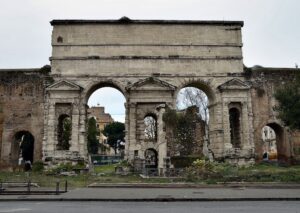
Following is a summary of the tomb discoveries Tabor discusses:

  1. The Ossuary of Yehonatan ben Yeshua (Jonathan son of Yeshua) — This is an ornately inscribed but unprovenanced bone box that came into the possession of Tabor and which awaits publication and return to the collection under management of the Israel Antiquities Authority.
  2. The Ossuary of Caiaphas (summarized above).
  3. The Tomb of Bethphage on the Mount of Olives — A tomb with a circular rolling blocking stone at its entrance. The tomb features early Christian ‘graffiti’ on an internal wall surface. It is suggested by Tabor as a likely candidate for the first (temporary) tomb in which Jesus was laid directly after his crucifixion (not to be confused with the second, more permanent tomb belonging to Joseph of Arimathea as mentioned in the Gospel account).
  4. The Tomb of the Shroud in Hinnom Valley — Located just south of Jerusalem, this tomb was looted when first encountered by Tabor and archaeologist colleague Shimon Gibson. Here, skeletal remains and an intact burial shroud was found within the tomb, a very rare discovery. Also a first, the skeletal remains revealed the deceased suffered from advanced leprosy. The shroud was carbon dated to the 1st century AD.
  5. The Talpiot “Jesus Family” Tomb — First discovered during clearing of the area of Talpiot south of Jerusalem for construction of condominiums in 1980, this tomb contained 10 ossuaries. Six of the ossuaries were inscribed with names identifiable with names known to be associated with Jesus and his family, including the name of Jesus himself.
  6. The Talpiot “Resurrection Tomb” — Discovered just steps away from the “Jesus Family Tomb” and now situated beneath a condominium, this tomb was initially investigated but subsequently re-explored 25 years after its discovery by a team using a robotic arm and camera device. The tomb contained ossuaries with inscribed images and inscriptions relating (by interpretation) to the raising of the dead, or resurrection.
  7. The James Ossuary — This famous ossuary, and the story behind it, featured the inscription, “James, son of Joseph, brother of Jesus”.  It was brought to light in 2002 from an antiquities dealer and from the beginning became the center of a debate firestorm. Recent geochemical studies have shown that the ossuary likely originally came from the “Jesus Family Tomb” described above.
  8. The Ossuary of Simon and son Alexandros — One of a number of ossuaries discovered through excavation in 1941 of a tomb by archaeologists in the Kidron Valley near Jerusalem. It featured inscriptions of the names of Simon the Cyrenian (suggested to be the Simon of Cyrenia of the New Testament biblical account), and his son Alexandros.
  9. The Abba Tomb — This tomb was found just north of Jerusalem in 1970. It is where Abba, son of Eliza the Priest, and Mattathia son of Judah were buried. Tabor suggests that this Mattathia (Matthew) was in fact the last Maccabean (Hasmonean) king, Antigonus (aka Mattathia or Mathew). The ossuary associated with Antigonus contained nails used for crucifixion, along with skeletal remains.
  10. The Tomb of Yehochanan — This tomb was found north of Jerusalem not far from the Abba tomb in 1968. It contained the remains of a man who, based on the evidence found in the tomb, was crucified. The evidence uncovered provided new insights on how individuals were crucified during the Late Second Temple period in Jerusalem.
  11. Cave 2001 at Masada — In the 1960’s archaeologists found 25 skeletons of men, women and children who were once living in a cave at the southern tip of the summit of Masada near the Dead Sea during the time of the famous siege of Masada. Suggested to have been among the defenders of Masada during the siege, Tabor theorizes that they were the remains of what was left of the Hasmonean priestly royal family based on DNA analysis.

Tabor hopes to realize future DNA analysis of embedded residues within ossuaries such as those described here to develop family profiles for further study.

________________________________

The James ossuary. Paradiso, Wikimedia Commons

________________________________

Inscription detail, James ossuary. Paradiso, Wikimedia Commons

________________________________

Aerial view of Masada. Samirsmier, Pixabay

________________________________

For more details about the “Jesus Family Tomb” and the “Resurrection Tomb”, see the article, In Search of the Historical Jesus, previously published in Popular Archaeology Magazine.

________________________________

Advertisement

Uncovering Homer & Troy

Much has been written about the ancient city of Troy, in both the academic and mythical sense. What follows is a brief interview with Dr. Paul Cartledge, a renowned British ancient historian and academic, answering with his take on Homer and Troy….

___________________________
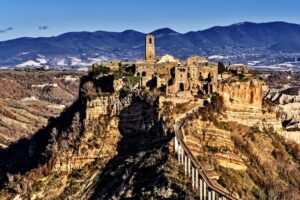
RM (Richard Marranca):Homer was a bard. Can you tell us what the word “bard” means?

Bust of Homer. British Museum, Public Domain, Wikimedia Commons

PC: Behind Homer lies an unbroken succession of oral poets or bards stretching back probably to the 13th century BCE at least. ‘Bard’ is how we translate Greek aoidos, which literally means ‘singer’ (masculine). A poiêtês (again, masculine) was literally (just) a ‘maker’, a craftsman, rather than an inspired creator or creative.


RM: Could Homer’s Troy be based on some actual place and situation – like competition, a battle, war? And didn’t the Hittites refer to Troy (using a different name) in one of their documents? 

PC: Yes, there are Hittite documents of the 13th century referring to a Wilusa – which sounds like the Greeks’ (W)Ilion. And there are other possible linguistic correspondences in the same Hittite records (excavated from their capital at Boghazkoy in central Anatolia not too far from today’s Ankara – and deciphered): e.g., Ahhijawa has suggested to some ‘Achaea’ (Homer never calls Greeks ‘Hellenes’ but ‘Achaeans’ ‘Danaans’ and ‘Argives’), and an individual called Aleksandu may be an equivalent of Greek Alexandros (another name for Homer’s Paris). So, the Hissarlik site [which is identified as Troy by at least some scholars] could have been within the Hittites’ radar – but there’s no corresponding Greek (Linear B) documentary evidence that it was of the Hellenes…


RM: Homer is a real mystery – as is Troy itself. Are the Iliad and the Odyssey by the same author/s?

PC: They are drawn from the same deep well of formulaic epic verse tradition, yes, but only possibly are they by the same master-author/composer, that is, notionally the monumental composer who did a deep dive and came back to the surface with a single theme to unite separately each of the two epics (see above). Experts will tell you that there are differences of not only language but also theological or moral-political outlook between the two, and that may well be so. Experts also themselves differ, not least over the date or dates of the monumental compositions, though most today would I think go for the 8th rather than the 7th (or even 6th) century.


RM: How about the search for what was actual or historical?

PC: As to what was or may have been the – actual, historical – causal nexus or context that underlies the ‘Trojan War’ scenario of the Iliad, it’s perfectly possible to imagine some Greeks coming into conflict with some ‘Trojans’ (northwest Anatolians), perhaps over trade, and just about possible to imagine that the theft of a Greek queen/princess might have been a casus belli, but it’s perfectly impossible to imagine any such trade or diplomatic grievance resulting in… Homer’s Trojan War: ten years’ siege, thousands of fighters and ships involved, most with absolutely no stake of any kind in the successful outcome of such a mega-conflict, etc.

_______________________________
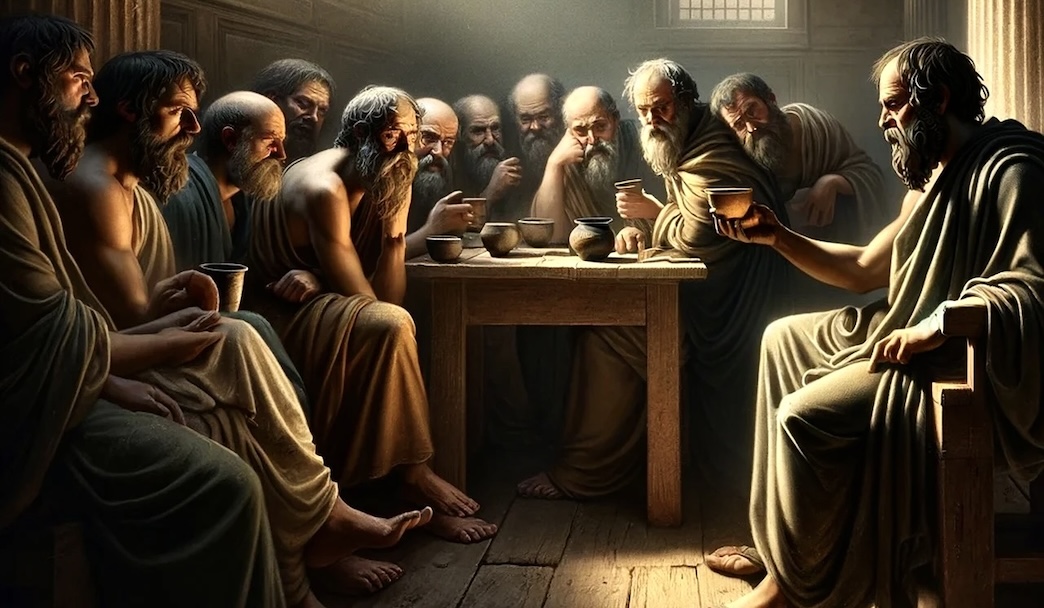
Scene from the Trojan War, as imagined by the painter. Public Domain, Wikimedia Commons

_______________________________

 

RM: Troy, Homer, Heinrich Schliemann – it’s a bit confusing. Can you shed some light on that?

PC: Scholars today argue the toss as between Troy VIh and VIIa for being ‘Homer’s’ city, on the grounds that they’re both about the ‘right’ date (13th century BCE) for the one besieged by Agamemnon & Co. Regardless, not  a trace of evidence has come to light proving, even suggesting, that a Greek siege caused the collapse of either city/level, and there’s general agreement that it was an earthquake or series of them that impacted VIh, anyway. So what Schliemann found – or rather re-found and mostly destroyed – was Homer’s imaginary Troy, not the Trojan War.


RM: So, all those (archaeological) layers – the site of Troy itself – has little relation to Troy? Is there any evidence such as fire and skeletons? 

PC: They have every relation to the ‘myth’ of Troy, that is Homer’s imaginary city (cf. the great 2019 British Museum Exhibition ‘Troy – myth and reality’) but little or none to do with — let’s call it ‘the real’ Late Bronze Age site at what in Turkish is now known as Hissarlik! A small cremation cemetery was found outside the walls, associated with the architectural/urban phase archaeologists call VIh (roughly 13th century BCE), but that’s it.

______________________________
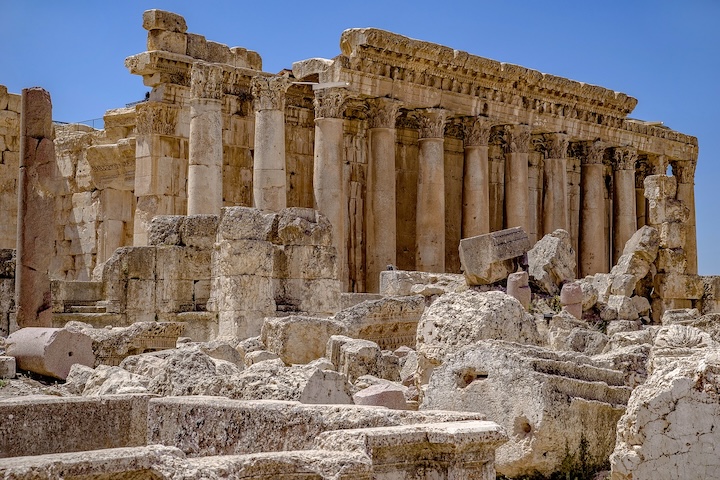
Archaeological site of Hissarlik (‘Troy’). CherryX, CC BY-SA 4.0, Wikimedia Commons

______________________________
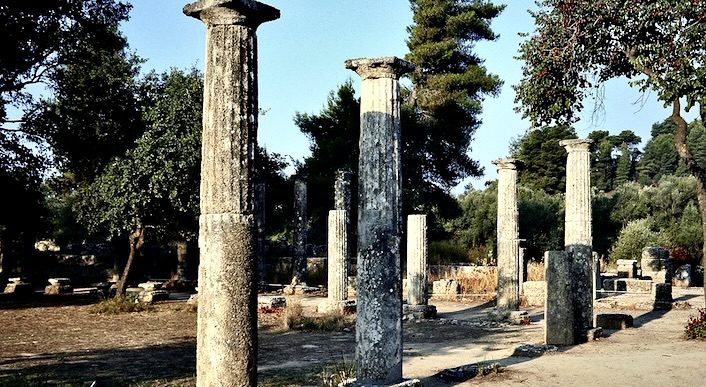
 

RM: Can you speak about some of the early archaeology at Troy with Frank Calvert and Heinrich Schliemann?  

PC: The catalogue of the B.M. exhibition (noted above) has a superb chapter entitled ‘Archaeological Troy’.  There the names of Robert Wood and Charles Maclaren, among many others, are given their due alongside Frank Calvert – as necessary predecessors of Schliemann and his bandits — sorry, team of excavators. Prussian (eastern German) businessman Schliemann set out to prove that Homer was not only an epic poet but in effect a historian, and he did find a site that already the ancient Greeks had identified as Homer’s Troy – they named their new 8th-century settlement nearby Ilion or New Ilion.


RM: Did Schliemann do damage to the site?

Heinrich Schliemann, Ed. Schultze Hofphotograph Heidelberg Plöckstrasse 79, Public Domain, Wikimedia Commons

PC: As to ‘excavation’, well, what Schliemann did beggars the imagination. Driving trenches across and through the tell resulted in incalculable destruction and loss of both artefacts and information. And predictably, Schliemann soon proved himself to be more of a treasure-hunter than archaeologist properly so called, decking out his teenage Greek bride Sophia in what he of course called the jewellery of Helen’.

______________________________
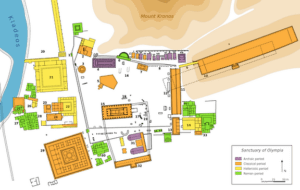
 

RM: And what about that famous mask that he found?

PC: As to the gold so-called ‘mask of Agamemnon’ (found at one of the other major Bronze Age sites he had ‘excavated’, Mycenae in the Peloponnese of mainland Greece), that was several hundred years too old to be the death-mask of any real, historical ‘Agamemnon’, supposing there ever had been any such regal figure.

______________________________
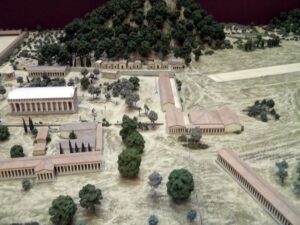
The Mask of Agamemnon. Gautier Poupeau, Public Domain, Wikimedia Commons

______________________________
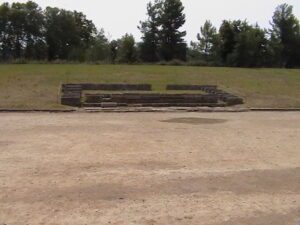
Cover Image, Top Left: Sections of the walls of Hissarlik, or ‘Troy’. Dosseman, CC BY-SA 4.0, Wikimedia Commons

Advertisement

The Evolution of the Human Pair Bond

Brenna R. Hassett, PhD, is a biological anthropologist and archaeologist at the University of Central Lancashire and a scientific associate at the Natural History Museum, London. In addition to researching the effects of changing human lifestyles on the human skeleton and teeth in the past, she writes for a more general audience about evolution and archaeology, including the Times (UK) top 10 science book of 2016 Built on Bones: 15,000 Years of Urban Life and Death, and her most recent book, Growing Up Human: The Evolution of Childhood. She is also a co-founder of TrowelBlazers, an activist archive celebrating the achievements of women in the “digging” sciences.

Our species stands out from the animal kingdom in many ways. Some of them are obvious: we are big-brained primates who use tools and language, a social species with symbols, culture, and art. These are all artifacts of our evolution, the process by which our ancestors found adaptations that allowed them to succeed in a natural world that is often red in tooth and claw. Often, however, we think of evolution as affecting our physical bodies—changing the shape of our hominin ancestors so they could walk upright, or grow bigger brains. But evolution has other ways to act on a species, particularly in clever, social species like ours. It can shape the way we socialize and bond, the way we pass on learning and care, and even whom we love. This is why we find that one of the most remarkable adaptations our species has ever made lies in our very, very unlikely mating system: monogamy.

Monogamy is a strange word and an even stranger concept. The way we use it in our societies today to imply two people romantically linked for life is a far cry from what a scientist who actually observes primates like us would call it. Monogamy, simply put, is pair-bonding between two animals. Often it is pair-bonding with an eye towards reproduction, but it can also include animals that can’t reproduce together who form a pair-bonded social unit anyway. Perhaps the most famous example, though certainly not the only one, might be Roy and Silo, two chinstrap penguins from New York’s Central Park Zoo who formed a pair bond and even raised a chick together. There are other critical differences between what a scientist would define as a pair bond and what we commonly understand monogamy to be.

While humans tend to define monogamy as a once-in-a-lifetime pairing, with rituals and cultural rules that reinforce the idea of a lifetime bond, even the most pair-bonded of animals rarely are pair-bonded for life. Perhaps the most extreme animal monogamists on the planet are the far-flying seabirds albatrosses and petrels (all from the family Procellariiformes); almost every single pair is mated for life. However, even in these pairs, factors can intervene to disrupt the pair bond. Beyond simply losing one member of the pair, even allegedly mated-for-life albatrosses have cases of ‘extra-pair paternity’—almost 10 percent of chicks surveyed in one sample had a male parent who was not their female parent’s partner.

Humans, even those with strong cultural proscriptions against adultery, have very similar rates of extra-pair paternity—about 10 percent. While some cultures, particularly those that do not allow a great deal of female agency in choosing a partner, have slightly higher rates than others, this figure seems to be broadly the same across our species. While genetic monogamy—where two individuals breed exclusively with each other—may be elusive, even in the allegedly monogamous sea birds, social monogamy is not. Social monogamy is the type of pair bonding where the partners fulfill all the social roles needed in a pair bond without necessarily producing any genetic offspring—like Roy and Silo, tending a chick that was not their own. This suggests that it is social monogamy that is the most important part of pair bonding for many species—including our own.

Why would social monogamy benefit a species? It must offer some sort of advantage to our species, or we would not have adopted it—and we have indeed adopted it. Despite our very human flair for variety and adaptation, most societies around the world set a pair-bonded couple at the heart of how their members reproduce. Of course, there are examples of polygamy—marriage of one male to multiple females—and even polygyny—one female to many males in our wide array of cultural practices, but the vast majority of our fellow Homo sapiens will have social expectations of forming a monogamous pair bond.

So why have we evolved to have these bonds? It is not at all automatic that pair-bonds would be of adaptive value. In species that have evolved to sexually reproduce, the distribution of risk and reward for breeding behavior depends on how much each partner will need to invest in reproduction in order to produce a successful offspring. For the partner that makes the small gamete (sperm), investment costs are lower from the get-go, meaning strategies that maximize opportunities for reproduction. In fact, pair bonding is an incredibly rare phenomenon in the animal kingdom. Outside of birds, who are uncommonly fond of the state—90 percent of bird species create pair bonds—only 5 percent of animal species settle for ‘the one’ and form pair bonds. About 15 percent of primates, however, opt for pair-bonding.

Here we can start to unravel part of the mystery of the human pair bond, by examining what our other clever, social primate relatives use pair bonding for. The evolution of monogamy, or pair-bonding, has been a topic of major debates in anthropology and primatology. Most of the primate species that form pair bonds are actually quite distant from our species evolutionarily—the smaller monkey species like the marmosets, titi monkeys, and owl monkeys. Many of the original investigations of primate monogamy sought to explain the phenomenon in very Darwinian terms, looking at the advantage in genetic terms gained by reproducing monogamous pairs. In the 1970s, primatologist Sarah Hrdy suggested that pair-bonding might have evolved to be protective against infanticide because marauding male monkeys would not be motivated to harm their own genetic offspring but would be motivated to remove any offspring from a group that were not theirs.

This interpretation has been challenged in more recent times, particularly by anthropologist Holly Dunsworth. She argues that the kind of cognitive power required for a primate to understand whether offspring is genetically theirs or not is just not present in primate species. Perhaps pair-bonded species don’t have infanticide not just because the male primates are trying to maximize their genetic reproductive potential, but because primates are social animals and those male primates are simply primed to be ‘nice’ to the offspring of the females they are bonded to.

Current theories for why pair bonding exists, even though it doesn’t allow male primates to maximize their mating opportunities, follow several lines of evidence to understand what the actual adaptive benefit might be. One theory is that pair-bonding is the only way for males to keep up with females who roam over large territories; it allows them the opportunity to mate because otherwise, they wouldn’t be able to encounter any females. This is something that seems particularly applicable to the smaller monkeys like marmosets, where females hold territory.

Another theory for the evolution of pair bonding in primates looks at the reproductive benefit not just to the individual parent, in terms of the number of offspring possible, but to the effects on the next generation of having one more pair of helping hands. This looks at the net benefit to the offspring itself of having two parents provisioning it. In many species of primates, the offspring are helpless and a considerable burden on their carer. Having another pair of hands around may make the difference between growing an expensive, big-brained baby and falling out of the evolutionary race. Looking again at examples from the primate order we can see that the role of the male parent can be critical in the survival of the species—our male titi monkey will carry his offspring for the first year of their life, until they are old enough to move around on their own.

What does this mean for our own species? Well, we definitively have adopted a pair-bonded architecture—social monogamy is at the core of our societies. Why we have done so is less clear—but as more and more work is done on understanding the benefits of monogamy to a species we see that there are several factors that may have influenced our ancestors’ choices to develop such an outré mating system. In fact, monogamy in primates seems to have evolved multiple times, and for multiple reasons. Computational models that have examined the likelihood of different evolutionary explanations have used these multiple evolutionary episodes in our nearest relatives to predict that, for humans, multiple factors may have given us the monogamy we have now. Adaptations to pair bonding that ensure males meet roving females might have been a stepping stone to developing the kind of multiple-parental care that keeps something as extraordinarily demanding as a human baby alive. So while our cultural perceptions of monogamy might not fit the evolutionary reality, we can say that as a species, we are awfully fond of a pair bond.

This article is a re-publication from the original source: Human Bridges, a publication of the Independent Media Institute, under a collaborative agreement.

Excavating & Drawing in Oaxaca: Discussions with Archaeologist Guy Hepp

Editor’s Note: Following is an interview conducted by Richard Marranca of archaeologist Guy Hepp, who is Associate Professor of Anthropology at California State University, San Bernardino. Dr. Hepp has been involved in research related to the ancient people of Oaxaca, a atate in southwestern Mexico. Oaxaca has a rich history of human occupation going back as far as 11,000 years ago, though it is best known for the ancient  Zapotec and Mixtec civilizations……….

_______________________________
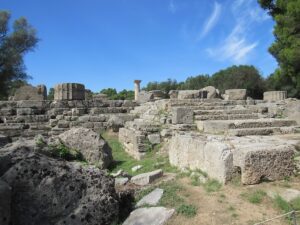
Part 1

RM (Richard Marranca): Hello Guy. It’s been a few years since we first met in Oaxaca and did the interview. I take it you recently returned from Tututepec? Can you tell us about this place and the Mixtecs?

GH (Guy Hepp: It’s great to hear from you, Richard. Yes, I volunteered on a project at Tututepec in 2022, directed by my good friend Marc Levine from the University of Oklahoma. This was coming full circle, for me, as Marc’s dissertation project in Tututepec in 2005 was my first experience in Oaxaca. Tututepec is both an ancient site and a modern town on the western Pacific coast of Oaxaca. It was the capital of a coastal empire stretching from near the Guerrero border to roughly the Isthmus of Tehuantepec during the late Postclassic period (1100–1522 CE). It is still the county seat in the region (largely for symbolic reasons) and one can still hear Mixtec spoken there, particularly by the older residents. There’s much to tell about Tututepec, including its founding by the famous hero-king Lord 8-Deer “Jaguar Claw,” whose exploits are recorded in the preserved Mixtec codices, but I refer you to research by Marc and others for the details.

RM: Can you say a few things about the excavation and ongoing research?

GH: I don’t want to spill the beans on Marc’s project, as this is his research area and he was kind enough to have me join his project as a volunteer. In addition to helping with the excavations, my focus has been on the ceramic figurines from the site. As I discuss below, figurines have been a specialty of mine since my MA project, completed in 2007. Marc has a wonderful relationship with the modern Tututepec community and an ongoing collaboration with the Museo Yucusaa, the town’s community museum. His research questions focus in part on craft specialization at the household and neighborhood levels. Tututepec is a fascinating inversion of a familiar trend. Rather than a large modern city crowding around archaeological ruins, the modern town has dwindled due to a shift in the population out of the defensible piedmont and onto the coastal plain below, where the local stretch of the Pan-American highway was built. As a result, modern Tututepec is dwarfed and surrounded by the terraces and preserved foundations of its ancient footprint. Marc has excavated in different parts of the site with the hopes of better understanding the economic specializations among the different households and neighborhoods and how those factored into the local economy.

RM: Is your focus the ceramic figures? 

GH: I did a study of Formative period (2000 BCE – 250 CE) ceramic figurines from coastal Oaxaca for my MA thesis and have retained an interest in them in my subsequent work. Though an art history professor of mine would remind me that art need not directly mirror reality, I still find anthropomorphic (human-shaped) figurines one of our best ways to get a glimpse of how people in the past dressed and thought of the human body and identity. And yes, one of my favorite things about studying such figurines is that they give me an excuse to do scientific illustrations, which were my first entrée into professional archaeology when I was a high school student. Marc and I agreed that we would collaborate on a study of the Late Postclassic period figurines from Tututepec, as these are poorly understood but show some indications of widespread interactions and shared practices in Mesoamerica in the last few centuries before the arrival of the Spanish.

RM: Do archaeologists draw things or is that a specialized branch of artist-archaeologists? I recall a few Egyptologists who started out that way?

GH: Most archaeologists hire professional artists for their artifact illustrations and reconstruction drawings, though they might make their own schematic drawings of things like ceramic vessel profiles. Scientific illustration just happens to be a way I can bring two of my interests (art and archaeology) together. In fact, for me, archaeology is a wonderful sort of compromise that allows me to bring together my loves of writing, art, travel, music, teaching, and studying the past. Usually, I do pen-and-ink artifact illustrations using a standardized stippling technique. Later, I digitize these for publication. I’ve also done paintings such as an oil painting reconstruction of the ceramic vessel assemblage recovered from the Early Formative period (2000–1000 BCE) site of La Consentida during my dissertation project.

_______________________________
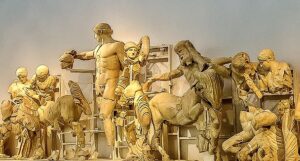
Painting of the Tlacuache ceramic complex by Guy Hepp.

_______________________________
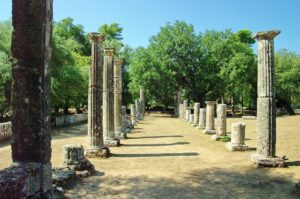
RM: Do you generally draw objects from excavations and is that part of your job?

GH: I usually do illustrations of objects that are iconographic, meaning they bear decorations that I think may be useful for interpreting something about ancient beliefs, identity, or social practices. These artifacts may come from museums or excavated contexts. While museum examples may be more complete, they frequently lack the contextual information of excavated examples, which can help us better understand the roles they played in the past. Formal illustrations are still useful in the era of digital imagery because they can help us depict subtle surface details of objects, even eroded ones, that otherwise might just look like a blob in a photograph. Publishers tend to like these illustrations because they’re eye-catching, can convey a lot of information, are cheap to print, and don’t require color. When pigment is part of the decoration of an object, of course, we need to find a way to indicate that in the illustration or use photography in that instance. I began doing artifact illustrations for pay as a high school student (my first archaeology job) and have since done pro-bono illustrations for friends and colleagues just because I love to do it and it gives me a chance to work with some truly amazing pieces, such as a stone rain deity mask I illustrated for my friend Jeff Brzezinski’s project. From a copyright perspective, artifact illustration also gives me the chance to show imagery from other research projects or artifacts whose whereabouts are unknown without worrying about image permission. I simply re-draw the object and cite the source like a bibliographic citation, since the artwork is mine.

______________________________
Above and below: All artifacts illustrated here are from the Early Formative period (2000–1000 BCE) village site of La Consentida, Oaxaca, Mexico. Based on radiocarbon dates from the site, most probably date to about 1850–1500 BCE, specifically. All dates are calibrated. Figure above: Figurine depicting possible ballplayer with protective belt and broken tripod support for standing and repositioning. Image courtesy Guy Hepp.

______________________________
Playable bird instrument (ocarina) from ritual cache. One of the oldest known ceramic musical instruments in Mesoamerica. Image courtesy Guy Hepp.

______________________________
Head of a crested bird instrument (whistle or ocarina) with smoothed interior surface from resonating chamber. From early platform fill layer near human burials. Image courtesy Guy Hepp.

______________________________
Part II

RM: Your essay, Landfalls, Sunbursts, and the Capacha Problem: A Case for Pacific Coastal Interaction in Early Formative–Period Mesoamerica, is wide-ranging and fascinating. So, there are objects in Mesoamerica that show influences from far away in S. America? Can you speak about this long network of exchange?

GH: When the Spanish arrived in the 16th century, they recorded long-distance expeditions of merchants using balsa rafts and traveling between distant coastal points in Ecuador and West Mexico. This exchange network is still not fully understood but has been replicated with experimental archaeology, studied with complex charts of offshore currents, and is likely responsible for the broad distribution of spondylus shell jewelry and some metallurgical techniques, including lost-wax casting, which seem to have been imported to Mesoamerica from South America. In the paper you’re referring to, I argued based on pottery decorations (particularly a motif sometimes called the “sunburst”) as well as basic ceramic forms and patterns of human dental modification, that this interaction network can be pushed much further back, to approximately 3,500–4,000 years ago.

This would explain why early ceramics in western Mesoamerica are dissimilar to those found closer to Central America, in a region called the Soconusco. It would also suggest that there were two ancient sources of Mesoamerican pottery traditions, one stemming from Central America and the other from northern South America by way of this Pacific coastal maritime route. This is a bold claim, but it actually revives work in the mid-20th century by scholars such as Isabel Kelly, who predicted by at least as early as the 1970s that we should expect to see evidence along the Pacific coast of “landfalls” by participants in such a network connecting South America and Mesoamerica. This project was fantastic to work on because it combined ceramic analyses from my dissertation work in Oaxaca with opportunities to visit some of the oldest pottery in the Americas (called Valdivia) in Ecuador and the Capacha phase ceramics of West Mexico. My paper was part of a larger research collaboration with scholars working mostly in later periods, and there’s much more to do. Linguistic evidence, for example, would be a strong way to support such an argument.

RM: Where did the shapes and objects first appear in S. America?

GH: This is a fascinating area of emerging research and one in which I’m not an expert. The Valdivia ceramics of the Pacific coast of northern South America are some of the oldest in the hemisphere but there are even older ceramics that are poorly understood from elsewhere in South America, including in the Amazon. If some of the earliest ceramics and complex communities existed in the Amazon rainforest, they are difficult to trace now, in part because of the highly acidic sediments of the forest and a lack of extensive study there.

_____________________________
Valdivia bowls with labyrinth pattern, Museo Casa del Alabado, Quito, Ecuador. Marsupium, Creative Commons CC0 1.0 Universal Public Domain Dedication, Wikimedia Commons

_____________________________
I’ve seen it suggested by a Brazilian scholar that the Amazon rainforest itself is not a primordial, natural phenomenon but rather the remnants of an anthropogenic garden landscape long curated by native peoples to emphasize cultivation and support village life. We have so much more to learn about ancient human influence in the Americas and the true early origins of the Anthropocene.

RM: Were historians and archaeologists of past generations aware of this long-distance bartering and exchange?

GH: Arguments for long-distance trade and interaction were very common in archaeology throughout most of the 20th century. These fell from favor after about the 1970s and were replaced by an emphasis on local developments of many technological innovations. Without discounting the ingenuity of local populations to develop their own traditions and goods, I am in a camp of scholars who think that this theoretical pendulum shift away from “diffusionist” arguments may have been an over-correction. The baby was tossed out with the bathwater, so to speak, and we now tend to underestimate the abilities of ancient people to travel, navigate, communicate, and exchange goods and ideas across long distances. Calling me a “neo-diffusionist” might be going too far, as I think we always must remember that local people will adapt ideas from elsewhere to their own needs. I do think that we must follow the evidence, though, even when it suggests that people of the past surmounted daunting obstacles.

RM: Can you tell us about your upcoming plans for research in Oaxaca?

GH: I’ve recently submitted a grant proposal to return to coastal Oaxaca to study La Consentida, the Early Formative period village site where I did my doctoral dissertation work. If approved, this new study would take place over at least three seasons and include excavations at La Consentida, more excavations and mapping at a neighboring site called Cabeza de Vaca, and the first of what will likely be several seasons of laboratory analysis of the artifacts and other materials we recover. La Consentida, and likely also Cabeza de Vaca (based on some artifacts found at the surface) were among the earliest settled villages in Mesoamerica. Radiocarbon dates for La Consentida, for example, indicate that the site was occupied between about 2000 and 1500 BCE, which was a time of fundamental changes in Mesoamerica including the establishment of settled villages, a shift toward the first complex social hierarchies, and an increasing reliance on domesticated foods such as maize. Whereas the goal of my dissertation project was to gather as much information as possible about the broad topics of social organization, settlement practices, and ancient diet, my goals for this new project will intentionally be much narrower. The team and I (it will be a collaborative endeavor) will focus on remnants of domestic contexts, particularly houses and their associated refuse. We hope to better understand the social units (or “households”) that occupied the homes of Early Formative period coastal Oaxacan communities to question decades-old assumptions about gender roles, the organization of the family, and in general the social units that populated these settlements. For decades, researchers have assumed that the house in early Mesoamerican villages was the domain of women and that public space was reserved for men. But ethnohistoric evidence from Oaxaca describing the public and political activities of women and collectives, as well as the ubiquity of artifacts gendered “feminine,” such as figurines, really throw this into question in my opinion. At the very least, these old assumptions, which may say more about 20th-century Western society than they do about the Early Formative period, should be crafted into testable research questions.

For my dissertation project, I was in coastal Oaxaca multiple times, the longest of which had me living in a small coastal town for 10 months. Since my wife and I recently had a baby, and because I have teaching responsibilities during the academic year, I am hoping that this new targeted approach will help us address some very specific (but fundamental) research questions and take place in shorter, concentrated visits to coastal Oaxaca so I can still be a good dad at home!

________________________________
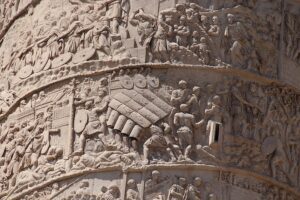
Guy Hepp is an Associate Professor of Anthropology at California State University, San Bernardino. He holds a B.A. and a Ph.D. from the University of Colorado at Boulder and an M.A. from Florida State University. His research is focused on early complex societies of Mesoamerica and especially the archaeology of La Consentida, an Early Formative period (2000–1000 cal BC) village in Oaxaca, Mexico. This project, funded by the National Science Foundation and the Fulbright Program, was awarded the Society for American Archaeology’s 2016 Dissertation Award. In 2019, Hepp published a book based on his dissertation with the University Press of Colorado. He recently co-edited another book with the University Press of Florida and has authored publications about mortuary archaeology, paleoethnobotany, interregional interaction, radiocarbon dating, heritage politics, ceramic figurines, musical instruments, masks, and the archaeology of the senses.

________________________________
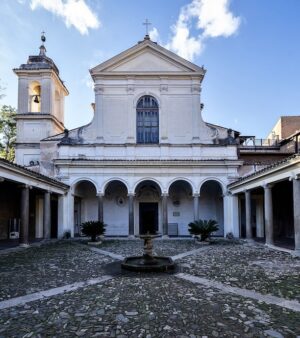
Advertisement

See the incredible archaeology, architecture, and art of northern Spain. A unique tour with special expert guides and lecturers through the collaboration of Popular Archaeology Magazine and Stone & Compass Tours. Not to be missed. Read More About It: https://popular-archaeology.com/article/northern-spains-triple-a-archaeology-architecture-and-art/.

________________________________
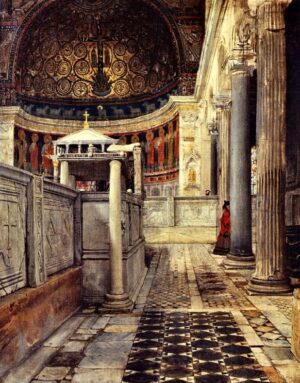
National Geographic Wayfinder Award Recipient – Aliaa Ismail and the New Era of Techno-Archaeology

You may recognize her from several documentaries such as Lost Treasures of Egypt, Unearthed and others. Egyptologist Aliaa Ismail of Factum Arte is a proud recipient of the National Geographic Wayfinder Award. She was previously awarded the Future 50 Leaders Award in 2022 by the Project Management Institute for using new technology to preserve ancient historical treasures. This award holds the promise of a continuing cooperation with her projects in the future as she is now an honorary NatGeo society member. 

Like Sarah Parcak’s revolutionary use of LIDAR satellite scans to locate thousands of settlements and 17 previously unknown pyramid sites throughout Egypt, Aliaa is part of an exciting, new wave of guardians with a clear vision, embracing the latest technology to transform the field of archaeology for the better. These guardians of ancient Egypt devote their entire lives to researching, discovering, preserving, and educating the masses on the importance of one of humanity’s most impactful cultures.

In a world embattled by climate change, fragile ancient sites in Egypt can be destroyed in an instant and lost forever. Aliaa’s ongoing projects of creating 3D replicas of these important ancient sites makes them accessible to all, amplifying their importance on a global scale. To create the replica of King Tutankhamun’s tomb and Seti I, Aliaa (pictured left) and her Egyptian team of conservators utilized a variety of high-tech tools to collect the massive data necessary to forge an exact replica. For example: portable chemical imaging technology and X-ray fluorescence in chemical imaging technology were implemented to help uncover changes made in Egyptian tomb paintings by the original artists thousands of years ago that may never be noticed through plain eyesight. Additionally, hyperspectral imaging analyzed the painting on multiple wavelengths, such as ultraviolet or infrared, revealing more secrets than are visible to the human eye.

Before Factum Arte’s Theban Necropolis Preservation Initiative (TNPI) was given permission to scan these tombs, the process of analyzing one tomb could take an average of 10 to 15 years. Now, the new digital tools and technological advances help shave years off the process.

_____________________________
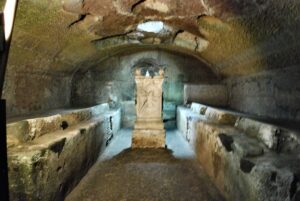
An Interview with Aliaa

EV (Eric Vasallo): What current projects are you working on and have you received the permit to begin documenting Nefertari’s tomb yet?

Aliaa: We have been waiting for years for permits in order to begin scanning and documenting Nefertari’s tomb as well as Ay’s (Tut’s successor) tomb. It is currently in pending status. I am hopeful to get good news next year and that this award will aid in this process of granting permission to continue our conservational work. 

EV: Nicholas Reeves formulated his theories for discoveries of potential doorways behind the painted plaster walls of Tutankhamen’s main burial chamber using Factum Arte’s scans of Tut’s tomb. What other discoveries have been made during your projects while photographing and documenting the minute details of tombs?

Aliaa – Belzoni made wax and plaster casts of Seti tomb in the 1800’s to make a facsimile to show in an expo in London. Those marks are still visible in their scans – those casts with the original traces of ancient paints. His replica has been lost to time and is most likely hidden in a London basement somewhere. 

My team and I are still processing the monumental amount of high-resolution data collected from Seti tomb and hope to create a partial replica to be permanently housed inside the new Grand Egyptian Museum (GEM).

_____________________________
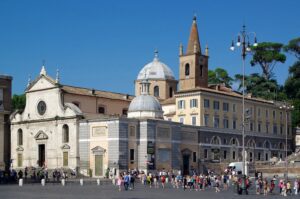
The team at work.

_____________________________

The team together.

_____________________________

EV: Does the Theban Necropolis Preservation Initiative (TNPI) anticipate any benefits toward your pursuits in utilizing Artificial Intelligence (AI) possibly to collect and interpret data faster than via human intervention? Where do you envision that technology being implemented in your field?

For Factum Arte’s VR tut experience their high-res data had to be downgraded to create the VR experience as these technologies work with low-res files.  So AI promises to connect their high-res data to incorporate into a more detailed and immersive VR experience. 

EV: What was the inciting event if any that led you to where you are today? What sparked your interest to become an Egyptologist?

Aliaa- I was born in Cairo, Egypt but my family soon moved to South Africa for work, and I essentially grew up in Lesotho not knowing anything about ancient Egypt. I was disconnected from the rich cultural past of my country. I enrolled in the American University at Cairo and originally planned to go for some architectural or engineering degree like my father and an elective came up which was a class on ancient Egypt taught by none other than Salima Ikram. She was amazing and after that class, it opened my eyes and I never looked back. I was 100 percent committed to passionately pursuing a career as an Egyptologist. 

EV: If you had a billionaire ready to invest in your work, what dream preservation project would you embark on? 

Aliaa – My dream would be to implement a program as a way to educate and empower local communities to learn of the importance of these neglected ancient sites, because these local people are ultimately the caretakers of the sites. This is why grassroots activism is so important to ignite interest and a love for these ancient sites to preserve them for generations to come instead of falling into obscurity and neglect. Looters, for example, always come from other cities. They are not locals. These local Egyptians that I train, will sustain the conservation after the grant money runs out. I always reinforce to them the importance of preserving an artifact and how the information held inside the artifacts is lost when it is sold on the black market.

EV: You were also given this award for your Green Desert Project, where you and your spouse have restored arid desert to its original green, fertile state. Where are you with this project?

Aliaa- The Green Desert project was started by my husband Abdo Ghaba’s father, Mohammed Hassan Ghaba on the West Bank of Luxor with a crop of wheat, hibiscus, peanuts, onions, date, and sycamore trees. He had a vision to restore fertility to the desert. Egypt in the 50’s encouraged people to settle on agricultural land and because of that shift, desertification has been encroaching across the country. In what used to be one the of the world’s most abundant bread baskets, today Egypt cannot feed itself without importing grain. The project is fully green. We use solar panels and deep well water which was very expensive to accomplish. We have successfully experimented with Guava trees, clover, and wheat crops. The Green Desert Project is self-funded, and plans are to start a crowd funding campaign to fund further work towards the project’s goal of planting 10,000 trees. The hope is to start a national, government sponsored project of increasing agricultural production nationwide. In the meantime, I am focused on nursing my newborn baby boy, Suleiman, named after a prophet. 

____________________________

The Future

Technology is fast transforming the field of archaeology. Just this month, the first discovery using Artificial Intelligence was made in Peru’s Nazca lines. AI was able to recognize hidden geoglyphs previously invisible to the naked human eye.

Deep learning can simulate the behavior of the brain, learning large amounts of data. It is a driver of AI capable of performing analytical and physical tasks without human intervention and currently lies behind everyday products like digital assistants (Siri, Alexa) or self-driving cars. Deep learning can aid archaeologists in deciphering lost languages that have eluded scholars for decades. It can also quickly piece together artifacts in museum storage across the world and create a 3D virtual model for researchers to study. For example: there are thousands of cuneiform tablets yet undeciphered or translated in museum storage spaces. If you teach the Deep Learning AI how to translate the language held in the tablets it can quickly scan and translate the thousands of fragments, piecing them together in a fraction of the time it would take a human. The technology is not as “smart” thus far and would require human moderators to check the data it produces, but it still holds the potential to save money and time for scholars in the field.

One problem created by these new technologies spurring discoveries of ancient sites is that it is outpacing the authorities’ ability to care for them. The flipside is these new technologies can help lower the costs of excavation and make them less destructive with more powerful scanning tools.

Some academics estimate that over 60% of Egypt’s sites and artifacts are still hidden underground. If true, Aliaa and the other guardians in this new wave of techno-archaeologists will assure that the antiquities are excavated, protected and carefully preserved for future generations of humans to learn and understand the complexity of the civilizations that have given us meaning and changed our evolutionary path.

It is poetic justice for Aliaa’s mission, who once was a young, disconnected Egyptian herself, unaware of the importance of the ancient Egyptian civilization to humanity, to now actively re-engage and train a small army of local Egyptians, educating them about their priceless cultural heritage. 

“If you are thinking 1 year ahead, plant seeds
If you are thinking 10 years ahead, plant a tree
If you are thinking 100 years ahead, educate the people.”

 —- Chinese Emperor Kuan Tsu, 5th century BCE

Like a seed dropped into black fertile Nile soil, Aliaa Ismail is planting seeds for the future by educating and empowering her fellow Egyptians. Like the Ancient Egyptians in their quest for immortality, she has found a way of continuing her guardianship of Egypt’s rich cultural heritage for generations to come.

Join us in congratulating this pioneer transforming her field to a high-tech future. We certainly can’t wait to see what she accomplishes next.

Emerging technology such as LIDAR satellite scanning, Artificial Intelligence, and Deep Learning are already transforming the field but don’t expect archaeologists to hang up their trowels or brushes any time soon. They will be adding these tools to their arsenal, taking the field well into the future.

What will archaeology look like in 2030 or beyond?

_______________________________
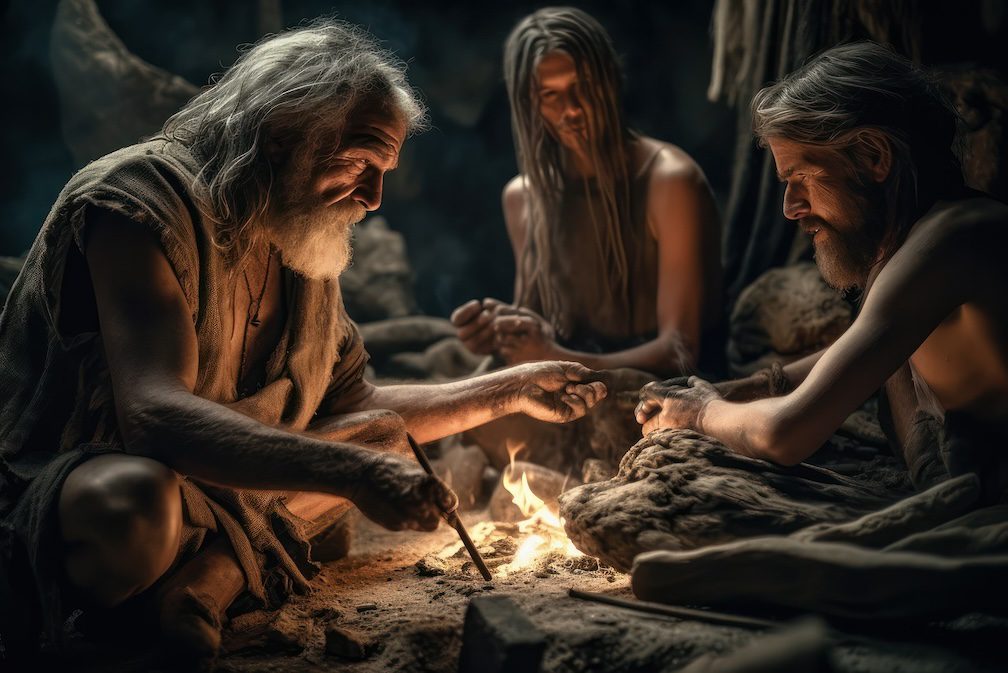
Sources

Wayfinder Award recipients:  https://blog.nationalgeographic.org/2023/05/31/the-national-geographic-society-announces-the-2023-wayfinder-award-recipients/

Space archaeologist using lasers from space to discover lost ancient sites:
https://bigthink.com/the-present/ted-prize-winner-sarah-parcak-uses-satellites-and-the-wisdom-of-crowds-to-revolutionize-archeological-exploration-and-preservation/

Discovery made utilizing AI:

https://news.artnet.com/art-world/nazca-geoglyphs-peru-ai-2316856

Belzoni’s facsimilie of Seti I’s tomb in 1821 at the Piccadilly Exhibition in London:  https://www.researchgate.net/publication/30957073_Giovanni_Battista_Belzoni’s_exhibition_of_the_reconstructed_tomb_of_Pharaoh_Seti_I_in_1821

The Archaeology Podcast – discussion on how AI is transforming the field of Archaeology: 
https://podcasts.apple.com/us/podcast/the-archaeology-show/id1168248976?i=1000622805422

______________________________
Advertisement

See the incredible archaeology, architecture, and art of northern Spain. A unique tour with special expert guides and lecturers through the collaboration of Popular Archaeology Magazine and Stone & Compass Tours. Not to be missed. Read More About It: https://popular-archaeology.com/article/northern-spains-triple-a-archaeology-architecture-and-art/.

______________________________

Petrarch…The Original Latin Lover

Professor Frank J. Korn has retired from his teaching position on the Classical Studies faculty at Seton Hall University.  He is a Fulbright Scholar at the American Academy in Rome and the author of nine books on various aspects of the Eternal City.  He is listed in Marquis Who’s Who as “a notable classical educator and writer.”  Recipient of the Princeton Prize for Distinguished Teaching, he resides with his wife Camille in Scotch Plains, N.J.  The couple’s three sons –  Frank, Ronald, and John and their families live nearby.  His latest book    Below Rome, the Story of the Catacombs    which he co-authored with his wife, is available on Amazon or from the publisher, St. Johann Press, Haworth, N.J.

His storied life was dominated by two enduring loves: one of the heart, the other of the mind. The stunningly beautiful Laura was the object of the first; the romantic mystery of long ago Rome, the second. Both held him in thrall throughout his earthly days.

Born to a Florentine exile and his wife at Arezzo in Tuscany on July 20, 1304, Francesco Petrarch spent much of his boyhood in Avignon in Provence, in the south of France. In the schools there he was introduced to the Latin language, a subject to which he would remain passionately attached until his last breath. (Literally! As we shall see in due course.)

When his dear mother died in 1318, the precocious teenager mourned and honored her with exquisitely composed Latin verses of his own. By this time he was spending most of his time and all of his allowance tracking down the scarce copies of works by ancient authors. His father, an attorney, disdained his son’s feverish interest in such things as a waste of time and packed him off to the nearby University of Montpelier for law studies.

Some months into Francesco’s first term, the elder Petrarch, aiming to check up on his reluctant law student, paid a surprise visit to Francesco’s tiny, cluttered room. When the cranky parent spotted a volume of Vergil’s Aeneid and one of Cicero’s Rhetoric on a shelf, he angrily tossed both into the blazing fireplace. With the heartbroken young man reduced to sobs, the father was moved to rescue the two badly charred treasures from the flames.

By the year 1326, out from under his father’s thumb, Francesco had put aside all thoughts of a legal career and had turned his focus on becoming a published poet.

On Good Friday, April 6 of the following year, while attending services at the Church of Sainte Claire in Avignon he breathlessly beheld for the first time the lovely Laura who would become his version of Dante’s Beatrice who, sadly for the Divine Comedy composer, was already married. Dante had to resign himself to the cruel fact that his ardent love for one he considered the ideal of womanhood    beautiful, intelligent, dignified, modest, gentle, charismatic, with an air of mystery    would have to remain forever Platonic. He had to console himself with a collection of panegyrical poems to her, under the title La Vita Nuova.

The opening verses tell us much about the depth of Dante’s feelings:

Tanto gentile e tanto onesta pare la donna mia quand’ella

altrui saluta ch’ ogni lingua deven tremando muta e li

occhi no l’ardiscon di guadare…e par che sia una cosa

venuta da cielo in terra a miracol mostrare.

….

(She seems so honest and kind my lady when she greets

others that every tongue becomes tremblingly mute

and eyes dare not even glance at her,,,and it seems she

may be something come from Heaven down to earth

miraculously.)

Like Beatrice, Petrarch’s heartthrob was also wed by now, leaving him with nothing but a burning, unrequited love. Unlike Beatrice, however, who stood aloof and denied Dante even a passing glance, Laura — while remaining ever faithful to her marriage vows    managed, even if perhaps unwittingly, to keep alive the love and ambition of the young Petrarch by her grace and warmth and smiles.

______________________________
Laura and Petrarch. Sandra Cohen-Rose and Colin Rose, Creative Commons Attribution 2.0 Generic, Wikimedia Commons

______________________________
The young man softened his bitter disappointment by resolving to love her from afar, and immortalize her through his pen, making Laura the central figure of his Canzoniere, a vast harvest of 366 ardent love sonnets, written in Italian.

In one poem he tells of his first sighting of the woman of his dreams:

Ov’ Amore co’ begli occhi

cor m’ aperse

…e la’ v’ ella mi scorse

nel benedetto giorno

….

(Where Love opened my heart

with those lovely eyes

…and there where she noticed me

upon that holy day.)

In another, he depicts the object of his affection in an enchanting bucolic setting, seated on a sun-washed Spring day beneath a tree beside a murmuring brook:

Da bei rami scendea

(Dolce nella memoria)

Una pioggia di fior sovra il suo grembo.

Qual fior cadea sul lembo

Qual su le trecce bionde.

….

(From the beautiful branches there dropped

…How sweet the memory –

A shower of blossoms on her.

Some fell on her apron,

Others upon her blond tresses.)

…………………………

Meanwhile, his love of ancient literature was also growing ever more intense, taking him on long journeys in search of his idols    Vergil, Ovid, Horace, Livy, et al. The works of the fabled Roman authors, you see, had slipped into neglect and abandonment with the fall of Rome. The barbarian invaders had rampaged through the old empire, destroying everything in their path, among which were libraries and other centers of scholarship. The precious and priceless writings of the Classical Age virtually perished in this madness. The study of and interest in Roman literature had withered away, but Petrarch [portrait drawing, left] dedicated himself to doing something about it. For this, all Latin professors and their students, ever since, owe an enormous intellectual debt to him.

Never truly at ease in the world into which he was born, Petrarch sought to live among his friends of Classical Rome. In Latin literature he found ideals of truth and beauty, which he exhorted the whole Western World to reclaim. The wonders of antiquity clutched at his very soul. The past, he insisted, was the road to understanding the present and preparing for the future. He felt that the decline of humanity in Medieval times could be ascribed to mankind’s severance of ties to its own glorious past. Thus he thought it called for a renewal of knowledge that tied the present to antiquity. Consequently, he encouraged and fostered a return to primary sources by way of the study of the works of those long ago authors.

A tireless wandering classicist, he traveled throughout Italy and other parts of Europe in his quest for old manuscripts, however tattered they might be. He followed up rumors, chased down leads, made endless inquiries, bought shabby, worn codices at any price. Francesco even had friends and mere acquaintances on the lookout as well, urging them to forage among the bookshelves of monasteries, seminaries, academies, and other centers of learning. Driven by his unquenchable thirst for knowledge, he would read, annotate, and refurbish every treasured acquisition and then make multiple copies.

At Liege in Belgium he thrilled to his discovery of a dusty, cobwebbed copy of Cicero’s defense of Archias. During a sojourn in his native Arezzo, he stumbled upon a badly battered but still legible text of Quintilian. In Mantua he found Pliny’s Natural History. But it was in Verona, birthplace of Catullus, that Petrarch made the supreme discovery of his life. While scouting every nook and cranny of the cathedral library there, he unearthed from a huge pile of crumbled and crumpled old tomes a collection of Cicero’s Letters to Atticus, as well as monastic reproductions of the statesman’s correspondence with Quintus, his kid brother, and with Brutus. Petrarch’s tenacity was paying off. He was ecstatic!

These letters afforded glimpses of the social life of Rome in the first century before Christ. They also shed much light on the pulsating political landscape of the dying Roman Republic, and on Cicero’s complex personality.

The quintessential scholar pored over every line in an all-out effort to know Cicero like a living, breathing friend. The similarities between the two writers    separated by thirteen centuries  – were numerous and noteworthy. Both were sensitive, cultured, idealistic, humane men of letters. Both were practitioners of an elegant florid style. Both sang the praises of the old Republic. In fact, Petrarch hoped to live to see the day of its resurrection.

Coming to the conclusion that genuine correspondence on everyday matters constituted a literary genre of its own (i.e. letters addressed to private individuals but meant for a public readership), he suddenly developed an itch for letter writing. He honed his skills by penning long rambling open messages, in Latin, to his contemporaries and to his fellow literati from old Roman times such as Horace, Ovid, Vergil, and Livy. And of course, Cicero.

Here are the opening lines of his first of two letters to him:

Franciscus Ciceroni suo salutem.

Epistolas tuas diu multumque

perquisitas atque ubi minime

rebar inventas, avidissime perlegi

….

(Greetings from Francesco to Cicero,

I have read most eagerly

your letters which I had sought

for such a long time and found

them where I least expected to.)

Petrarch continues, sometimes lauding Cicero for his decency, his intellect, his eloquence etc., but more often calling him out for his shortcomings:

“Now perhaps it’s time to listen to someone else’s advice and constructive criticism, to a fellow writer, that is, who greatly

admires you and treasures your very name.”

Petrarch goes on to mention, in passing, many of Cicero’s important and influential friends such as Pompey, Brutus and Octavian    and bitter foes such as Julius Caesar and Marc Antony.  He chastises Cicero for his tendency toward inconsistency and even pettiness:

In one breath you speak glowingly of such people as your   

         brother and his son, of Dionysiuis Pomponius (Cicero’s

         boyhood tutor), of Dolabella (a politician and general who

         happened also to be his son-in-law) and in another breath

        you turn on them in your wrath. But perhaps such mood

        swings I should overlook.” 

Yet Petrarch continues to pile on, chiding Cicero for letting petty politics rankle him and cost him his normally proper and dignified bearing; for ignoring the wise counsel of his dear brother Quintus; for often failing to practice the stoicism he preached; for letting himself be swept into the vortex of Rome’s political turmoil instead of holding himself above the fray.

The fourteenth century A.D. correspondent closes his letter to the first century B.C. recipient with this lament:

You would have been better off now in your old age if you

        had never held high office, never boasted of your triumph

        over Catiline the conspirator, never yearned for power and

        fame, if you had lived out your senior years indulging the

        peaceful life of the mind that you so cherished: reading,

        philosophizing, meditating on the eternal life, not on this

        evanescent existence, and savoring the tranquility of your

        cozy country villas.  Farewell my Cicero.”

The scholar/poet signed off citing his whereabouts whence he penned this letter:

From Verona, a city on the banks of the Adige in

         Transpadane, Italy, June 16 in the year of the Lord you

         never knew, 1345.”

Six months later, Petrarch sends Cicero another letter, much less critical and far more adulatory:

“I’m afraid you found my previous letter offensive. What I

found fault with was the way you lived your life, not your

intellectual achievements, especially your mastery of

language. …You are the father of eloquence and so

many of us cherish and thank you for the elegance of your

Latin. Whatever talent I have as a writer of prose, I owe

to you. As for any success I enjoy in poetry, however, I

must say I am indebted to Publius Vergilius Maro (Vergil).

In your old age, you read works by him in his youth and

lavished great praise on them, and predicted a great

future for him…”

Petrarch continues in this vein for the rest of this rather lengthy epistle, and concludes with this “postmark.”

From the land of the living, on the banks of the Rhone

In southern Gaul, (i.e. Avignon), December 19, 1345.”

So admiring of the words and deeds of the Classical authors was Petrarch that he sometimes found himself wishing that he had lived in their era so that he could have had the opportunity to meet them and know them in actuality rather than merely in his imagination.

He opens his letter to the historian Titus Livius (Livy) with these sentiments:

I only wish, with Heaven permitting, either that I had lived

          In your times, or you in mine, for I would have been all the

         better for it. As it is though, I must content myself with

         knowing you solely from your published works.

Re:  the condition of the books he found, he writes to the rhetorician Quintilian—–

I just recently became acquainted with your literary talent,

        having stumbled upon a mangled, shabby copy of your book,

        On Oratory.

        …..Right at this very moment there might very well be  – 

somewhere on someone’s shelves, an edition of it in

        good condition    without the owner having the slightest

        idea of what an eminent guest is in his library.

In a glowing message to the Roman historian Asinius Pollio, Petrarch gushes:

Some years back I came up with the idea of sending social

        letters to certain gifted authors of long ago, including you.

                  I congratulate you for your distinguished consulship, for your

brilliant mind and writings, and for a host of other

accomplishments; and for your wise decision to spend

the concluding years of your illustrious life in the pleasant

ambience of your idyllic villa up in Tusculum.  (Note:

Tusculum was a town in the Alban Hills, south of Rome.)

The ever scholarly Petrarch tried hard to learn Greek so that he might read, in the original, the Hellenic masters from across the Adriatic, particularly Homer; but he had scant success with the language. We learn this from his Latin letter to the author of the Iliad:

I have long wanted to write to you if only I knew your native

tongue. I was not fortunate enough, however, to master it. 

Petrarch’s correspondence, with both his living and deceased friends, forge a record of life in the gloomy past of the Middle Ages in Europe and at the same time somewhat of an intimate diary of the Tuscan poet himself.

All his epistolary activities notwithstanding, Petrarch continued to find time and energy to produce some of the finest poetry ever written    much of it in Latin, the rest in Italian. His epic Africa, in Latin hexameters, extolled Rome’s victorious struggle against Hannibal of Carthage, while singling out, for the lion’s share of praise, the general Scipio, to whom the Roman Senate awarded the honorific: “Africanus” for his smashing conquest in the Third    and last    Punic War.

Another epic by Petrarch, Trionfi (Triumphs) composed in Italian, tells of a dream he had in which Humanity begins to move, ever so slowly but inexorably, toward a renewed belief and reverence for God.

Like Dante’s Divina Commedia, it was composed in the exceedingly difficult terza rima, a verse form consisting of tercets (i.e. three-line stanzas in which the second line rhymes with the first and third of the next stanza).

Petrarch’s abiding admiration of the glory that was Rome would induce him to return to the Eternal City from time to time. There he would lose himself in reverie amid the majestic rubble of the Forum Romanum. On one of his visits    April 1341    in solemn ceremonies on the Capitoline Hill, he was crowned by the Senate with a laurel wreath and proclaimed the pre-eminent poet of his era.

He and his circle of fellow intellectuals, including Bocaccio, had by their enthusiasm for the art, architecture, and literature of Classical Rome, inaugurated a movement which came to be known as Humanism, and which was to refashion European culture. It also laid the groundwork for the great creative epoch that followed. We know it as the Renaissance.

Francesco Petrarch is a most splendid example of how an inquiring, thirsty mind can be stimulated and energized for life by exposure to Classical Studies. He would be the perfect “poster boy” for the perennial campaign to restore Latin to its once prominent place in the curriculum of elementary, secondary, and higher education.

This extraordinary Man-For-All-Seasons died at his desk at his country house in Arqua, in the Euganean Hills near Padua, on July 19, 1374, one day shy of his seventieth birthday. He was found slumped over an open volume of … Cicero.

____________________________
The author and his wife in the main piazza of Arpino, Cicero’s boyhood hometown.  (Photo by Teresa Mastrobuoni.)

____________________________
Advertisement

See the incredible archaeology, architecture, and art of northern Spain. A unique tour with special expert guides and lecturers through the collaboration of Popular Archaeology Magazine and Stone & Compass Tours. Not to be missed. Read More About It: https://popular-archaeology.com/article/northern-spains-triple-a-archaeology-architecture-and-art/.

____________________________
Sufi Stories: A Calming Refuge for Mental Well-being and Moral Upliftment

Life’s fast-paced rhythm, packed with technology and relentless work demands, often leaves us feeling drained and stressed. In this whirlwind of obligations, we might lose touch with our inner selves, compromising our mental well-being. The ancient wisdom of Sufi stories offers a soothing retreat from this intense daily routine. They invite us to contemplate profound moral values, providing an ideal backdrop for bedtime stories for both adults and children.

Sufi Stories: A Treasure Trove of Wisdom and Tranquility

Originating in the Islamic mysticism called Sufism, Sufi stories are parables and fables packed with metaphysical insights and life lessons. Written by Sufi saints and scholars, these stories extend beyond the boundaries of religion, touching upon universal themes of love, compassion, truth, and justice. Reading a Sufi story can feel like slipping into a tranquil meditation, where the hustle and bustle of life fade into the background.

Origin and history of the literary genre

The origin of Sufi stories can be traced back to the early centuries of Islam, around the 7th century CE. The practice of storytelling was a common way of teaching and conveying moral, ethical, and spiritual lessons in the Middle Eastern and Central Asian societies of that time. These stories became an integral part of Sufi teachings and were passed down from generation to generation through oral tradition.

The stories were not just religious texts but were also filled with metaphors, allegories, and symbols. They were used to communicate complex and profound spiritual truths, often involving tales of Sufi saints, mystics, and their experiences on the path of divine love and self-realization. The stories often featured themes such as love, devotion, sacrifice, patience, and the annihilation of the self in the divine.

One of the most famous collections of these Sufi stories is the Mathnawi, composed by the 13th-century Persian poet Rumi. This extensive poem, often referred to as the “Quran in Persian,” contains a variety of stories derived from everyday life, the Bible, the Quran, and other traditional folklore. These tales were intended to provide moral instruction and spiritual guidance to the reader or listener.

Another significant contributor was Fariduddin Attar, a 12th-century Persian poet, who is known for his book “The Conference of the Birds.” In this book, the journey of a group of birds seeking the Simorgh, or the mythical bird representing God, is described, which is filled with spiritual symbolism and profound metaphoric meanings.

Sufi stories have remained popular for centuries not only in Islamic culture but also have found resonance in the West due to their universal themes of love, self-discovery, and the quest for divine union. They have been widely translated and interpreted in various languages and continue to be a source of spiritual wisdom and insight for people of various cultural and religious backgrounds.

Sufi stories have been written in many languages, reflecting the widespread influence of Sufism across different cultures and geographical regions. Here are some of the main languages in which Sufi stories and teachings have been written:

  • Arabic: Being the language of the Quran, Arabic holds a central place in all Islamic literature, including Sufism. Many early Sufi texts and stories were written in Arabic.
  • Persian: Persian was the cultural and literary language of many Islamic regions, especially in areas like Iran, parts of Afghanistan, and the Central Asian regions. Many renowned Sufi poets and scholars, including Rumi, Hafez, and Attar, wrote in Persian.
  • Turkish: With the advent of the Ottoman Empire, Turkish became an important language of Sufi literature. Yunus Emre, one of the most famous Turkish Sufi poets, wrote many poems and stories that are considered cornerstones of Turkish literature.
  • Urdu: In South Asia, particularly in areas that are now Pakistan and India, Urdu was a key language for Sufi literature. Poets like Bulleh Shah and Mian Muhammad Bakhsh wrote profound Sufi poetry and stories in this language.
  • Bengali: The Bengal region, straddling present-day Bangladesh and the Indian state of West Bengal, has a rich tradition of Sufi literature in the Bengali language. Lalon Fakir is one of the most renowned Bengali Sufi poets.
  • Punjabi: In the Punjab region, spanning parts of present-day India and Pakistan, Sufi poetry and stories were often written in Punjabi. Baba Farid and Bulleh Shah are notable Punjabi Sufi poets.

Other languages in which Sufi literature can be found include Pashto, Sindhi, Kashmiri, and more. Sufi teachings have also been translated into numerous languages worldwide, further broadening their reach. These translations have made Sufi stories accessible to a global audience and ensured their continued influence and relevance.

Stories and Mental Well-being

Our mental well-being is often compromised when we become entangled in our daily work’s tension and intensity. Stress, anxiety, and emotional burnout lurk in the shadows of this relentless pace. Sufi stories offer a remedy, a refuge, a sanctuary where we can realign ourselves.

Reading Sufi stories allows us to disconnect from the outer world and dive into a realm of wisdom and calm. These tales’ soothing nature can help reduce stress levels, while their profound wisdom prompts introspection and self-awareness, promoting better mental health. It’s akin to the tranquility found in the eye of the storm; around us, life may be tumultuous, but inside, we find a calm serenity that strengthens us.

Promoting Truthfulness and Other Moral Values 

Sufi stories offer more than just tranquility; they also act as a conduit for moral values. Among the most profound lessons they teach is truthfulness. Sufi stories illustrate the importance of honesty with oneself and others, a virtue that’s vital in the complex fabric of human relationships. Living a life of truth not only promotes ethical conduct but also fosters self-esteem and mental harmony.

Sufi tales also delve into themes like humility, forgiveness, and selflessness, all integral to personal growth and the creation of a harmonious society. These stories teach us how our actions can have rippling effects on others, nudging us to make moral choices.

Sufi Stories: A Well of Bedtime Stories for Kids and Adults

Sufi stories are remarkably versatile, appealing to both children and adults. For children, they serve as engaging tales that impart valuable lessons subtly. The captivating narratives draw children into an imaginative world, stimulating their creativity and critical thinking while conveying moral teachings.

For adults, Sufi stories resonate on a deeper level. They open up a dialogue with our inner selves, shedding light on our thoughts, emotions, and behaviors. As bedtime stories, they offer a quiet space for reflection before sleep, promoting mental relaxation and a good night’s rest.

In Conclusion

Sufi stories provide a haven from the daily grind, a calming refuge where we can soothe our minds and nourish our souls. Their teachings of truthfulness and other moral values guide us in our personal journeys and interpersonal relationships. Moreover, as bedtime stories, they provide comfort and serenity to children and adults alike. In the heart of Sufi stories, we find an ocean of tranquility, a beacon of wisdom, and a path to mental well-being.

______________________________
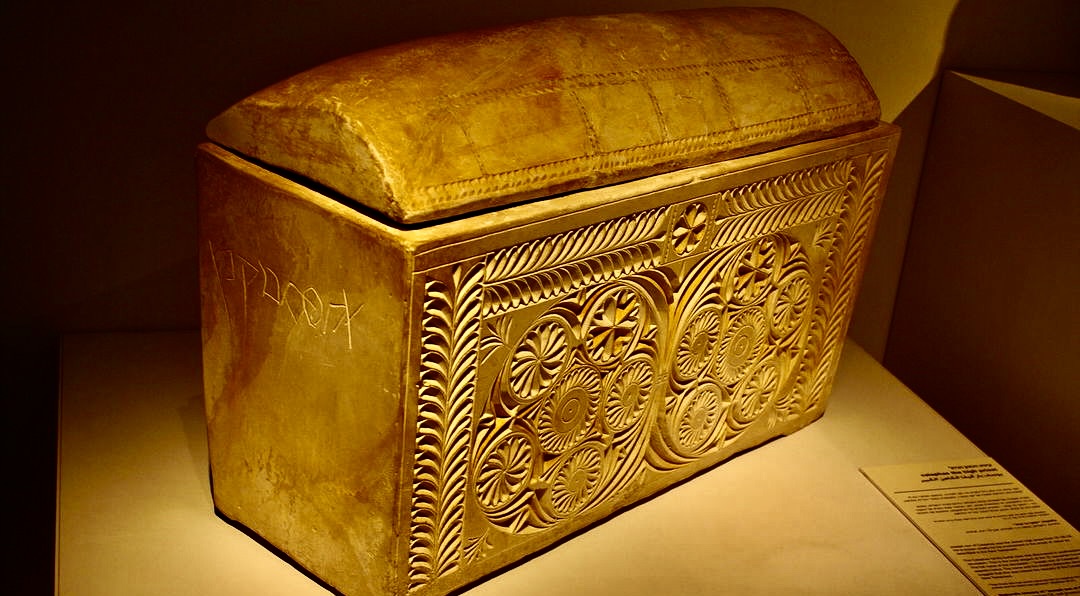
Cover Image, Top Left: milaoktasafitri, Pixabay