At the Museo di Santa Caterina in Treviso, Italy, I had been given the dangerous freedom of choosing any subject I wanted. The museum did not make the decision easier. Its archaeological rooms move from stone tools to Bronze Age swords, from the grave goods of the ancient Veneti to Roman portraits and funerary monuments. Above them, in the former convent, frescoes and later paintings belong to another Treviso altogether. Chronology offered the obvious way through the museum. Yet an urn is not a date range. It once held a person, and it was placed there by people who knew that person by name. That simple fact changes the scale of the story. When the political world changes, what happens to the name by which a person is remembered? On a funerary vessel, the answer was not theoretical. Someone had to choose the name. Someone had to choose the language.
That choice can be traced in the cemeteries of Montebelluna, some 20 kilometers northwest of Treviso, in the Veneto of northeastern Italy. Long before Venice existed, this landscape was home to communities of the ancient Veneti, and generations of their dead were buried here. Their graves preserve vessels, ornaments, weapons, and other traces of individual lives. Some of the funerary vessels also carry names. As Rome became an increasingly powerful presence in the region, those names, and the alphabets and formulas used to record them, began to change. But the Roman part of the story comes later. The graves are older.
Among Luigi Bailo’s early acquisitions for Treviso’s civic museum in 1882 were grave goods from Montebelluna, including a remarkable bronze cista dating to the sixth or fifth century BCE. Its decoration was worked in embossed sheet bronze and finished with a burin; across its surface, figures move through a world already fully its own, among them a farmer at the plough. The same technique appears on five votive discs depicting a key-bearing goddess, a type attested in the Piave Valley between the fourth and second centuries BCE and associated with cultural contact with the Celtic world. These objects belonged to a society with its own ritual vocabulary, imagery, and networks of exchange. Those networks reached across the Adriatic, the Po Plain, and into the Alpine world. Long before families began inscribing names in Venetic and, later, in Latin, that language of belonging was already there.
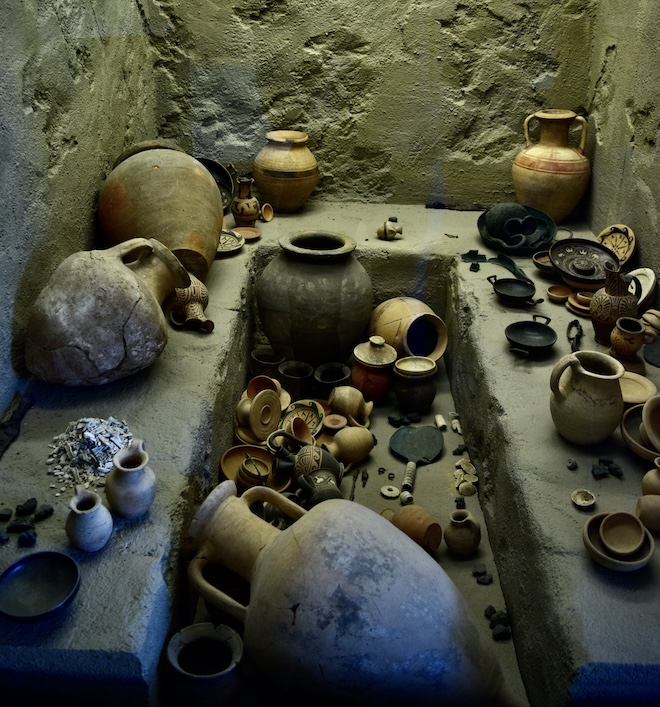
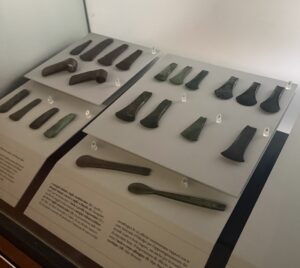
The dead were cremated and buried with objects that could signal status, gender, social role, and ritual identity. Some of those objects already had another life. Metal vessels used during funerary banquets could later become cinerary urns; brooches, buckles, and jewelry accompanied the deceased into the grave. Axes and bronze-sheet cylinders, once described as sceptres and now more cautiously interpreted as probable ceremonial spindles, may likewise have marked a particular role or rank. A grave, then, was not simply a container for remains. It was also a carefully assembled statement about who a person had been and how those who buried them wished that person to be remembered. That is why the names matter.
Across the first century BCE and into the beginning of the first century CE, the change becomes visible at the scale of individual burials. Tomb 304 at the Posmon cemetery contains ten burials made over several generations, with inscriptions in both Venetic and Latin. One vessel is particularly revealing: the name Essonna Cnussicina, formed according to Venetic naming practice, appears to have been cancelled and replaced by Ostia Cusonia, and the two versions may even be in the same hand. Tomb 174 preserves other experiments. There is Lukatka in Venetic script; elsewhere, Ostruo Luccaticos T. f. is written in Latin characters and incorporates Roman-style filiation while retaining names rooted in the local naming stock. Another funerary vessel carries the uncertain reading A(?) M Pulio Lucretis(?), closer again to a Roman naming formula. These are not steps in a clean progression from “Venetic” to “Roman.” They are choices made within families, sometimes within the same tomb, about how a person would be named and remembered. Seen this way, the inscriptions become difficult to treat as evidence alone. The alteration from Essonna Cnussicina to Ostia Cusonia is only a few marks on the surface of a vessel, yet it records a decision made at the most intimate scale: how one person would be named among the dead. Someone wrote one form, then changed it. Elsewhere, in the same cemeteries, families moved between Venetic and Latin scripts, local names and Roman formulas, sometimes combining them rather than choosing one world over the other.
Standing before these objects, that unevenness feels more revealing than any neat account of “Romanization.” Political change can be described in dates and institutions; here it survives in something much smaller, in the hesitation, adaptation, or certainty with which a name was written down. By this time, the larger political landscape was changing decisively. Northeastern Italy was being drawn ever more fully into Rome’s political and cultural system, and the region would ultimately become part of Roman Italy. On a map, that transformation can look almost inevitable: one order expanding as another recedes. The cemeteries at Montebelluna tell a less orderly story. At Posmon, change could advance, pause, combine older and newer forms, and even seem to reverse direction within a single family. What appears from a distance as “Romanization” becomes, at the scale of the grave, a succession of individual accommodations, choices about what to keep, what to adopt, and what still felt like one’s own. And it is precisely that uncertainty that makes Montebelluna so compelling. The closer one looks, the less Romanization resembles a straight line. Rome is becoming more powerful, its institutions more consequential and its language increasingly visible, yet the people living through that transformation refuse to arrange themselves neatly on either side of it. A family might adopt a Roman convention without abandoning an older name; one generation could make a different choice from the next. From a distance, the empire seems to move across territory. Here it moves through households, habits, and decisions so small that most would have disappeared completely had someone not written a name onto a vessel and placed it in a grave. Names are only one place where that negotiation becomes visible. The objects surrounding the dead tell a similar story. Older forms and practices could persist beside newer ones; a vessel or an ornament might belong to a local funerary language even as other elements of the burial pointed toward Rome.
What fascinates me here is the absence of a clean break. Cultural change seems to gather rather than replace, in things kept, altered, or newly introduced, until a grave can hold several histories at once. That is also where our own categories begin to feel inadequate. “Venetic” and “Roman” are useful words when we talk about populations, languages, or political systems; they become far less stable when pressed onto a single life. A name might belong to one tradition, the alphabet to another, the objects in the grave to several more. What looks contradictory from the outside may not have felt contradictory at all to the people living it. That possibility I find strangely moving. We tend to imagine identity as something people possess intact, but here it appears more like something assembled, piece by piece, from family, language, objects, and the shifting world beyond the cemetery. A metal vessel might first have belonged to the world of the living, passed from hand to hand during a funerary meal, before being given a second and final purpose as an urn. That change of function is easy to describe archaeologically; it is harder not to imagine what it meant to the people who did it. An ordinary act of holding, pouring, sharing became part of the work of remembrance. The same object could move from use to ritual, from the living body to the cremated dead, giving it more than one meaning.
Perhaps that is why these graves feel so resistant to simple categories: nothing in them seems to have had only one life. In the museum, those different lives survive only in fragments: bronze, ceramic, a line of writing, the curve of a vessel behind glass. Each of those objects belonged to several moments before it reached this case. It was handled, used, drawn into ritual, placed with the dead, buried, excavated, catalogued. Once you know that history, the display case feels almost too small for everything that happened before.
When I left Santa Caterina, I kept thinking about the names. Montebelluna does not give us a neat sequence in which one identity disappears and another takes its place. Families combined older names, Latin letters, and Roman formulas in ways that do not match our tidy categories. What remains feels close to lived experience precisely because it is inconsistent. People adjusted at different speeds, in different directions, for reasons we can only partly recover. And suddenly the enormous subject of Roman expansion comes down to decisions made within a household, sometimes to a few letters cut into the surface of a funerary vessel.
In August, outside Santa Caterina, the scale shifted again. Water ran along old brick, arcades broke the sun into shade, bicycles slid past, glasses rang out at café tables, voices flared briefly and vanished around corners. After the concentrated stillness of the museum, the city felt almost indecently alive. But I no longer heard that liveliness as a contrast. It was simply another layer, this time not contained in a display case, but moving around me. What had just felt distant now seemed strangely near.
__________________________
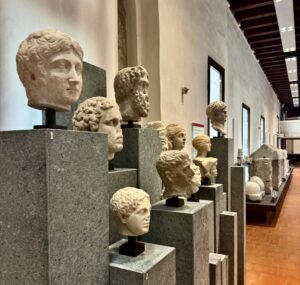
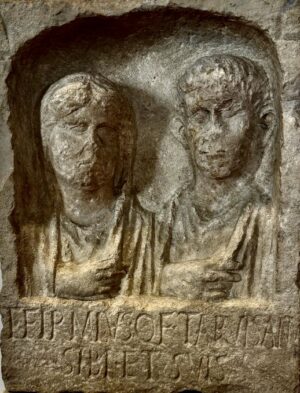
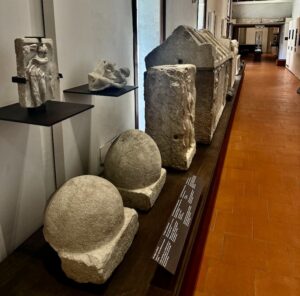
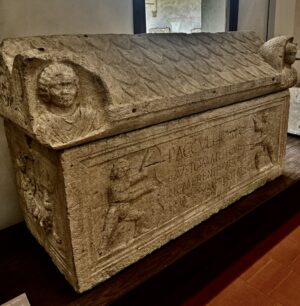
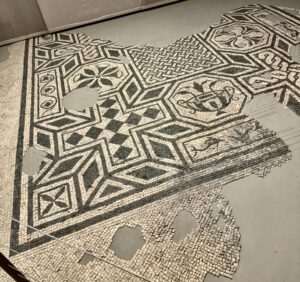
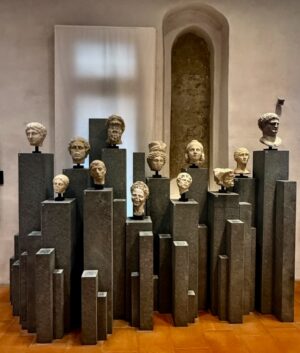
Above and below: interior views of the Santa Caterina Museum galleries and exhibited objects.
__________________________
__________________________
__________________________
__________________________
__________________________
__________________________
__________________________
References:
1. Museo di Santa Caterina, Collezioni Civiche di Treviso.
2. Parco e Museo Archeologico Naturalistico di Montebelluna.
3. Public information on the Posmon necropolis and related finds, Comune di Montebelluna.
4. Scholarly overview on Venetic inscriptions (A. Marinetti).
5. Epigraphic Database Roma (EDR).6. General background on the Romanization of Veneto (academic overviews, e.g. G. Cresci Marrone, L. Capuis).
__________________________