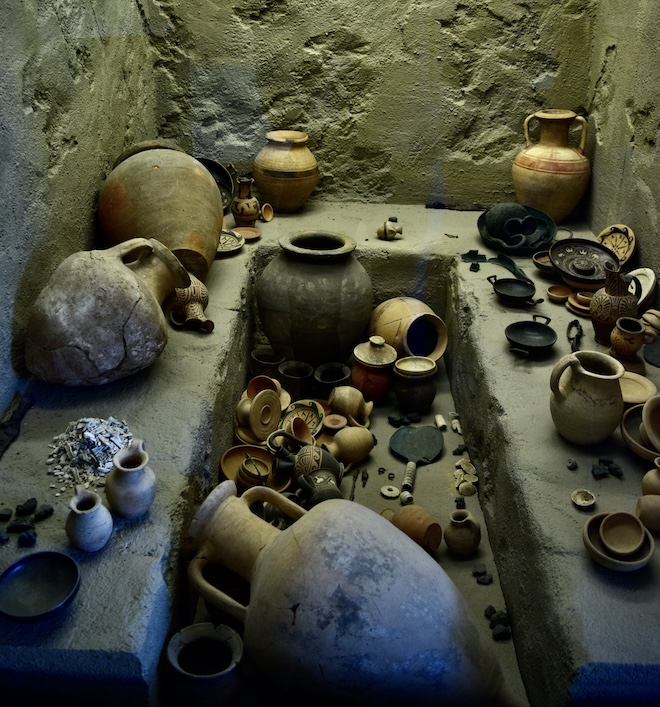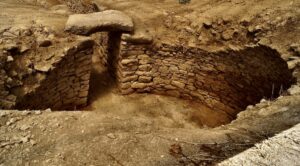
Golden treasures gleam around a king armed with gold and ivory swords. He is covered in jewels and crowned with a boar’s-tusk helmet. His queen is at his side, glittering in precious jewels. The adolescent princess who might have been their daughter is bedecked with a necklace of gold rosettes at the height of their bloom. As much as they sound like images painted onto a mural or actors posing for a tableau, these royals appear in an unexpected context. They have instead been laid—and laden with riches and ornaments—in their graves.
Many burials in antiquity sent the dead to the afterlife with troves of priceless artifacts like these early Mycenaean elites. The difference is that while most graves were filled and tombs were shut, these bodies interred from between 1700 and 1400 BCE were arranged with their personal effects to create a postmortem work of art. They were meant to merge objects with the body in death, more than memento mori, but the last memories those close to them would have before they were lowered into the earth. Archaeologist Rachel Emma Philips is convinced these stunning visuals conveyed more than status. She reexamined the graves in the tomb known as Dendra tholos at Midea in southern Peloponesse, Greece, an entire century after archaeologist Axel Persson and his research team unearthed and possibly misunderstood them.
Persson thought that the artistic arrangements of the bodies with their jewelry, weapons, and other possessions were only meant for mourners to view as they were carried towards the tomb. The bodies would then be immediately taken down into their grave pits and buried. As for the valuables that would remain hidden for thousands of years, the thinking behind this was that confining those objects to the tomb would emphasize how the social standing of the deceased was so high, nobody else could have them in their possession. He also assumed them to be members of the royal family of Midea, though that has been questioned. Phillips argued that these scenes were purposely designed to be viewed for a slightly longer period of time, more like a wake that culminates in a funeral. They needed to leave a lasting impression.
“I…advocate for an artistic approach to burial, centered around the twin concepts of curation and aesthetics, to show that within the early Mycenaean mortuary sphere, the act of deposition created hybrid artworks that combined the corpse with other materials and so mediated the dead through these materials,” she said in a study recently published in Cambridge Archaeological Journal.
This is not to say there were no tears in grief. Seeing bodies turned into surreal visions somewhere between life and afterlife must have had an intense visual and sensory impact on mourners. Phillips’ interpretation is also not without controversy, especially since she acknowledges most archaeologists would probably hesitate to support a theory with the “aestheticization of a putrefied corpse” that strayed from such elaborate burials being staged to parade the wealthy elite. She alternatively sees this mortuary tradition as a use of materials such as gold and silver to embellish the dead in such a way that the materials and body become one, like vessels, ornaments, and swords forming a silhouette of the king’s body to leave behind a vague image of him long after his earthly remains have decomposed.
Even Persson could not help but observe how densely covered in objects these bodies were, so much so that he could barely get a glimpse of the bones. Beyond that, Phillips wonders why certain materials were preferred. For what reason had metal vessels been chosen over ceramic vessels that were imported and considered more exotic and rare? It might have been that the visual effect held more significance than their value. They seem to show an interest in otherworldly shine, which extends to a wooden box on the body of the king, whose bronze ornaments were meant to reflect sunlight. Gold was the most preferred metal among these artifacts. Silver cups found with the female burials who are supposedly a queen and a princess have gold interiors, and one was found inlaid with gold. These were ancient special effects.
The boar’s tusk helmet on the male burial is especially significant. It is not carved from tusk, but reimagined in glass, a symbol of military prowess, meaning the presumed king may have been a warrior king or not a king at all, but a soldier fallen in battle. This helmet does more than reinforce the identity of a warrior. It literally reconstructs him with materials that will not decay, an immortal transformation. Anything that catches this much light was meant to be seen, a silent spectacle mourners would behold as his body was lowered into the grave. How the helmet is positioned is also important. Phillips thinks it purposely covered the parts of the face that would be most visible for mourners watching from above. Illuminated by torchlight, the helmet and his other weapons and ornaments could be seen through the shadows.
“[This interpretation] is an approach that locates creative action in the combination and deposition of specific objects with the dead,” she said, adding that “In its focus on the concentration of artistic action in the mortuary sphere…it has also revealed the intrinsic connection between art and emotion, and between death and creation, across time and space.”
Cover Image, Top Left: Dendra, Argolis, Greece: Tholos tomb of the mycenaean cementary. Schuppi, CC BY-SA 3.0, Wikimedia Commons
_____________________________