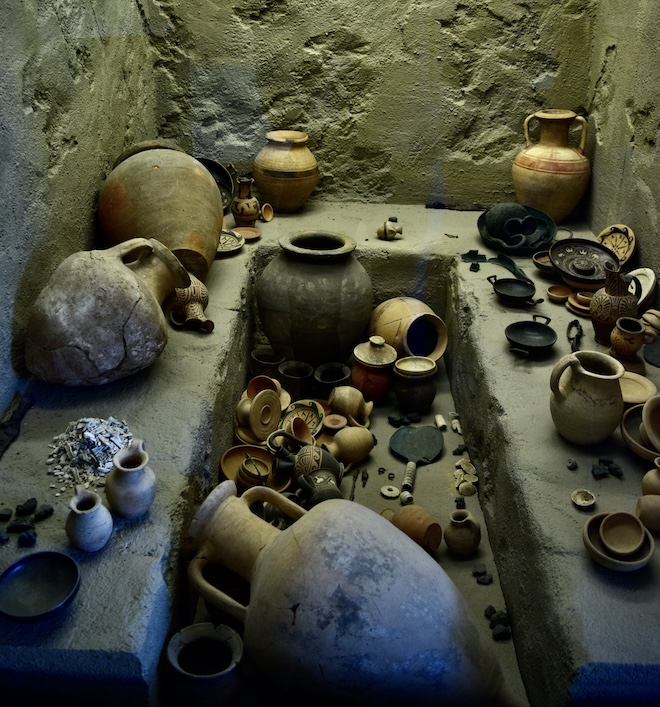
Kids haven’t changed much in ten thousand years. They still make messes, practice new skills by miniaturizing adult tasks, and quietly claim corners of shared spaces as their own. What is remarkable is that archaeologists can detect all of this in the material record without names or dates, relying instead on the objects, marks, and floor plans children left behind. Here are six of the clearest lessons those clues still teach us.
While materials have evolved, modern households still rely on specific tools to manage these same spatial dynamics. Creating clear outdoor perimeters often involves using a playground border to keep kids secure. Inside the home, managing family clutter frequently requires furniture like Home Reserve’s adaptable modular couch with built-in storage to maximize utility. These modern structural solutions mirror how ancient communities naturally organized their shared domestic environments.
1. Miniature Tools and Tiny Toys
Across cultures and centuries, excavations uncover scaled-down versions of adult tools. Researchers note that 66% of objects at certain sites were either full-scale or miniature versions of adult implements. Miniature Arctic bows, small ceramic grinding stones, and reduced-size clay vessels appear at settlements spanning multiple continents.
These items served a practical function rather than a decorative one. Children used them to rehearse adult tasks in low-stakes settings before graduating to standard equipment. Historical evidence shows that miniature harpoons and bows-and-arrows directly link to the learning of specific survival skills.
| Key Insight: Miniature tools weren’t decorative objects; they were training equipment. By handling scaled-down Arctic bows, grinding stones, and clay vessels, children rehearsed adult skills in low-stakes settings, leaving evidence of active learning. |
2. Boundaries Making Shared Areas Safer
Ancient courtyard settlements across the Mediterranean utilized low mudbrick walls and raised earthen borders to define secure movement zones. Shared open spaces require these legible edges to keep children safe during the day. The tamped surface demarcations kept toddlers from drifting into hazard areas like cooking hearths or storage pits.
These physical boundaries functioned as practical safety measures rather than aesthetic choices. Communities thought deliberately about child security within active adult work environments. Modern commercial play areas apply this same protective instinct, using flexible playground border systems from WillyGoat to contain playground surfacing and keep children safely within designated activity zones.
| Pro Tip: Clear edges protect without confining. Ancient low walls and raised borders let children play freely in shared areas while staying away from hearths, pits, and sharp tools the same principle behind modern playground borders. |
3. Fingerprints and Practice Marks on Pottery
Ancient ceramics often preserve the literal fingerprints of small hands. Children who shaped clay alongside adults left behind wobbly edges and irregular patterns that archaeologists now recognize as deliberate practice. The clay itself reveals who handled it, since children’s prints feature a distinct difference in breadth of epidermal ridges compared to adult hands.
Neolithic settlements like Çatalhöyük yield pottery with these specific ridge proportions. These markers confirm that younger household members were active participants at the hearth rather than passive observers. They learned the craft by working directly with the raw materials alongside seasoned artisans.
4. Household Layouts Showing Children Learning
Ancient floor plans reveal exactly how early families shared their daily space. Excavations show hearth locations and tool clusters overlapping directly with sleeping areas. When children’s objects appear consistently within arm’s reach of adult work zones, the layout indicates a strategy of deliberate proximity.
Younger residents learned daily routines simply by being present during household chores. Ancient Near Eastern courtyard houses display this pattern clearly through practice ceramics clustered near adult craft zones. Families embedded education into the natural rhythm of domestic life instead of isolating kids into dedicated playrooms.
5. Communal Courtyards and Open Play Spaces
Tamped floor surfaces in ancient settlements prove that open central areas served multiple functions simultaneously. Plazas and shared yards reliably operated as active zones for physical games. Archaeologists identify these specific areas through concentrated clusters of gaming pieces left behind in the dirt.
Ancestral Puebloan plazas and Indus Valley yards both demonstrate this communal approach. Play in these shared environments allowed kids to build physical abilities while staying visible to the broader community. They occupied the same ground where adults traded goods and gathered for social events.
6. Adaptable Family Rooms for Shared Living
Bronze Age structures across multiple cultures prove that ancient family rooms avoided narrow specialization. A single enclosed space served simultaneously for sleeping, craft work, and household storage. Researchers consistently find sleeping platforms and domestic items packed within the same small footprint.
Multi-use space remains an essential solution for the reality of shared living. Today, households maximize their square footage by choosing modular Home Reserve furniture to handle daily clutter. Consolidating storage and rest into one adaptable room reflects a historical constraint that ancient builders solved thousands of years ago.
Putting It All Together
The design instincts archaeologists recover from ancient sites provide durable solutions for modern households. Defined boundaries keep outdoor play areas secure, while modular living room seating absorbs the daily clutter of household storage.
Families continue to adapt their spaces to match the physical needs of growing residents. Analyzing historical floor plans proves that functional household design has always prioritized proximity and safety.
______________________________
Advertisement