Archives: Articles

This is the example article

Texts to Textiles: Reconstructing Mycenaean textile production through Linear B

In the latest released episode of Dr. Ester Salgarella’s podcast series, Aegean Connections, Marie Louise Nosch, Professor of ancient history at the Saxo Institute, University of Copenhagen, relates the significance of textiles and their production and commerce in the Bronze Age palatial societies of the Mediterranean. She does this by discussing how the reading and analysis of Linear B, the ancient script of the Mycenaean civilization, has revealed a surprising amount of information about the making, trade distribution, business and value of textiles as a prominent part of the economies of societies of the time.

“Textile production was the fuel of the Bronze Age economy”, says Nosch in the podcast interview.

Indeed, at least among the elite in the even earlier Minoan cities like Knossos in Crete and Akrotiri on the island of Santorini, the evidence for the sophistication and importance of textiles for clothing was clearly illustrated in the magnificent frescoes known today among the archaeological remains and collections of those sites.

Nosch also elaborates how Linear B texts have described in detail the stages of textile production, as well as the remarkable standardization and fixed cycles that defined broadly applied expectations in the world of textiles of the Mediterranean Bronze Age.

Readers can listen to much more about this in the newly released, free podcast, Texts and Textiles: reconstructing Mycenaean textile production through Linear B.

___________________________

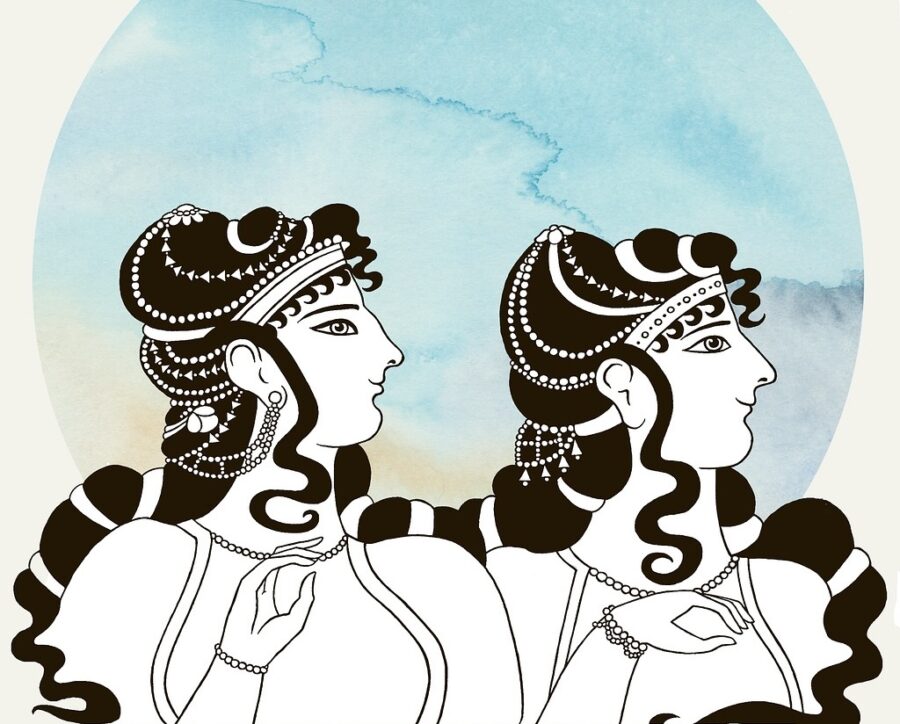
Cover Image, Top Left: Wall painting from the House of the Ladies in Akrotiri. An iconic example of the sophisticated and artful style of clothing made possible by the mastery and production of textiles during the Bronze Age. 

___________________________

Advertisement

EXPLORE THE ANCIENT ETRUSCANS IN PERSON!
Experience a unique, up-close-and-personal hike among ancient hilltop towns in central Italy. You will walk the sensational countryside of the regions of Umbria and Tuscany, soaking in important sites attesting to the advanced Etruscan civilization, forerunners of the ancient Romans; imposing architectural and cultural remains of Medieval Italy; local food and drink; and perhaps best of all — spectacular scenic views! Join us in this collaborative event for the trip of a lifetime!

Popular Archaeology collaborates with Wayfaring Walks to visit ancient Etruscan sites in Italy

Far from the crunch of the madding crowd one typically encounters with the big Italian tourist sites in places like Rome, Florence, Venice, and Naples, a small group of travelers will have the opportunity to explore spectacular off-the-beaten-path sites scattered across the Italian provinces of Umbria and Tuscany. The sites, mostly situated at or near aesthetically scenic and historic Medieval and Etruscan hilltop towns and villages, will define a picture of the Etruscans, the ancient civilization that preceded the Romans. The Etruscans dominated most of the Italian peninsula for centuries, and heavily influenced the culture and character of the civilization that eventually became the Roman Empire.

What distinguishes this tour from most other tours revolves around one human activity — walking. Rather than shuttling large groups of tourists from one congested site after another in chartered buses or vans, this comparatively smaller group will spend the majority of its time hiking across the countryside, taking ancient paths, roads and trails in between up-close-and-personal historic, cultural and archaeological sites that tell the story of the ancient Etruscans as well as the later Medieval and Roman periods.

“Unlike the typical tourist-type experience, this group will be hiking through country that most people, other than the local population, do not see. It will be a more intimate encounter with the landscape and people of ancient and historic Italy,” says Dan McLerran, founder and editor of Popular Archaeology Magazine. “Along with this, the mere act of walking has a profound impact on personal health, both physically and mentally/emotionally. In our mad dash in life to tick off the tasks we have created for ourselves in this life, we forget to ‘smell the flowers’ and nurture closer relationships with others along the way — the very things that make life worth living.”

The trip plan, created and operated by Wayfaring Walks, will take participants to towns that feature ancient and Medieval architecture set high atop rocky, cliff-like formations, as well as anciently-carved and constructed tombs and underground habitations beneath.

“Along with developing new relationships with like-minded people participating in the walk, this will be a photographer’s paradise, so if you are into creating distinctive and artistic images with your camera, this will be an excellent opportunity to do so,” added McLerran.

The towns the group will encounter are among the most scenically picturesque in Italy, affording views not encountered by most vacationing visitors. Moreover, the experience promises to focus on education as well, expanding the participant’s understanding of the ancient and historic cultures encountered.

The walk is open to anyone interested, although individuals who are premium subscribers to Popular Archaeology Magazine will be offered a $500 discount on the trip price (for the first 4 who register). Participants should know that the walking/hiking element of this tour is NOT mandatory. If for any reason a person cannot or does not wish to do some or all of the walk aspect of the tour, arrangements can be made with the tour leader and manager to do limited independent explorations of the towns and sites on the travel itinerary. 

For more information about this, and how to register, go to Etruscan Hilltop Towns at https://www.wayfaringwalks.com/tour/etruscan-hilltop-towns/. For current premium subscribers to Popular Archaeology Magazine, go to https://www.wayfaringwalks.com/welcome-popular-archaeology-subscribers/

________________________________

View of Civita Bagnoregio, one of the towns to be visited. Orlando Paride, Creative Commons Attribution-Share Alike 4.0 International license, Wikimedia Commons

________________________________

Orvieto. Courtesy Wayfaring Walks

________________________________

Pozzo di San Patrizio, Orvieto. Courtesy Wayfaring Walks

________________________________

Sorano. Courtesy Wayfaring Walks

________________________________

The Citta del Tufo Archaeological Park. Courtesy Wayfaring Walks

________________________________

Sorano Castle stairs. Courtesy Wayfaring Walks

________________________________

Pitigliano, illuminated. Courtesy Wayfaring Walks

________________________________

Archaeological team discovers ancient Etruscan ritual pit and votive niche

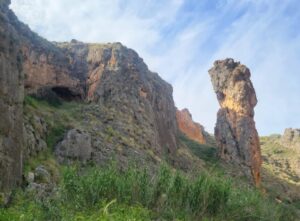
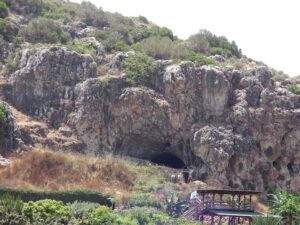
A team of students led by archaeologist Luca Nejrotti recently unearthed two previously undiscovered features among ancient Etruscan tombs in Tuscany, Italy. During the summer of 2024, in collaboration with the Archaeological Park “Città del Tufo”, the team, consisting of archaeologists, students and local volunteers, revisited six Etruscan tombs nestled for more than 2500 years within the area known as the Via Cava di San Sebastiano, near the town of Solano.

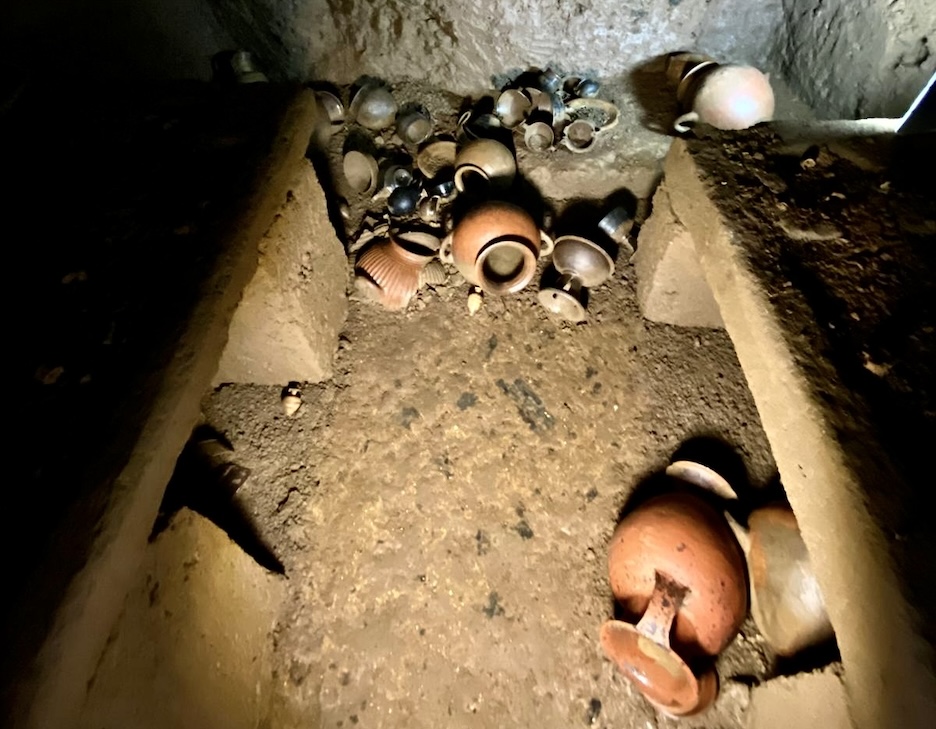
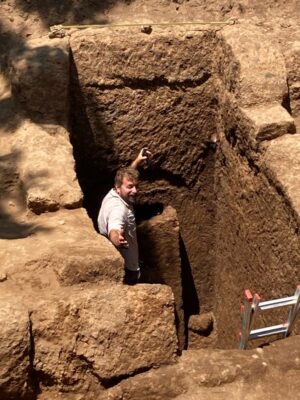
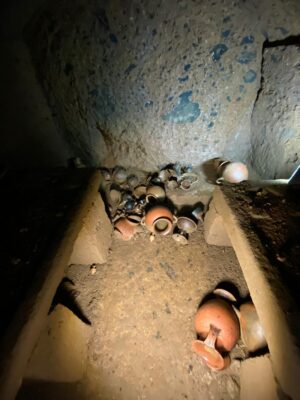
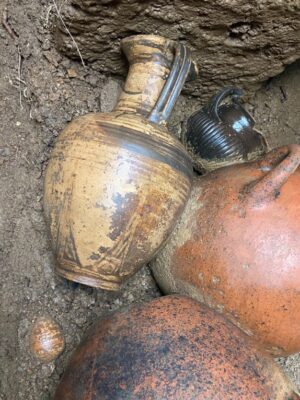
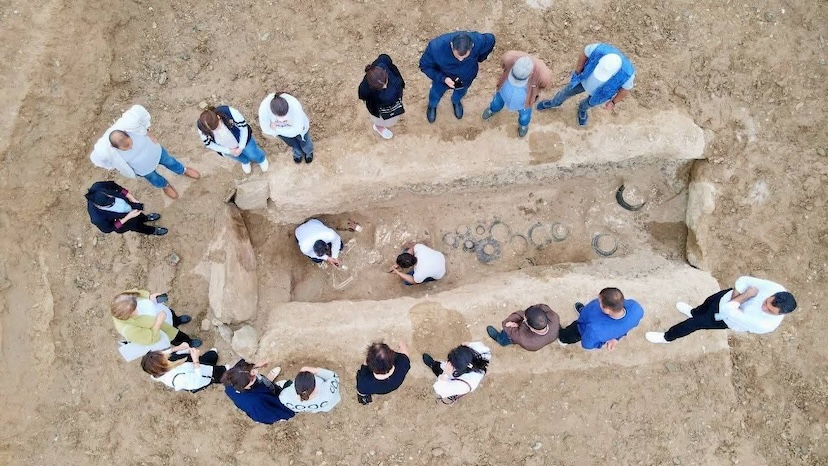
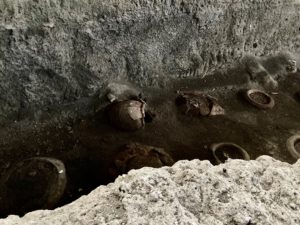
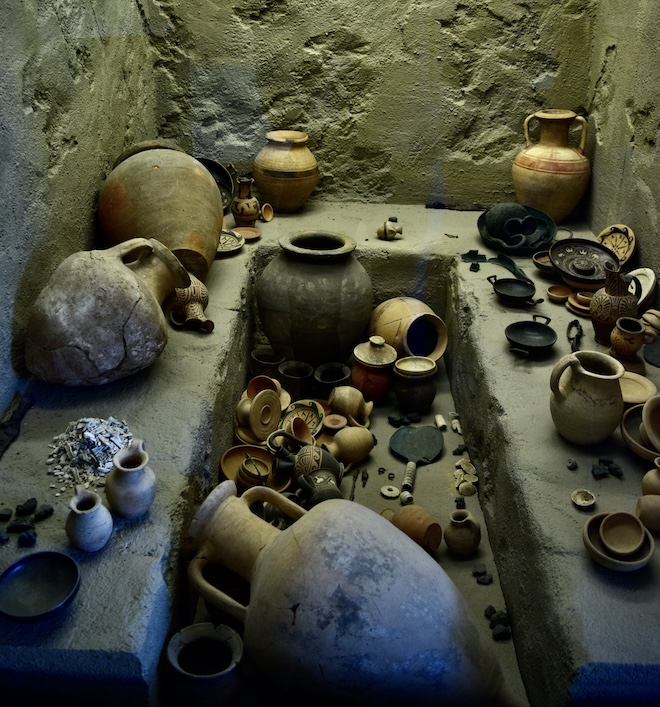
The team revisited a number of 7th – 6th century BC tombs carved anciently into the area’s characteristic volcanic tufa rock, already explored and exposed by Roman looting and 19th and 20th century digging. At the end of their season, they uncovered two previously unknown features left untouched for more than 2500 years — a ritual pit and a funerary niche. The ritual pit contained a double-handled bowl and four dishes, and the funerary niche, sealed with terra-cotta tiles, revealed nine ceramic vessels, spindle whorls, and a bronze fragment.

According to lead archaeologist Nejrotti, the finds “represent an exceptional testimony to the religious practices associated with funerary offerings”.  

Although the details of ancient Etruscan religious practices and culture are not as well known as those of the ancient Greeks and Romans, their tombs have revealed the significance of religious beliefs and practices in their society.

The Etruscans were an ancient people who preceded the Romans and inhabited current day central Italy from around 900 BC to roughly 100 BC. They possessed a common language and culture but governed themselves independently through federations of city-states (three confederacies in all: Etruria (today’s Tuscany, Latium and Umbria), the Po Valley with the eastern Alps, and the area known today as Campania. At its greatest extent, Etruria covered what is now Tuscany, western Umbria, northern Lazio, the Po ValleyEmilia-Romagna, south-eastern Lombardy, southern Veneto, and western Campania.

More about the team’s work and results can be found in the major feature article recently published in the winter 2025 issue of Popular Archaeology Magazine.

_________________________________

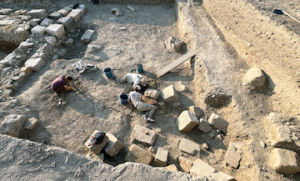
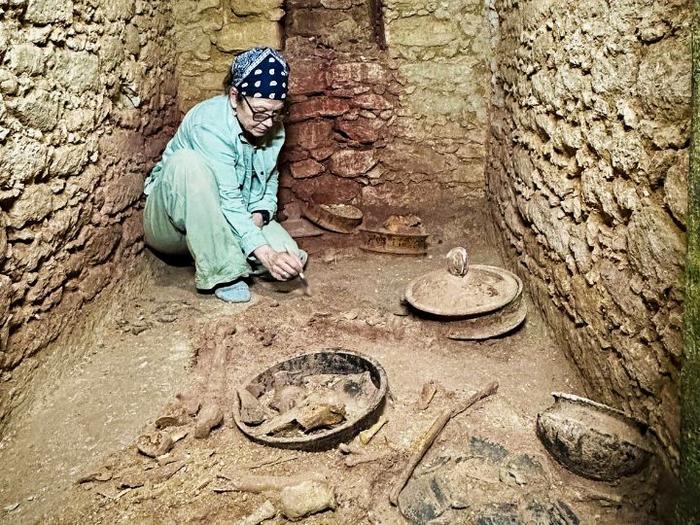
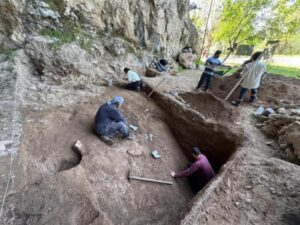
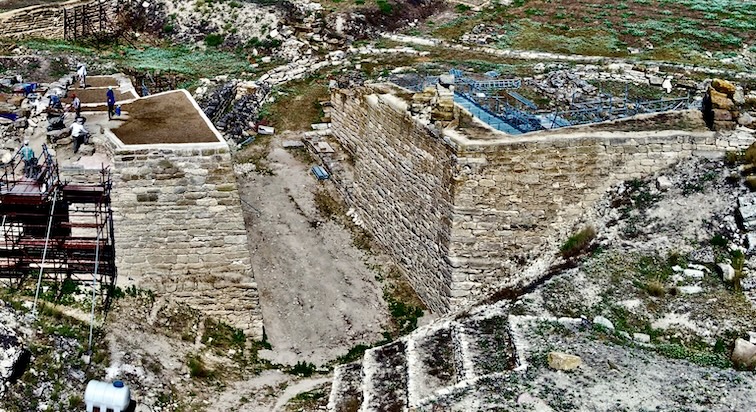
Excavating the ritual pit. Courtesy Luca Nejrotti

_________________________________

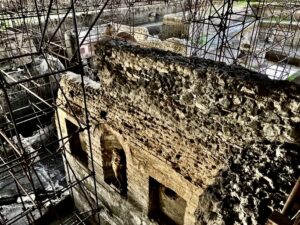
The funerary niche after the removal of the tiles. Courtesy Luca Nejrotti

_________________________________

Advertisement

EXPLORE THE ANCIENT ETRUSCANS IN PERSON!
Experience a unique, up-close-and-personal hike among ancient hilltop towns in central Italy. You will walk the sensational countryside of the regions of Umbria and Tuscany, soaking in important sites attesting to the advanced Etruscan civilization, forerunners of the ancient Romans; imposing architectural and cultural remains of Medieval Italy; local food and drink; and perhaps best of all — spectacular scenic views! Join us in this collaborative event for the trip of a lifetime!

Ukraine was a crossroads of human mobility until around 500 years ago

Estonian Research CouncilThe North Pontic region, which encompasses present-day Ukraine, was for centuries a crossroads of migration from multiple directions, connecting the vast Eurasian Steppe with Central Europe.

A study recently published in Science Advances uses ancient human remains to reveal the remarkably high genetic heterogeneity in the region during the last 3,500 years up to around 500 years ago. The study is led by Lehti Saag, a researcher at the University of Tartu Institute of Genomics (UT IG) and a former Marie Skłodowska-Curie postdoctoral fellow at University College London (UCL), alongside professor Mark Thomas from UCL and Pontus Skoglund from the Francis Crick Institute. The study was made possible by the resilience of Ukrainian researchers – second author Olga Utevska who is currently a MSCA4Ukraine fellow at UT IG, and numerous archaeologists still actively conducting excavations in Ukraine despite the war.

The analyses show that at the end of the Bronze Age, broad-scale ancestry proportions are similar to contemporary populations in the rest of Europe – a mixture of European hunter-gatherer, Anatolian early farmer and Steppe pastoralist ancestries – and these ancestry components have been present in the Ukraine region since then until today. However, from the Early Iron Age until the Middle Ages, the appearance of eastern nomads in the Pontic region became a regular occurrence. Their genetic composition varied from Steppe-like superimposed on the locals to high degrees of East Asian ancestry with minimal local admixture.

At the same time, individuals from the rest of the Ukrainian region had ancestry mostly from different regions in Europe. The palimpsest created by migration and population mixing in the Ukraine region will have contributed to the high genetic heterogeneity in geographically, culturally and socially homogeneous groups, with different genetic profiles present at the same site, at the same time and among individuals with the same archaeological association.

_________________________

Scythian burial at the Skorobir necropolis in the fortified settlement of Bilski. Iryna Shramko

_________________________

Article Source: Estonian Research Council news release.

*North Pontic crossroads: Mobility in Ukraine from the Bronze Age to the early modern period, Science Advances, 8-Jan-2025. 10.1126/sciadv.adr0695 

_________________________

Advertisement

EXPLORE THE ANCIENT ETRUSCANS IN PERSON!
Experience a unique, up-close-and-personal hike among ancient hilltop towns in central Italy. You will walk the sensational countryside of the regions of Umbria and Tuscany, soaking in important sites attesting to the advanced Etruscan civilization, forerunners of the ancient Romans; imposing architectural and cultural remains of Medieval Italy; local food and drink; and perhaps best of all — spectacular scenic views! Join us in this collaborative event for the trip of a lifetime!

Tattoos revealed on mummified skin

Proceedings of the National Academy of Sciences—Researchers used lasers to reveal highly detailed tattoos on 1,200-year-old mummies from Peru. Mummified human remains from pre-Hispanic South America provide evidence of a long history of tattooing in the region. The ink used in tattoos tends to bleed and fade with age, a process further exacerbated by mummification, rendering the original designs difficult to discern. Michael Pittman and colleagues used laser-stimulated fluorescence to study approximately 1,200-year-old tattoos on mummified individuals belonging to the pre-Columbian Chancay culture in present-day coastal Peru. The authors inspected more than 100 mummified individuals for tattoos. The preserved skin of the mummified individuals fluoresced brightly, in contrast with the black tattoo ink. The resulting high-contrast images virtually eliminated the effects of ink bleed, revealing previously hidden details of the tattoo designs. The complex geometric and zoomorphic patterns were inked with a finely pointed object, possibly a single cactus needle or sharpened animal bone. The authors note that the artistic details and precision of the tattoos exceed that of contemporary Chancay pottery, textiles, and rock art, suggesting that some tattoos were the product of special effort. According to the authors, the findings provide insight into the artistic development and complexity found in pre-Columbian South America.

______________________________

1,200-year-old mummified forearm under laser-stimulated fluorescence revealing details of tattoo designs. Michael Pittman and Thomas G Kaye

______________________________

1,200-year-old mummified hand featuring tattoos. Michael Pittman and Thomas G Kaye

______________________________

Article Source: PNAS news release

*“Hidden artistic complexity of Peru’s Chancay culture discovered in tattoos by laser-stimulated fluorescence,” by Thomas G. Kaye, Judyta Bąk, Henry William Marcelo, and Michael Pittman, Proceedings of the National Academy of Sciences, 13-Jan-2025. https://www.pnas.org/cgi/doi/10.1073/pnas.2421517122

______________________________

Advertisement

EXPLORE THE ANCIENT ETRUSCANS IN PERSON!
Experience a unique, up-close-and-personal hike among ancient hilltop towns in central Italy. You will walk the sensational countryside of the regions of Umbria and Tuscany, soaking in important sites attesting to the advanced Etruscan civilization, forerunners of the ancient Romans; imposing architectural and cultural remains of Medieval Italy; local food and drink; and perhaps best of all — spectacular scenic views! Join us in this collaborative event for the trip of a lifetime!

When the past meets the future: Innovative drone mapping unlocks secrets of Bronze Age ‘mega fortress’ in the Caucasus

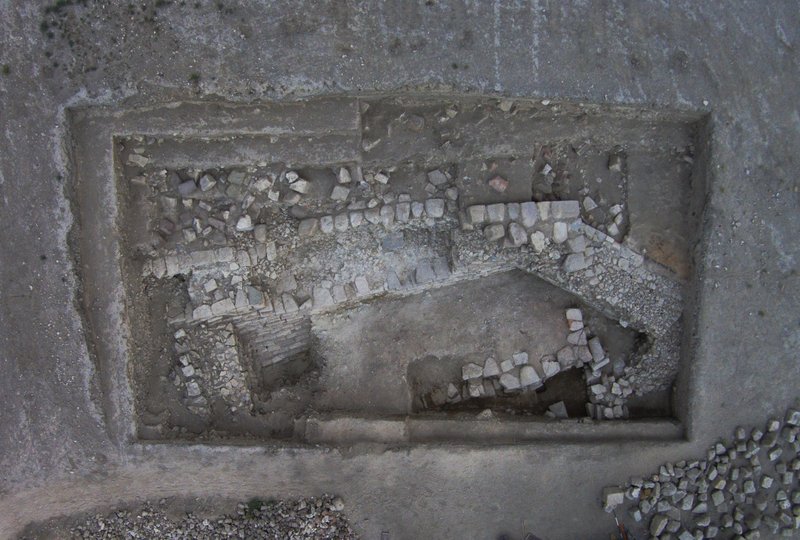
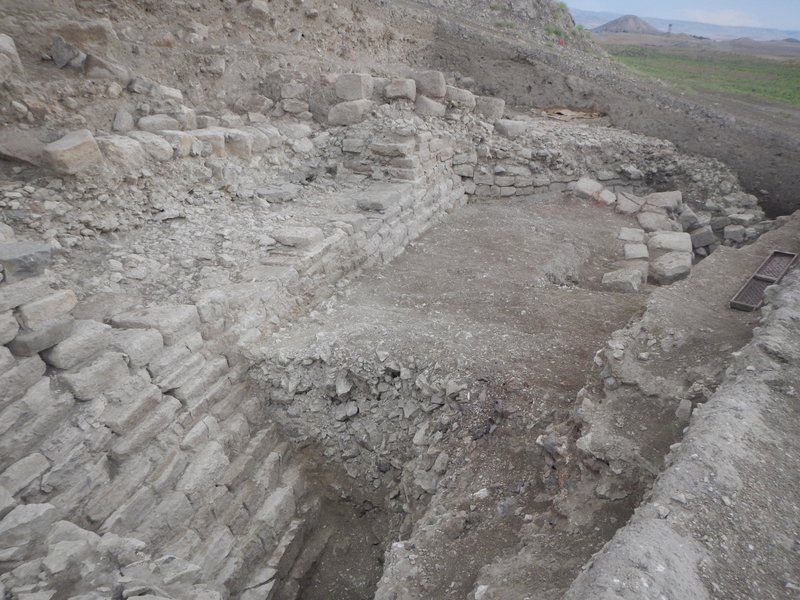
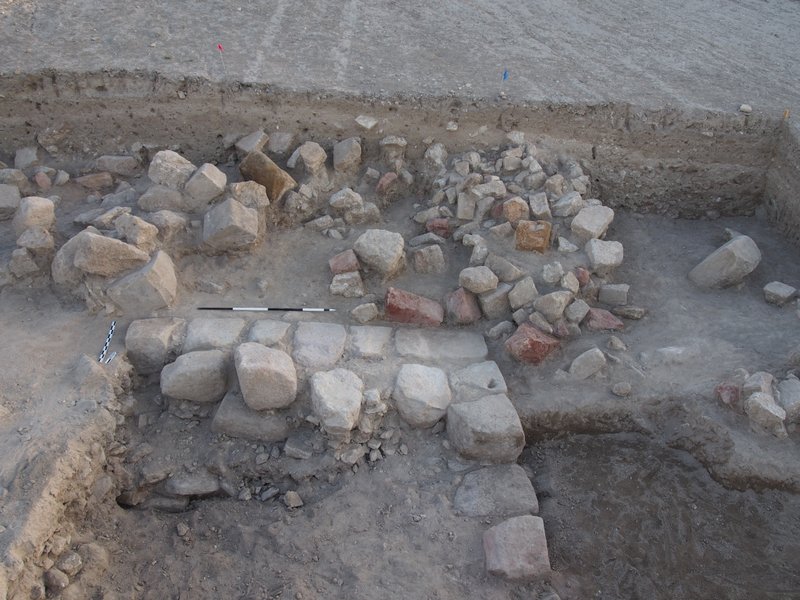
Cranfield University—A Cranfield University, UK, academic has used drone mapping to investigate a 3000-year-old ‘mega fortress’ in the Caucasus mountains. Dr Nathaniel Erb-Satullo, Senior Lecturer in Architectural Science at Cranfield Forensic Institute, has been researching the site since 2018 with Dimitri Jachvliani, his co-director from the Georgian National Museum, revealing details that re-shape our understanding of the site and contribute to a global reassessment of ancient settlement growth and urbanism.

Fortress settlements in the South Caucasus appeared between 1500-500 BCE, and represent an unprecedented development in the prehistory of the regions. Situated at the boundary between Europe, the Eurasian Steppe, and the Middle East, the Caucasus region has a long history as a cultural crossroads with distinctive local identities.  

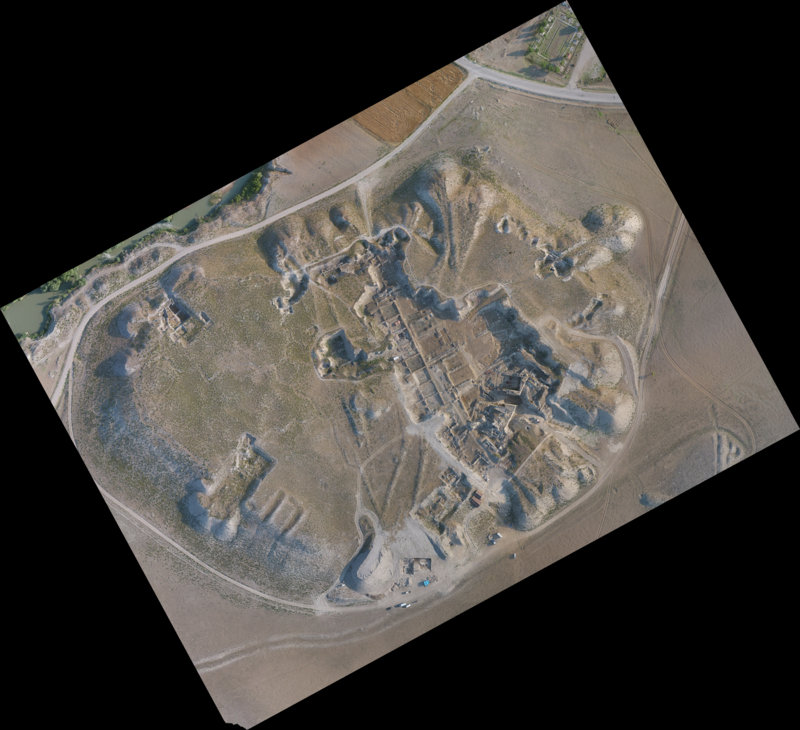
Research on the fortress – named Dmanisis Gora – began with test excavations on a fortified promontory between two deep gorges. A subsequent visit in Autumn, when the knee-high high summer grasses had died back, revealed that the site was much larger than originally thought. Scattered across a huge area outside the inner fortress were the remains of additional fortification walls and other stone structures. Because of its size, it was impossible to get a sense of the site as a whole from the ground.

“That was what sparked the idea of using a drone to assess the site from the air,” commented Dr Erb-Satullo. “The drone took nearly 11,000 pictures which were knitted together using advanced software to produce high-resolution digital elevation models and orthophotos – composite pictures that show every point as if you were looking straight down.

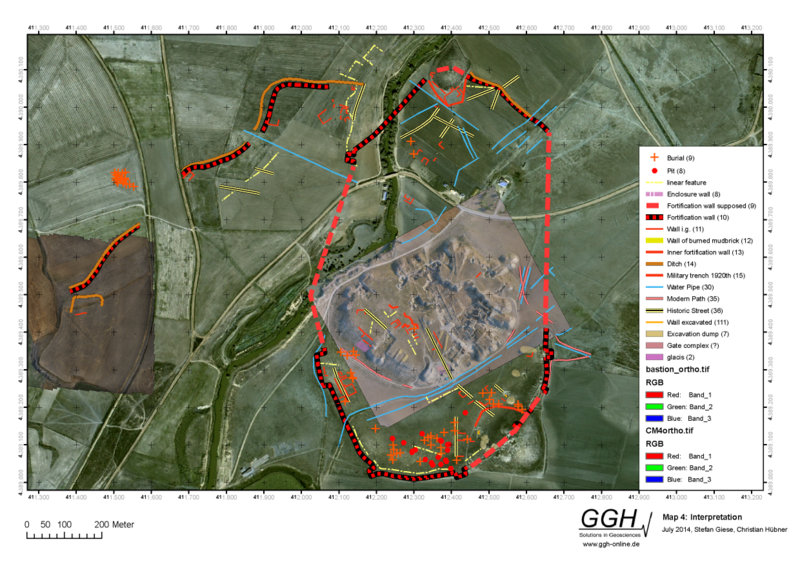
“These datasets enabled us to identify subtle topographic features and create accurate maps of all the fortification walls, graves, field systems, and other stone structures within the outer settlement. The results of this survey showed that the site was more than 40 times larger than originally thought, including a large outer settlement defended by a 1km long fortification wall.”

The research team used a DJI Phantom 4 RTK drone which can provide relative positional accuracy of under 2cm as well as extremely high-resolution aerial imagery. In order to obtain a highly accurate map of human-made features, the team carefully checked each feature in the aerial imagery to confirm its identification.

To understand how the landscape of the site had evolved, the orthophotos were compared with 50-year-old photos taken by a Cold War-era spy satellite declassified in 2013. That gave researchers much needed insight into which features were recent, which were older. It also enabled researchers to assess what areas of the ancient settlement were damaged by modern agriculture. All of those data sets were merged in Geographic Information System (GIS) software, helping to identify patterns and changes in the landscape.

“The use of drones has allowed us to understand the significance of the site and document it in a way that simply wouldn’t be possible on the ground” said Dr Erb-Satullo. ”Dmanisis Gora isn’t just a significant find for the Southern Caucasus region, but has a broader significance for the diversity in the structure of large scale settlements and their formation processes. We hypothesize that Dmanisis Gora expanded because of its interactions with mobile pastoral groups, and its large outer settlement may have expanded and contracted seasonally. With the site now extensively mapped, further study will start to provide insights into areas such as population density and intensity, livestock movements and agricultural practices, among others.”  

This data will give researchers new insights into Late Bronze Age and Early Iron Age societies, and how these communities functioned. Since the aerial survey was completed, Dr. Erb-Satullo has been carrying out further excavations at the site, uncovering tens of thousands of pottery shards, animal bones, and other artefacts that tell us more about the society that built this fortress.

This work* has been funded by the Gerda Henkel Foundation, the Gerald Averay Wainwright Fund and the British Institute at Ankara.

___________________________

Atmospheric photo of the site at dusk, showing the location at the convergence of two gorges. 2023 excavations of inner fortress are visible in foreground. Nathaniel Erb-Satullo

___________________________

Photo of structures in the outer settlement, 1km long fortification wall is visible in upper left. Nathaniel Erb-Satullo

___________________________

Article Source: Cranfield University news release

*MEGA-FORTRESSES IN THE SOUTH CAUCASUS: NEW DATA FROM SOUTHERN GEORGIA, Antiquity, 8-Jan-2025. 10.15184/aqy.2024.197 

Penn Museum’s New Exhibition Preserving Assyria Highlights Restoring Iraq’s Cultural Heritage Through Community-Led Archaeology

PHILADELPHIA, January 7, 2025—In conflict zones like Syria and Ukraine, erasure is a part of systematic genocide and cultural cleansing, but a new exhibition shifts the focus to cultural heritage restoration through community-led excavation—Preserving Assyria showcases archaeology’s role in safeguarding cultural heritage from targeted destruction.

With 16 objects on display from the Penn Museum’s collection, touchable 3D replicas of monumental relief carvings, and interactive multimedia components, this exhibition will be on view in the Merle-Smith Galleries on the Lower Level starting Saturday, February 8, 2025.

One of the world’s earliest empires, Assyria represents a crucial part of Iraq’s cultural identity, which the so-called Islamic State of Iraq and Syria (ISIS) attempted to erase by destroying many Mesopotamian monuments in 2016––one of which was Mashki Gate in the ancient city of Nineveh (near Mosul in Northern Iraq).

With a long history of collaborating with the Iraqi researchers and officials, exhibition curators Dr. Michael Danti, Program Director of the Iraq Heritage Stabilization Program, and Dr. Richard L. Zettler, Director Emeritus, intend to spotlight the groundbreaking archaeological discoveries at Mashki Gate, and underscore how collaborative excavations center the cultural heritage priorities of the local people.

“Working closely with our Iraqi colleagues and local communities, scientific field archaeology is playing a key role in recovery efforts in Iraq, shedding new light on ancient cultures and, at the same time, enabling us to reconstruct damaged sites in more authentic and sustainable ways,” Dr. Danti explains. “Our main goal is to re-establish and enhance access to cultural heritage as a fundamental human right.”

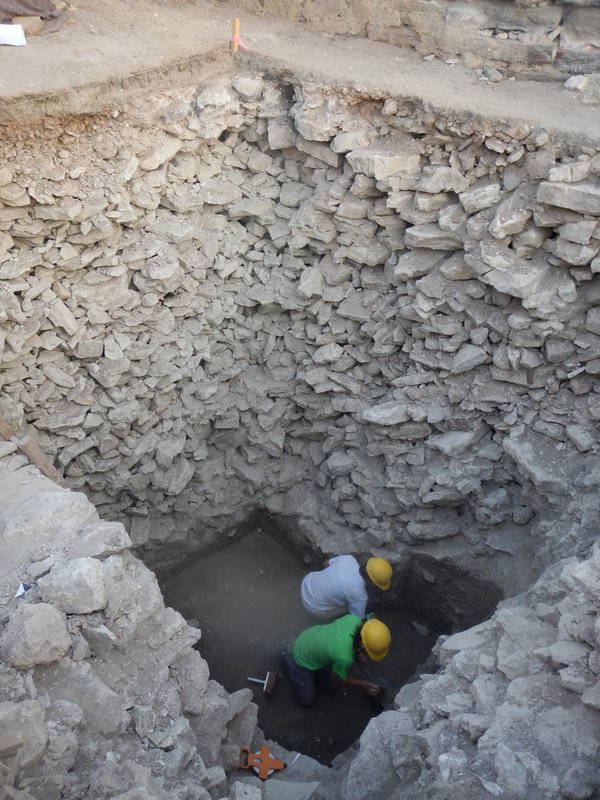
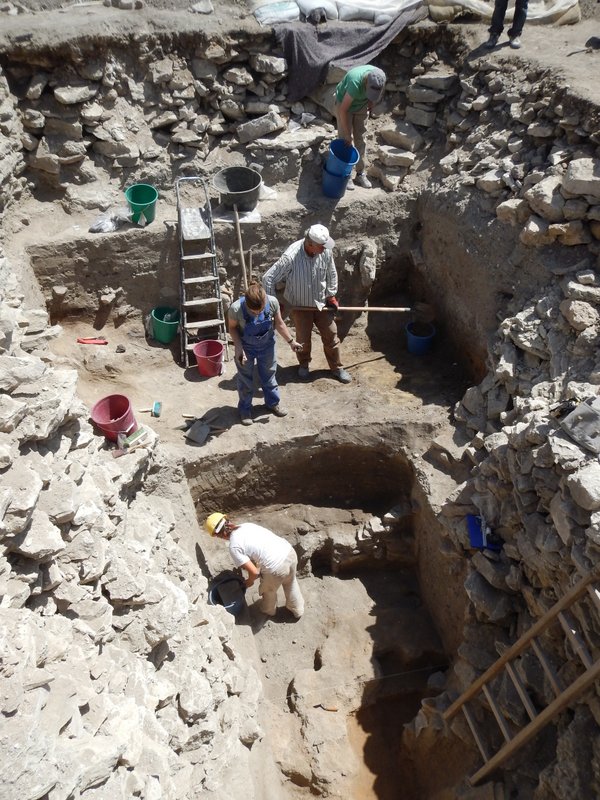
One of the biggest discoveries since the 19th century are superbly preserved marble reliefs unearthed at Mashki Gate. They date back to an Assyrian king, Sennacherib, who ruled Nineveh from 705 to 681 BCE. As the original skillfully carved panels, depicting finely chiseled war scenes, mountains, grape vines, and palm trees remain in Iraq, visitors will be able to view intricate replicas, made via 3D scanning,of segments from these extraordinary reliefs.

“…These panels can become a celebrated cultural and archaeological attraction for Iraqis and international tourists. Personally, I have longed to touch our ancestors’ artifacts on museum visits in the West. Now, with these panels restored by Iraqi hands, I can experience the joy of physically connecting with our heritage and marvel at the skill and dedication of ancient artists,” explains Iraqi Assyriologist Dr. Ali al-Jabouri, Professor Emeritus at University of Mosul.

To chart the story of the Neo-Assyrian empire and its deep significance to Iraq’s heritage, the exhibition will feature a timeline of Assyrian history; digital reconstructions of what the ancient city once looked like; illustrations of King Sennacherib’s palace; and images from current excavations that offer “day-in-the-life” glimpses of archaeologists-in-action.

Preserving Assyria will illuminate select artifacts from the Penn Museum’s Near East collections, such as a stamp-inscribed brick from Tell Yarah, Iraq (near Mosul) written in the Sumerian language (911-612 BCE); a Sumerian clay tablet that contains ancient spells to ward off witchcraft (1900-1600 BCE); a glazed terracotta wall tile from Hasanlu, Iran (1000–800 BCE), cylinder seals made of quartz and marble; and a protective amulet made of carnelian.

Public programs related to the new exhibition include a special Curator’s Lectureon February 8 at 2:00 pm in Rainey Auditorium, as well as an engaging four-week online class, The Deep Dig: The Rise and Fall of Assyria, led by Dr. Michael Danti beginning March 6.

Included with Museum admission, Preserving Assyria will be on view through February 2026.

___________________________

Opening at the Penn Museum on Feb. 8, 2025, the Preserving Assyria exhibition will showcase a rendering of a restored palace wall in Nineveh. Photo_ Penn Museum.jpg

___________________________

The remarkably preserved reliefs discovered at the Mashki Gate in Nineveh offer exquisite detail. Portions of this have been 3D scanned and replicas will be on display as a part of Preserving Assyria at the Penn Museum. Opening Feb. 8, 2025  Photo_ Penn Museum.jpg

___________________________

This Mashki Gate marble relief shows a high-ranking captive of the Assyrians during a military campaign. Portions of this have been 3D scanned and replicas will be on display as a part of Preserving Assyria at the Penn Museum. Opening Feb. 8, 2025.   Photo_ Penn Museum.jpg

___________________________

The U.S.-Iraqi excavation team continue their work to protect and preserve cultural heritage. Opening Feb. 8, 2025, a new exhibition, Preserving Assyria, highlights the Penn Museum’s cultural preservation work in Iraq. Photo-Penn Museum.jpeg

___________________________

Penn’s Dr. Michael Danti cleans one of the seven ancient reliefs found at Nineveh. Photo-Penn Museum.jpeg

___________________________

An international team of Iraqi archaelogists, alongside researchers from the Penn Museum, uncover the 6.5-foot-high monumental doors ot an Assyrian king’s palace. Photo_ Michael Danti, Penn Museum.JPG

___________________________ 

ABOUT THE PENN MUSEUM

The Penn Museum’s mission is to be a center for inquiry and the ongoing exploration of humanity for our University of Pennsylvania, regional, national, and global communities, following ethical standards and practices.

Through conducting research, stewarding collections, creating learning opportunities, sharing stories, and creating experiences that expand access to archaeology and anthropology, the Museum builds empathy and connections across diverse cultures.

The Penn Museum is open Tuesday–Sunday, 10:00 am–5:00 pm. On first Wednesdays of the month, it is open until 8:00 pm. The Café is open Tuesday–Thursday, 9:00 am–3:00 pm and Friday and Saturday, 10:00 am–2:00 pm. On Sundays, the Café is open 10:30 am–2:30 pm. For information, visit www.penn.museum, call 215.898.4000, or follow @PennMuseum on social media. 

________________________

Article Source: Penn Museum news release.

________________________

Advertisement

EXPLORE THE ANCIENT ETRUSCANS IN PERSON!
Experience a unique, up-close-and-personal hike among ancient hilltop towns in central Italy. You will walk the sensational countryside of the regions of Umbria and Tuscany, soaking in important sites attesting to the advanced Etruscan civilization, forerunners of the ancient Romans; imposing architectural and cultural remains of Medieval Italy; local food and drink; and perhaps best of all — spectacular scenic views! Join us in this collaborative event for the trip of a lifetime!

Cutting edge simulations unveil clues to human evolution

University of Liverpool—The University of Liverpool has led an international team of scientists to take a fresh look at the running capabilities of Australopithecus afarensis, the early human ancestor famously represented by the fossil ‘Lucy’.

Karl Bates, Professor of Musculoskeletal Biology, convened experts from institutions across the UK and the Netherlands. Together they used cutting-edge computer simulations to uncover how this ancient species ran, using a digital model of ‘Lucy’s’ skeleton.

Previous work on the fossilized footprints of Australopithecus by multiple research teams has suggested that Lucy probably walked relatively upright and much more like a human than a chimpanzee. These new findings demonstrate that Lucy’s overall body shape limited running speed relative to modern humans and therefore support the hypothesis that the human body evolved to improve running performance, with top speed being a more critical driver than previously thought.

Professor Bates said: “When Lucy was discovered 50 years ago, it was by far the most complete skeleton of an early human ancestor. Lucy is a fascinating fossil because it captures what you might call an intermediate stage in Homo sapiens’ evolution. Lucy bridges the gap between our more tree-dwelling ancestors and modern humans, who walk and run efficiently on two legs.

“By simulating running performance in Australopithecus and modern humans with computer models, we’ve been able to address questions about the evolution of running in our ancestors.

“For decades scientists have debated whether more economical walking ability or improved running performance was the primary factor that drove the evolution of many distinctly human characteristics, such as longer legs and shorter arms, stronger leg bones and our arched feet. By illustrating how Australopithecus walked and ran, we have started to answer these questions.”

The team used computer-based movement simulations to model the biomechanics and energetics of running in Australopithecus afarensis, alongside a model of a human. In both the Australopithecus and human models, the team ran multiple simulations where various features thought to be important to modern human running, like larger leg muscles and a long Achilles Tendon, were added and removed, thereby digitally replaying evolutionary events to see how they impact running speed and energy use.

Muscles and other soft tissues are not preserved in fossils, so palaeontologists don’t know how large ‘Lucy’s’ leg muscles and other important parameters were. However, these new digital models varied the muscle properties from chimpanzee-like to human-like, producing a range of estimates for running speed and economy.

The simulations reveal that while Lucy was capable of running upright on both legs, her maximum speeds were significantly slower than those of modern humans. In fact, even the fastest speed the team predicted for Lucy (in a model with very human-like muscles) remained relatively modest at just 11mph (18kph). This is much slower than elite human sprinters, which reach peak speeds of more than 20mph (38kph). The models show the range of intermediate (‘jogging’) speeds that animals use to run longer distances (‘endurance running’) was also very restricted, perhaps suggesting that Australopithecus didn’t engage in the kind of long-distance hunting activities thought to be important to the earliest humans.

Professor Bates continued: “Our results highlight the importance of muscle anatomy and body proportions in the development of running ability. Skeletal strength doesn’t seem to have been a limiting factor, but evolutionary changes to muscles and tendons played a major role in enhancing running speed and economy.

“As the 50th anniversary of Lucy’s discovery is celebrated, this study* not only sheds new light on her capabilities but also underscores how far modern science has come in unravelling the story of human evolution.”

The study, ‘Running performance in Australopithecus afarensis’ was published in Current Biology (DOI:10.1016/j.cub.2024.11.025).

__________________________

Reconstruction of “Lucy”, Warsaw Museum of Evolution. Shalom, CC
BY-SA 3.0, Wikimedia Commons

__________________________

Article Source: University of Liverpool news release

*Running performance in Australopithecus afarensis, Current Biology, 6-Jan-2025. 10.1016/j.cub.2024.11.025

__________________________

Advertisement

EXPLORE THE ANCIENT ETRUSCANS IN PERSON!
Experience a unique, up-close-and-personal hike among ancient hilltop towns in central Italy. You will walk the sensational countryside of the regions of Umbria and Tuscany, soaking in important sites attesting to the advanced Etruscan civilization, forerunners of the ancient Romans; imposing architectural and cultural remains of Medieval Italy; local food and drink; and perhaps best of all — spectacular scenic views! Join us in this collaborative event for the trip of a lifetime!

Footprints in Time: Second Edition

Editor’s note: What follows is the updated anthology on recent trace fossil discoveries that have revised scholarly thinking on human prehistory. These stories tell us that there is much more to be explored beyond fossil bones and stone tools for shedding light on the deep human past.  

___________________________


Ancient Cousins on an Ancient Shoreline

Scientists are uncovering more evidence that at least two distinctly different hominin species roamed the country around an ancient lake shoreline in present-day Kenya.

The landscape surrounding Lake Turkana in northwestern Kenya can be described as stark, dry and forbidding. Despite this, occasional heavy rains are no stranger to the region, and when they strike, they can leave enough change on the surface in their aftermath to expose objects that beforehand were hidden beneath.

Like fossil bone fragments.

Teams of highly trained fossil-hunting Kenyans, with eagle eyes primed to spot such fragments, have become regulars on the ground after such downpours. In 2021, regular Richard Loki noticed some very large bird tracks while walking and scouring the surface. And then he found something else much more exciting — a hominin footprint. The find prompted Luise Leakey, a paleontologist and granddaughter of the famous African fossil hunter Louis Leakey, to lead a team to excavate the footprint surface in July 2022. After careful and meticulous excavation of what turned out to be multiple prints, and evaluating the site and applying 3D imaging technology, the team of scientists determined that there were actually two sets of footprints, each set representing a different species of hominin. Researchers evaluated form, gait and stance indicated by the footprints, and compared the data to other relevant data and research.

Kevin Hatala, the resulting published research study’s first author, and an associate professor of biology at Chatham University in Pittsburgh, Pa., led the research and study* to identify and interpret the footprints and the implications. Analysis showed that two individuals of separate species, classified as Homo Erectus and Paranthropus Boisei, both bipedal hominins, walked the same surface at approximately the same time.

The researchers concluded that there is now confirming evidence of two different types of hominin bipedalism in the East Turkana region at the same time, and that they are associated with two different species contemporaneously using the same ancient lake habitat.

“Their presence on the same surface, made closely together in time, places the two species at the [ancient] lake margin, using the same habitat,” said Craig Feibel as documented in a Rutgers University news release*. Feibel is also an author of the study that Hatala led and a professor in the Department of Earth and Planetary Sciences and Department of Anthropology in the Rutgers School of Arts and Sciences.

According to Feibel, footprints like this are considered “trace fossils”. This means they are not actually part of the body but show evidence of behavior.

The age of these prints? Feibel analyzed the stratigraphy and applied dating techniques, resulting in an age determination of 1.5 million years ago. He also studied the deposition of the footprints on the surface. His analysis indicates that the two hominins walked the same surface only within a few hours of each other.

“The idea that they lived contemporaneously may not be a surprise,” said Feibel. “But this is the first time demonstrating it. I think that’s really huge.”*

___________________________

A footprint hypothesized to have been created by a Homo erectus individual. Kevin G. Hatala. From New footprints offer evidence of co-existing hominid species 1.5 million years ago, by Becky Ham, American Association for the Advancement of Science, Nov. 28, 2024.

___________________________

An aerial photo of the excavated trackway surface, with members of the research team along its perimeter. Credit Louise N. Leakey, From New footprints offer evidence of co-existing hominid species 1.5 million years ago, by Becky Ham, American Association for the Advancement of Science, Nov. 28, 2024.

___________________________

A footprint hypothesized to have been created by a Paranthropus boisei individual. Kevin G. Hatala, From New footprints offer evidence of co-existing hominid species 1.5 million years ago, by Becky Ham, American Association for the Advancement of Science, Nov. 28, 2024.

___________________________

Members of the research team excavating the trackway surface. Neil T. Roach, From New footprints offer evidence of co-existing hominid species 1.5 million years ago, by Becky Ham, American Association for the Advancement of Science, Nov. 28, 2024.

___________________________

A trackway of footprints hypothesized to have been created by a Paranthropus boisei individual. Credit Neil T. Roach, From New footprints offer evidence of co-existing hominid species 1.5 million years ago, by Becky Ham, American Association for the Advancement of Science, Nov. 28, 2024.

___________________________

This latest development is one among a number of recent fossil footprint discoveries that have shed additional light on human prehistory and evolution. It follows a line of remarkable discoveries that have revealed trace fossils extending back in time well over 3 million years….

*Article Source: A fossil first: Scientists find 1.5-million-year-old footprints of two different species of human ancestors at same spot, by Kitta McPherson, Rutgers University news release

___________________________


Laetoli: The Unfolding Story

3.66-million-year-old footprint finds at the iconic hominin site of Laetoli may be changing what we know about ancient human-related ancestors.

Laetoli, Tanzania — September, 2015 — A small team of scientists and skilled excavators crouched face-down into shallow square 2 x 2 meter test pits they had carefully and methodically dug into the dry volcanic sand of an African savanna landscape. They were isolated here, with the only nearest sign of civilization, a small village called Endulen, about 50 minutes away by car. The air was almost unbearably hot, typical of the long 7-month dry season in the Ngorongoro Conservation Area, a region of low-rolling light yellow-brown tropical grasslands textured with a mix of acacias, candelabra trees, jackalberry trees, whistling thorns, Bermuda grass, baobabs, and elephant grass. For millions of years, what is today the Conservation Area has been home to thousands of different species of animals, including the better-known varieties such as lions, cheetahs, hyenas, and jackals, with wildebeest, zebras and gazelles passing through. This team, led by Dr. Marco Cherin of the University of Perugia, Italy, was revealing some very ancient footprints — more than 3 million years old, to be more precise. They represented animals still common to the African landscape today, like equids, rhinoceros, giraffe, and guineafowl. 

But most tantalizing were the remarkably preserved footprints of a special animal.

A human.

Or something very akin to a human.

It’s certainly not the first time scientists have found traces of prehistoric humans, or extinct human-like relatives, in this region. About 50 km to the north of where Cherin and his colleagues were digging, scientists discovered some of the first fossilized evidence of an ancient ancestral human species, or hominin, over 55 years ago at Olduvai Gorge, radically changing the direction of human evolution research; and only 150 m to the north, another iconic site in the Laetoli area revealed remarkably well-preserved human-like 3.66-million-year-old footprints in 1978. But for Cherin, the 2015 find was perhaps the greatest discovery of his life, and for good reason. The footprints he and his colleagues were now uncovering provided potentially revelatory new answers to questions that scientists have debated for decades.

Rare Finds

Discoveries at Laetoli began around 1935, when the renowned paleontologist Louis Leakey was clued into investigating the area. Leakey recovered several mammalian fossils and one left lower canine fossil tooth which later proved to be that of a hominin. Then, in 1938 and 1939, German explorer Ludwig Kohl-Larsen found hominin molars, premolars and incisors in the same area, further revealing the area’s potential. But it wasn’t until 1974 when the discovery of yet another hominin premolar generated renewed interest in the area, drawing the renowned British paleontologist Mary Leakey to investigate sites in the area, revealing new fossils representing 23 hominin individuals, including a fragmentary infant skeleton, dated to between 3.46 and 3.76 million years old.

The dating and examination of the fossil remains suggested they were from Australopithecus afarensis, the hominin species made famous by Donald Johanson with his discovery of the fossil skeletal remains of ‘Lucy’ in 1974 in the Hadar region of Ethiopia. The Lucy find was dated to about 3.2 mya (million years ago), and today scientists broadly accept a date range of between 3.85 and 2.95 mya for the Au. afarensis species. 

____________________________________

Laetoli_03

(A) Location of the study area in northern Tanzania. (B) Location of Laetoli within the Ngorongoro Conservation Area, about 50 km south of Olduvai Gorge. (C) Plan view of the area of Laetoli Locality 8 (Sites G and S). Site G was the earlier, 1978 site. Site S is the current site. Figure: Giovanni Boschian. Licensed under CC BY 4.0.

___________________________________________________

laetolifootprints

Fossils were not all that were found in the Laetoli area, however. Laetoli is perhaps best known today for its ancient animal trackways created in ash laid down millions of years ago by the eruption of a nearby volcano, the ash having transformed into a volcanic tuff over time. To date, mammal, bird, and insect prints and trails have been found in 18 out of 33 specific locations. But perhaps the most sensational find turned out to be the ancient 88 ft.- long trackway consisting of 70 footprints embedded in an excavated layer of 3.66 mya volcanic tuff — a trackway that exhibited the clear signs of something quite human. Paul Abell, a member of Leakey’s team, first encountered them in 1978 after Leakey and her team uncovered a series of other animal tracks imprinted in the same ancient tuff beginning in 1976. The new finds made headlines in science venues worldwide, and initiated a subsequent series of studies, the results of which began to shed additional light on defining the Au. afarensis hominin species, which by 1978 had already been suggested by many scientists to be a forerunner to humans on the biological evolution spectrum.

Careful examination and documentation of the trackway revealed three individuals walking together in the same direction at the same time. They were of different body sizes, with the largest individual walking side-by-side with the smallest, and an intermediate-sized individual walking just behind the largest. All walked with a human-like speed. The shape of their feet and the configuration of the toes were consistent with what was known about the feet of Au. afarensis, fossil remains of which were found in the same area and sediment layer as the footprints. Perhaps the biggest takeaway from this discovery was the affirmation that Au. afarensis was bipedal, and walked much like a modern human — a gait where the heel strikes the ground first followed by a push-off from the toes. Secondly, the footprint trackway spacing indicated a short stride, suggesting the individuals were small in stature, or at least short-legged — also consistent with the general size determination for Au. afarensis at the time. (Image above right: The Laetoli hominin trackway, Momotarou2012, Creative Commons Attribution-Share Alike 3.0 Unported, Wikimedia Commons)

Where was this small group of early hominins going and why? To find a more friendly location in which to sojourn? To find a new watering hole? To date, there is no evidence to confidently suggest any answers. But information gleaned from study of the site has given some clues about the environment and the circumstances. It is clear that they were treading this path shortly after the ash fell and settled over the landscape following a nearby volcanic eruption. Much like mud, the ash was still fresh with the wetness bestowed upon it by a recent light rainfall, producing a consistency good for making impressions. The eruptions had to have been rather frequent, as subsequent layers of ash fall covered the footprints and thus preserved them before they were superimposed by any other subsequent activity, such as other animals. Other prints uncovered in the same tuff layers indicated the presence of another twenty different animal species that existed at the time, including hyenas, baboons, wild cats, giraffes, rhinos, wild boars, gazelles, several kinds of antelope, buffaloes, extinct elephant relatives, birds and hares. The sediments also showed that the climate was a little wetter than the present day.

Were these hominins toolmakers? No artifacts were found, at least within the same sediment beds that contained the trackway, and no artifacts have been found to date that could be associated with Au. afarensis anywhere else in the Laetoli area—still consistent with current thinking that afarensis was not a toolmaker, unlike later hominins.

_______________________________________

laetolifootprintstudy

Above: Three dimensional scans of experimental footprints and a Laetoli footprint.  Contours are 1 mm.

A) Contour map of modern human footprint (Subject 6) walking with a normal, extended limb gait and side view of normal, extended limb footprint.

B) Contour map of modern human footprint (Subject 6) walking with a BKBH (ape-like bent-knee, bent-hip) gait and side view of BKBH print.

C) Contour map of Laetoli footprint (G1-37) and side view of Laetoli footprint (G1-37). Note the difference in heel and toe depths between modern humans walking with extended and BKBH gaits. Laetoli has similar toe relative to heel depths as the modern human extended limb print.

This is the earliest direct evidence of kinematically human-like bipedalism currently known, and it shows that extended limb bipedalism evolved long before the appearance of the genus Homo. Since extended-limb bipedalism is more energetically economical than ape-like bipedalism, energy expenditure was likely an important selection pressure on hominin bipeds by 3.6 Ma.  Image: Raichlen DA, Gordon AD, Harcourt-Smith WEH, Foster AD, Haas WR Jr  Image and text from Raichlen DA, Gordon AD, Harcourt-Smith WEH, Foster AD, Haas WR Jr (2010) Laetoli Footprints Preserve Earliest Direct Evidence of Human-Like Bipedal Biomechanics. PLoS ONE 5(3): e9769. doi:10.1371/journal.pone.0009769

_______________________________________________________

Finding Chewie

As efforts in the ongoing exploration of human origins research would have it, the story at Laetoli did not end with the 1978 discoveries and their subsequent study. But it wasn’t until 2014, more than 35 years later, that the next major chapter in the area began to unfold. Plans to construct a new field museum in the Laetoli area tasked Fidelis T. Masao and Elgidius B. Ichumbaki of the University of Dar es Salaam and their co-workers to undertake a systematic survey and excavation (known as a cultural heritage impact assessment, a process required by Tanzanian law) before land preparation and construction could begin. Masao, long a well-known player in paleoanthropological research in Tanzania, and his colleagues asked Marco Cherin(1) of the School of Paleoanthropology of the University of Perugia, including researchers from the Universities of Rome, Florence and Pisa, to join them in 2015. A total of 62 randomly placed test pits were methodically and carefully excavated with the objective of exposing and examining the ‘Footprint Tuff’, the same sediments in which the Laetoli footprints were found in 1978. The first phase involved the use of small shovels to quickly remove the overlying modern topsoil (approximately 20–25 cm), graduating to lighter excavation tools such as trowels and pickaxes to dig into the underlying layers until they reached the first signs of the Footprint Tuff. From this point, Cherin and his team knew that excavation had to proceed with the highest level of caution, using small wooden tools, dental tools, small trowels and brushes. 

prints

What they had hoped to find began to emerge. In this case, fourteen hominin footprints, along with those of other animals, eventually took form in three test pits. According to Cherin and his colleagues, the hominin prints represented a single individual walking to create, in this exposure, a trackway of 32 meters in an SSE to NNW direction— the very same direction as those uncovered at the earlier Laetoli footprint site in 1978. And the tracks bore a remarkable similarity to those of the earlier site, calculated with a similar walking speed. But there was one major exception — these footprints were significantly larger. Cherin and colleagues determined that they represented an individual with large relative stature and mass, standing 165 cm in height. By the end of the September 2015 field season, they discovered a second hominin trackway, this one made by a smaller individual. But the apparent size of the first, larger individual, was a surprise, particularly given the assessment that this person, like those who made the trackways at the earlier Laetoli site, was likely a member of the Au. afarensis species, a species generally thought to be significantly smaller in stature than hominins that evolved later in the human evolutionary spectrum.  “We nicknamed him Chewie, after the famous Chewbacca of Star Wars,” said Cherin. 

All footprints, including those of other animals, were very carefully cleaned using soft brushes, revealing greater detail and to better measure, photograph, trace and map them for continuing study. Apart from the hominin footprints, the animal tracks provided critical information about the kind of environment where Chewie made his home — a mosaic of grassland, woodland, dry tropical bushland, and riverine forest — much like the savanna environment that exists there today. (Image above left: Fidelis T Masao and colleagues, Creative Commons Attribution 4.0 International, Wikimedia Commons)

_____________________________________________

Laetoli_04

Fidelis T. Masao (University of Dar es Salaam) (right) coordinates the digging operations with the Masai assistants. Photo Sofia Menconero. Licensed under CC BY 4.0.

___________________________________________________________

Laetoli_05

 Preliminary digging and cleaning operations at Laetoli Site S. Photo Sofia Menconero. Licensed under CC BY 4.0.

_____________________________________________ 

Laetoli_08

 Marco Cherin (University of Perugia) cleans the footprint-bearing surface at Laetoli Site S. Photo Sofia Menconero. Licensed under CC BY 4.0

_____________________________________________________________

Laetoli_10

 Giorgio Manzi (Sapienza University of Rome) and Fidelis T. Masao (University of Dar es Salaam) discuss the new discovery at Laetoli Site S. Photo Raffaello Pellizzon. Licensed under CC BY 4.0.

______________________________________________________________

Laetoli_09

 Four hominin tracks photographed at sunset in test-pit L8 at Laetoli Site S. Photo Raffaello Pellizzon. Licensed under CC BY 4.0.

________________________________________________________________

Laetoli_12

 Before the photogrammetric survey, all surfaces with footprints are sketched on plastic sheets. Photo Raffaello Pellizzon. Licensed under CC BY 4.0.

________________________________________________________________

Laetoli_14

 Shaded 3D photogrammetric elevation model of the L8 trackway. Color renders heights as in the color bar. Figure Dawid A. Iurino and Sofia Menconero. Licensed under CC BY 4.0.

________________________________________________________________

Getting to Know Afarensis

The footprint finds at the new site brought up the count by two hominin individuals, making it now five individuals for whom evidence has been found at Laetoli. Five individuals walking on the same ancient, soft, wet ash surface at the same time, 3.66 million years ago, long before the genus Homo, the genus to which modern day humans belong, walked the earth. 

Were they all part of the same group?

Cherin and his colleagues think so.

According to Cherin, their careful study of the geology and morphology of the area, including the detailed characteristics of the newly exposed stratigraphic sequence, provided “a very good margin of confidence”* that the newly discovered tracks belonged to the same surface as that found in the Footprint Tuff at the earlier site. “They were walking together on the same paleosurface, in the same direction and with the same speed,” says Cherin. “This allows us to consider the five individuals (the two in our [new] ‘Site S’ and the three in the 1970s ‘Site G’) as part of the same social group of Australopithecus afarensis.”

There may be some room for doubt, however. “The correlation between Site G and Site S cannot be absolutely indisputable, at least for the time being, because the original profile [of Site G] could not be examined directly,” state the study authors in the subject report. Moreover,  “it must be pointed out that extra-fine correlation between outcrops, even in a depositional environment with moderate lateral variability like the Footprint Tuff deposition area, can be affected by major uncertainty.”*  

Nonetheless, footprint evidence like this can potentially say much about the footprint makers. “Footprints are a rare and unique form of evidence of our ancestors, both physical and behavioral,” says Briana Pobiner, a key paleoanthropologist with the Smithsonian Institution in Washington, D.C.  “Fossils can tell us about the general body size and shape, but with footprints we can learn about how fast ancient people walked or ran and what kinds of social groups they were in.”

Pobiner speaks from experience. She was part of a team that investigated more than 400 footprints uncovered at another site in Tanzania called Engare Sero. Here, modern humans — Homo sapiens — walked across a surface of ash laid down between 5,000 and 19,000 years ago, spewed out from the nearby volcano, Ol Doinyo Lengai. The study of those prints revealed that some of the individuals were moving at a jogging pace, and one set of prints suggested the possibility of a broken toe. Other prints revealed what seemed to be a group of about a dozen associated people composed mostly of women and children, suggesting a particular social unit of people, or at least part of one, traveling southwest to an unknown destination. In this place, Pobiner shared some of the same feelings Cherin, Masao and others must have felt at Leotoli: “The opportunity to literally walk next to the footprints of an ancient human, to hundreds of them, was haunting,” Pobiner continued. “They were RIGHT THERE, in the same spot I was standing, but 19,000 years ago. They walked where I walked. What did they see? What were they thinking? The scenery today is stark and beautiful, with the volcano towering in the background; it’s hot, dry, and dusty. Was it the same back then? It’s hard not to feel an eerie, emotional connection doing research on human footprints.”  

Laetoli and Egare Sero are not the only places discoveries like this have taken place — Koobi Fora, another famous hominin site in East Africa, features hominin footprints that are 1.5 mllion years old, the Willandra Lakes site in Australia revealed 700 human footprints that are 20,000 years old, and in South Africa two sites along the coast have yielded prints dated as much as 120,000 years ago.

But all of these sites are rare when compared to the total fossil and archaeological record bearing on hominins.

What distinguishes the Laetoli discoveries from others, according to Cherin and colleagues, are the possible new implications the latest finds might have for understanding one of humankind’s earliest ancestral lineages, the Australopithecines, and more specifically, Au. afarensis. More than behavior and movement, the tracks at Site S may have revealed something about size and social structure.

“The remarkable stature of Chewie (165 cm) is the highest ever estimated for any australopithecine and is similar to average values of more derived hominin species, such as Homo erectus or Homo sapiens itself,” says Cherin. “This demonstrates that the increase of stature did not occur along a linear trend during human evolution and is not directly linked to encephalization.”

In other words, increase in height and/or body size does not necessarily conform to the traditional thinking that hominins like Homo erectus, a more derived or ‘advanced’ extinct human species that emerged later in the fossil record, were the first “tall” or more standard-sized humans, correlating with a similar increase in brain size. 

On the other hand, was Chewie an aberration among his species peer group? After all, today we know there are some unusually tall people among our own world population, deviating from the norm. Did Cherin and his colleagues simply come across one of those deviants among the Australopithecines? The discovery of additional tracks laid down during the same time horizon in East Africa and in other locations would of course likely shed additional light and provide evidence to either support or detract from Cherin’s tentative conclusion. 

Dimorphism and Gorillas

The Site S tracks revealed some additional implications, according to Cherin.  

“Given the impressive stature, Chewie was very likely a large male,” he suggests. “Another three Laetoli individuals have a stature of about 130-145 cm, thus being probably females (or sub-adults). The smallest individual (113 cm) was probably a juvenile. This social structure (i.e., one large male with more than one smaller female) is similar to that of the living gorilla, in which one male has a “harem” of smaller mates with their cubs. This similarity allows us to hypothesize that Au. afarensis may have been a polygynous species.”

The published study report summarizes the rationale for his thinking:

The impressive record of bipedal tracks from Laetoli Locality 8 (Site G and the new Site S) may open a window on the behaviour of a group of remote human ancestors, envisaging a scenario in which at least five individuals (G1, G2, G3, S1 and S2) were walking in the same time frame, in the same direction and at a similar moderate speed. This aspect must be evaluated in association with the pronounced body-size variation within the sample, which implies marked differences between age ranges and a considerable degree of sexual dimorphism in Au. afarensis. Significant implications about the social structure of this stem hominin species derive from these physical and behavioural characteristics, suggesting that reproductive strategies and social structure among at least some of the early bipedal hominins were closer to a gorilla-like model than to chimpanzees or modern humans.*

Some scientists, no doubt, have and will continue to take issue with the conclusions. Human evolution research, by its very nature, has always been a hotbed for debate, and continuing research and discovery has historically changed what we know about human evolution, new studies and finds either debunking or confirming previous hypotheses or conclusions. But for now, Cherin’s conclusions remain an intriguing possibility.

__________________________________________

Presentazione1

 Minimum and maximum estimated statures of selected fossil hominins by species and locality over time for the interval 4–1 million years. Figure Marco Cherin. Licensed under CC BY 4.0.

____________________________________

 Australopithecus afarensis: Defining a species

The story of the discovery of Australopithecus afarensis actually began with Donald Johanson and a team of scientists and excavators at a remote site in the area of Hadar, Ethiopia on November 24, 1974. Here, while surveying and mapping the area, Johanson spotted a forearm bone, skull bone, femur, lower jaw bone, pelvis, and some rib bones at the surface, identifying them as those of a hominin. This sparked two weeks of excavation resulting in the recovery of several hundred more bone fragments that constituted 40 percent of what was determined to be a single hominin (based primarily on the fact that there was no duplication in the recovered bone element anatomy). Nick-named “Lucy” by the excavators, the find became the first and perhaps most iconic specimen of the Au. afarensis hominin species. Examination of the bones further indicated that Lucy was indeed a female, standing about three-and-a-half feet tall and weighing between 60 to 65 pounds — diminutive by modern human standards — with a small brain, not much larger than a chimpanzee. Using paleomagnetic, paleontological, and sediment studies, researchers dated Lucy to almost 3.18 million years old. 


lucy1
Among the most revelatory findings from examination of Lucy’s bones was the determination that she walked upright, much like humans, suggesting a life-way much different than the other primates, where knuckle-walking and an arboreal lifestyle (movement in trees) was most characteristic. But Lucy’s arms were proportionately longer than those of later hominins and modern humans, a characteristic more like those of chimpanzees and the the other Great Apes. A recent study, however, has shed some additional light on the question. That study, by Christopher Ruff and colleagues of Johns Hopkins University and published November 30, 2016 in the open-access journal PLOS ONE, involved taking X-ray microtomography scans of Lucy’s upper arm bone (humerus) and upper leg bone (femur) to produce cross-sections for 3D modeling. This revealed that Lucy’s humerus and femur bone strengths were somewhere between the arm and leg bone strengths of today’s chimpanzees and humans, suggesting that Lucy, and by extension the Au. afarensis species, spent a significant amount of time using arms to move through trees. Based on modern animal analogs of behavior, this meant that Au. afarensis used trees to forage for food and escape predators. Moreover, Ruff’s analysis suggested that afarensis’ walking gait may have been somewhat different and less efficient than that of modern humans. In any case, however, the footprints at Laetoli have been considered strong confirmation that Au. afarensis walked upright as a sustained activity. (Pictured right, the full skeletal array of Lucy’s remains, 120, Creative Commons Attribution-Share Alike 3.0 Unported, Wikimedia Commons)

To date, scientists have recovered fossils from more than 300 Au. afarensis individuals discovered at various sites, such as Hadar and Dikika, in Ethiopia and Laetoli in Tanzania and have placed the species within a 3.85 – 2.95 mya date range.


lucy3

 Bone Clones skull cast of Australopithecus afarensis “Lucy”, Bone Clones, Creative Commons Attribution-Share Alike 3.0 Unported, Wikimedia Commons

 __________________________________________

afarensisendocast

An endocast of the Australopithecus afarensis brain on display in the Hall of Human Origins in the Smithsonian National Museum of Natural History in Washington, D.C.  To create an endocast, scientists fill the inside of the skull with a rubber-like material, making a model of the brain. The brain and its blood vessels leave imprints on the inside of the skull. Because more advanced brains have smaller veins and many more folds and lobes, an endocast is very useful in determing how intelligent a human ancestor might have been, and what portions of its brain were more developed.  Tim Evanson, Creative Commons Attribution-Share Alike 2.0 Generic, Wikimedia Commons

___________________________________________________

afarensismap

 Australopithecus afarensis paleoanthropological sites in East Africa – Tanzania, Kenya and Ethiopia  Chartep, Creative Commons Attribution-Share Alike 4.0 International, Wikimedia Commons

________________________________________________________ 

Based on research, if one were to observe a living Au. afarensis, one would see a creature that looked much like an ape with some human-like features. It had apelike face proportions and a small braincase and apelike long arms with hands exhibiting curved fingers. But it also had small canine teeth like other, later early humans and walked upright on a regular basis. Many scientists suggest that its adaptations for both walking upright and living in trees helped the species survive more than 900,000 years before going extinct, much longer than the time our own species, Homo sapiens, has existed.

__________________________________________

Site A and a Hominin Mystery

Though the big splash made from the discoveries at sites S and G continues to loom large in the history of human evolution research, these remarkable finds were not the only revelations uncovered at Laetoli. In 1976, two years before the excavations at sites S and G, Peter Jones and Philip Leakey identified a set of potential fossilized hominin footprints through excavations at nearby Site A. This site, a 490 m2 area dated to 3.66 million years ago (Ma), consisted of 18,400 animal tracks and a trackway featuring 5 footprints that appeared at first blush to be possibly hominin. The footprints indicated mammalian biped movement with “a rolling and probably slow-moving gait, with the hips swivelling at each step,”** and “somewhat shambling, with one foot crossing in front of the other” [cross-stepping, a behavior not usually attributed to a hominin gait]*** 

There was something therefore clearly curious about the footprints, and researchers were inconclusive about the footprint makers, entertaining the hypothesis that they could have been left by a juvenile ursid [bear]. Without further study and additional clearing of the prints’ matrix fill, scientists deferred further consideration to another time. 

Enter here Dr. Ellison McNutt, Assistant Professor, Ohio University Heritage College of Osteopathic Medicine, and a project team of researchers, In 2019, they re-located, excavated and cleaned the site A trackway, exposing the subject footprints more cleanly for detailed study. In the process, they produced a digital archive using 3D photogrammetry and laser scanning and compared the footprints to those of humans, chimpanzees, and American black bears. After extensive data collection, experimentation and comparative analysis, they concluded that the footprints “resemble those of hominins more than ursids” consistent with the “original interpretation of a small, cross-stepping bipedal hominin” as suggested from the initial excaation in 1976.**** 

What Hominin?

It would be easy to assume that the hominin footprints at Site A, given the similar date range and shared ancient Pliocene environment between the locations of sites S, G and A, should be attributable to A. afarensis. But McNutt and colleagues suggest otherwise in their 2021 published study report:

“We therefore conclude that the site A footprints were made by a bipedal hominin with a distinct and presumably more primitive foot than A. afarensis…..foot morphology and gait kinematics inferred from the preserved footprints precludes them from having been made by A. afarensis.”****

Given this conclusion, then, what other hominin produced these footprints? Available data is not robust enough to make that determination. It therefore remains a mystery until further discoveries, research and data from Laetoli and other Pliocene sites can better inform an emerging new paradigm where multiple taxa of hominins coexisted or at least overlapped in time on the same ancient African landscape.  

___________________________________

a, A model of site A generated using photogrammetry showing the five hominin footprints. b, Corresponding contour map of the site generated from a 3D surface scan with scale bar. c, Map of Laetoli localities 7 and 8, indicating the positions of bipedal trackways A, G and S (redrawn from ref. 49). d, e, Topographical maps of the two best preserved A footprints, A2 (d) and A3 (e). http://creativecommons.org/licenses/by/4.0/

___________________________________

Moving Forward  

Like many other hominin sites throughout Africa, scientists would likely tell us that there is probably much more to glean from the areas in which the sites are located, adding to the record of early human existence on the African continent. Laetoli has only revealed a fraction of the trackways that may still lie buried beneath the modern dry volcanic sand of this ancient savanna grassland. Cherin and his colleagues plan to return to the site. “We are now collecting funding for new field seasons at Laetoli,” says Cherin. “Our goal is to expose some additional footprints to study the locomotion of the track-makers and, simultaneously, to elaborate a proper conservation strategy to make these incredible findings available for future generations.”

The story of Laetoli is clearly not over.                                                                

___________________________________________________

Laetoli_01

 Reconstruction of the Laetoli palaeolandscape and the Au. afarensis group 3.66 million years ago. Artwork Dawid A. Iurino. Licensed under CC BY 4.0.

__________________________________________________

(1) Marco Cherin is a vertebrate paleontologist at the University of Perugia, Italy, whose first research topic is the systematics, biology, ecology and evolution of Plio-Pleistocene terrestrial mammals of Europe and East Africa. He works mainly on terrestrial carnivores, such as canids, felids, mustelids, etc.  In 2010, together with his colleague Angelo Barili (Natural History Museum, University of Perugia), he began a collaborative relationship with Fidelis Masao (University of Dar es Salaam). Every year they organize a field workshop in Olduvai Gorge, a famous Tanzanian paleoanthropological site not far from Laetoli. 

*Masao, et al., New Footprints from Laetoli (Tanzania) provide evidence for marked body size variation in early hominins, eLife 2016;5:e19568.DOI: 10.7554/eLife.19568 

**Leakey, M. Pliocene footprints at Laetoli, northern Tanzania. Antiquity 52, 133 (1978).

***Leakey, M. D. & Hay, R. L. Pliocene footprints in the Laetoli Beds at Laetoli, northern Tanzania. Nature 278, 317–323 (1979).

****McNutt, E.J., Hatala, K.G., Miller, C. et al. Footprint evidence of early hominin locomotor diversity at Laetoli, Tanzania. Nature 600, 468–471 (2021). https://doi.org/10.1038/s41586-021-04187-7.  Material and applicable images in this article relating to Site A are drawn from this study under the following license: http://creativecommons.org/licenses/by/4.0/

________________________________

Footprints in the Silt

The startling discovery of million-year-old human footprints on a beach in the United Kingdom had scientists jumping.

It was an almost desperate race against time. On one side was the ocean, its relentless incoming and outgoing tides beating and constantly reshaping the beach, as any ocean would do. On the opposite side were the overlying cliffs, the erosion of which through time helped to expose a series of small hollows, what appeared to be human footprints, on an ancient beach surface dated hundreds of thousands of years into the past. This team of scientists knew they had only a short window of time to observe and record them before the elements erased the hollows back into oblivion.

“When we first saw them, we were in a state of initial disbelief, but once we’d ruled out all the other possibilities we were utterly amazed that, first, they survived, and second, that we happened to be there during the few days that they were exposed,” said Nick Ashton, a curator with the British Museum for over 25 years. Ashton is also the Director of the Ancient Human Occupation of Britain Project (AHOB) funded by the Leverhulme Trust. He has been directing the oceanside Happisburgh Paleolithic excavations, where these footprint finds were located. The site has yielded evidence of a human presence as far back as 800,000 years ago, and the footprints tell a story of humans who may have walked this place even more anciently.

But Ashton and his team faced a serious challenge. Their task to initially examine and document them could only be measured in a few weeks, if not days. 

“The first problem was mobilizing a team to record them,” said Ashton. “But Sarah Duffy from York University stepped into the breach, coming down at short notice to record them using multi-image photogrammetry.” Duffy is an archaeologist with specialized expertise in digital imaging techniques as they apply to archaeology.

“The weather was foul,” he added. “We couldn’t get down to the beach until just after 5 pm just as it started to lash with rain. Heavy seas meant that there were only 3-4 hours in which to record them, but first we had to remove the beach sand that had accumulated since the last tide and remove the excess water from the hollows. As Sarah started the recording we were continually using sponges to remove the persistent rain-water. By this time the light was fading, despite being May and I really had little faith in the technique working. We eventually left the beach cold, wet and somewhat demoralized. However, the results were stunning.”

happisburgh9448

 Above and below: Area A (which includes the hollows/footprints) at Happisburgh from cliff top looking south. (Photo: Martin Bates).

happisburgh9454

The imaging showed that the hollows were elongated, like the shape of a foot, and the majority of them fell within the range previously determined through paleoanthropological research as juvenile to adult hominin foot sizes. “In many cases, the arch and front/ back of the foot can be identified and in one case the impression of toes can be seen,” write Ashton and colleagues in their more recent research report.*

Moreover, further study indicated that they were dealing not with just one individual, but a group of perhaps five individuals of mixed ages — perhaps an adult and several children. And whoever they were, they were apparently moving in a southerly direction along mudflats of an ancient estuary of a tidally-influenced river.

_________________________________________________________________________________________

happisburgh9444

 Above and below: The footprint hollows in situ on the beach at Happisburgh. (Photos: Martin Bates). 

happisburgh9437

happisburgh9442

 Above: Detail of footprint surface. (Photo: Martin Bates)


FIGURE5

Vertical image of Area A at Happisburgh with model of footprint surface produced from photogrammetric survey with enlarged photo of footprint 8 showing toe impressions. © Happisburgh Project

happisburghPRO-entire-section

Enhanced 3D model of footprint surface produced from photogrammetric survey by using color to indicate depth. © Happisburgh Project


But perhaps the biggest find had to do with age. The ancient laminated silt layers in which the footprints were found were directly associated with ancient laminated silt layers and lag gravels that had already been dated nearby. Artifacts, flora and fauna found within those layers helped to pinpoint the age range.

“An artefact assemblage has been recovered from these lag gravels, consisting of flint flakes, flake tools and cores. The sediments also contain a rich assemblage of fauna and flora which suggest that the archaeological evidence can be attributed to the later part of an interglacial. This interglacial is dated on the basis of biostratigraphical and palaeomagnetic evidence to the latter part of the Early Pleistocene, perhaps MIS 21 or MIS 25,” reported Ashton and colleagues.* 

In other words, the footprints, according to Ashton and his research team, are dated to between ca. 1 and 0.78 million years ago.

The finding was astounding. This meant that this was the oldest known hominin footprint surface outside of Africa. It pushed the record of human occupation of northern Europe back by at least 350,000 years. 

The footprints have become a major a milestone in a series of discoveries beginning in 2000 at this location, named after the nearby village of Happisburgh on the coast of eastern England. 

“The first evidence of Palaeolithic archaeology was a handaxe found by a local person walking their dog (Mike Chambers),” said Ashton. “Although this dates to 500,000 years ago, it led to further fieldwork and the discovery of ‘Site 3’ dating to 800,000 years old and subsequently the footprints.”

Happisburgh has been found to feature a remarkable concentration of Early Stone Age, or Lower Palaeolithic, sites that were buried in time under glacial sediments and subsequently exposed in time as a result of coastal erosion. Thus far, excavations have revealed numerous artifacts as well as butchered large mammal bones and other biological remains across five identified sites, tell-tale signs of a human presence during a cool climatic period around 500,000 years ago and earlier. At “Site 3”, the location of the recently discovered footprints, about 80 stone tools have been uncovered during large scale excavations from 2005 to 2010. Studies have shown that this area was once the location of an ancient river channel. The river was the ancestral river of the current Thames which, hundreds of thousands of years ago, flowed into the North Sea 150 kilometres north of its present day estuary. 

Research on the plant and animal remains recovered from the site have afforded archaeologists and other scientists the opportunity to reconstruct the climate and environment of the area as it existed more than half a million years ago, at the time the artifact-bearing sediments were deposited. They found that these early humans occupied the area during a cooling period when a conifer woodland was predominant: 

From palynological analysis of adjoining sediments, the local vegetation consisted of a mosaic of open coniferous forest of pine (Pinus), spruce (Picea), with some birch (Betula). Alder (Alnus) was growing in wetter areas and there were patches of heath and grassland. This vegetation is characteristic of the cooler climate typically found at the beginning or end of an interglacial or during an interstadial period….*

To date, no human fossil bones have been excavated at Site 3 or any of the other four sites. But now, analysis of the footprints, combined with current knowledge about early human occupation of Europe, are providing some clues about who these people were and how they might fit into the developing landscape of the first humans in the European geographic arena.

_______________________________

happisburghsibbick

 Reconstruction of Happisburgh, over 800,000 years ago. © John Sibbick

 _______________________________________

Measuring the Evidence

The researchers measured a total of 152 hollows/footprints, indicating a preponderance of elongated forms and shapes, form features and measurements that suggested they were made by perhaps 5 individual humans of varying size and age. Foot size yielded estimates of height. Most significantly, the dimensions seem to fit neatly into the range identified through previous studies and archaeological investigations as attributed to an early human form that is known to have occupied Europe during the Middle Pleistocene.

“Overall the estimated foot size, foot area and stature of the Happisburgh hominins correspond with the estimates for Homo antecessor,” report Ashton, et.al.*

Homo antecessor (or H. antecessor) — the name derives from landmark human fossil discoveries made at the archaeological cave sites of Gran Dolina and Sima del Elefante at the Sierra de Atapuerca mountain in northern Spain. There, archaeologists Eudald CarbonellJuan Luis Arsuaga and J. M. Bermúdez de Castro discovered fossil evidence of an extinct human species that lived between  800,000 to 1.2 million years ago. Carbonell and his colleagues estimate that the adult H. antecessor stood about 1.6-1.8 m (5½-6 feet) tall, similar to the recent estimates from Happisburgh (ca. 0.93 for the juvenile and 1.73 m for the adult), and weighed roughly 90 kg (200 pounds). Their brain sizes are estimated to be 1,000–1,150 cm³, smaller than the 1,350 cm³ average for modern humans. But because the fossil evidence is comparatively scarce, little else is known about the physiology of this ancient human species. To date, these sites are the only locations where fossilized remains of the species have been found, but the finds have interjected a new chapter in the developing picture of human evolution and the advent of early humans (hominins) on the European subcontinent. 

So now, Happisburgh adds yet another discovery to the mix: H. antecessor, or something like it, occupied the northern parts of Europe, or at least the region today known as the UK, as much as 1 million years ago. 

Walking the Beach

The evidence thus far could present an intriguing, albeit incomplete picture of what could be going on in this place so long ago. Informed by the findings and what he already knows about the prehistory of the area and the interdisciplinary science thus far applied to human beginnings in this part of the world, Ashton paints a hypothetical picture:

“We appear to be dealing with a small family group walking along the muddy fringes of an estuary perhaps 10 to 15 miles from the coast. It would be nice to imagine that they’re pausing in their walk to collect shell fish, crabs and possibly seaweed. Around would have been the grassy floodplain, grazed by deer, horse and bison together with more exotic animals such as rhino, hippo and elephant. In the distance coniferous forest would have dominated the surrounding hills.”

With more work, this picture could become much larger with greater detail. But time is of the essence. As Ashton reports: 

The rarity of such evidence is equalled only by its fragility at Happisburgh, where severe coastal erosion is both revealing and rapidly destroying sites that are of international significance. The pre-glacial succession around Happisburgh has now revealed several archaeological locations of Early Pleistocene and early Middle Pleistocene age with evidence of flint artefacts, cut-marked bones and footprints. Importantly, the sites are associated with a rich environmental record of flora and fauna allowing detailed reconstructions of the human habitats and the potential for preservation of organic artefacts. Continuing erosion of the coastline will reveal further exposures of the HHF and new sites, which promise to transform our understanding of the earliest human occupation of northern latitudes.*

“We’ll be continuing to work in the area as new information is revealed every time we visit,” he says. “Over the years we have built up a team of local people who walk the beaches on a far more regular basis and are excellent at reporting back any new discoveries, whether these be new sediments, artifacts or fossil bones.”

happisburgh051

Dr Nick Ashton, British Museum at the Happisburgh site. Dr Ashton is the Co-Director of the Happisburgh Project and the British Museum’s curator of the Palaeolithic collections. Photo: Happisburgh Project 

happisburghchrisstringer

Prof. Chris Stringer, a key author of the study report on the Happisburgh footprints. © Trustees of NHM: Professor Chris Stringer © Trustees of Natural History Museum

______________________________

*Ashton N, Lewis SG, De Groote I, Duffy SM, Bates M, et al. (2014) Hominin Footprints from Early Pleistocene Deposits at Happisburgh, UK. PLoS ONE 9(2): e88329. doi:10.1371/journal.pone.0088329

Cover Photo, Top Left: Photograph of the footprint hollows in situ on the beach at Happisburgh, Norfolk. (Photo: Martin Bates).

______________________________


Stepping Out of Africa: Early Human Footprints in Arabia

Fossilized footprints provide evidence of a human presence in the Saudi Arabian desert about 120,000 years ago.

It must have been an astonishing moment when they first laid eyes on them. Here, on this arid, inhospitable landscape, they found fossilized footprints of humans that inhabited what is the present-day Nefud Desert in Saudi Arabia about 120,000 years ago. For the first time, the remarkable discovery provided direct supporting evidence for the presence of anatomically modern humans (AMH, or Homo sapiens) in a region suggested by some scientists to have been inhabited during early exodus dispersal episodes of humans out of Africa well before the date range thought by most archaeologists for the exit (about 60,000 years ago). 

Through investigative field efforts led by Mathew Stewart of the Max Planck Institutes for Chemical Ecology (MPI-CE), the research team, consisting of members from MPI-CE and the Science of Human History (MPI-SHH) in Jena, Germany and Royal Holloway University of London, UK, along with other partners, discovered the footprints along with numerous other large mammal footprint tracks in the Alathar ancient paleolake deposit located within the western Nefud desert. The geological deposit, like the desert that surrounds it, has been dry for tens of thousands of years. But at one time it formed the bed of a fresh water lake. The researchers surveyed two sections within a 1.8-meter-thick deposit of sandy-silt diatomite layer, which was overlaid by a layer formed by windblown sand. They uncovered a total of 376 tracks, which included 44 elephant, 107 camel, and 7 hominin footprints. The sediment in which the tracks were found was sandwiched between a younger sediment above and an older sediment below, dating the tracks to a time between 112,00 and 121,000 years ago. 

“We immediately realized the potential of these findings,” said Stewart. “Footprints are a unique form of fossil evidence in that they provide snapshots in time, typically representing a few hours or days, a resolution we tend not get from other records.” Similar striking snapshots on the spectrum of human evolution have been discovered, for example, at Laetoli in Tanzania and near Happisburgh in the UK.

Other than the human footprints, equally noteworthy were the elephant tracks, as elephants are thought to have gone extinct in the Levant to the west about 400 thousand years ago. According to team member and study author Michael Petraglia of MPI-SHH, the evidence for the presence of large mammals like elephants and water-loving hippos, along with the paleoenvironmental evidence for open grasslands and significant water resources such as lakes in Arabia at this ancient time, likely meant the region was a desirable place for animals, including humans, to pass through and inhabit as a kind of corridor region between Africa and Eurasia. In the case of Alathar, the findings suggest that the animals and humans were coming together to forage and survive around the ancient lake during a time of increasing aridification (drying) and diminishing water resources. “We know people visited the lake, but the lack of stone tools or evidence of the use of animal carcasses suggests that their visit to the lake was only brief,” says Stewart. 

Following the Green

The findings actually represent an event within a larger pattern of environmental fluctuations and animal and human movements over time in the region. “In the present day,” says Ash Parton of the University of Oxford, a specialist on palaeoenvironmental change, “monsoon rains only reach the very south-southwestern edges of the peninsula; however, palaeoclimatic evidence suggests that over the past 130,000 years there have been several periods in which these rains extended all the way into the desert interior. Utilizing a technique that allows researchers to know when individual grains of sand were buried (optically stimulated luminescence dating), findings suggest that the ‘greening of Arabia’ occurred approximately every 22,000 years between around 130,000 and 50,000 years ago. During these times drainage systems became active, leading to the expansion of large meandering rivers and the development of vast freshwater lakes, some of which were up to 2000 km². Palaeoenvironmental evidence from relict lake beds in what are now the hyper-arid Nefud and Rub al Khali deserts of Saudi Arabia, also shows that these large lakes were fringed with grasslands and trees, and home to a wide variety of fauna.”

The Gateway to Eurasia 

The species of human that moved through the region during this time period remains a matter of debate. Neanderthals were in Eurasia at the time. But the archaeological record thus far does not support their presence in Arabia during this period, and the record for modern human habitation of the Levant region just to the west dates back to about 180,000 years ago. “It is only after the last interglacial with the return of cooler conditions that we have definitive evidence for Neanderthals moving into the region,” says Stewart. “The footprints, therefore, most likely represent [anatomically modern] humans, or Homo sapiens.”  

The footprints are located within what many scientists suggest was a ‘gateway’ between Africa and Eurasia, a possible general route for the dispersal of modern humans out of Africa and into the rest of the world. Although the earliest fossils of AMH discovered outside of Africa date to about 210,000 years ago in southern Greece and 180,000 years ago in the Levant, the exit routes they took from Africa into Eurasia have remained largely unknown and a topic of scholarly debate. But it is clear that investigations in Arabia will continue to play a prominent role in the debate. “Every new site being discovered in Arabia reveals remarkable new information which makes it a very exciting time to be working in the area,” said Huw Groucutt, an archaeologist and paleoanthropologist currently with the MPI-SHH who has been conducting research and working at sites in Saudi Arabia for years. “We are confident that……..we will make some major discoveries. We are also keen to see archaeological data emphasized when it seems that many archaeologists have been living in the shadow of genetics interpretations over recent years. Yet archaeological data is the only record of how humans were behaving in particular times and places, so we are trying to restore the balance to the subjects contributing to the story of modern human origins.” Thus the Alathar footprints, maintain Stewart and his colleagues, make an important contribution to the search for early movements of AMH out of Africa into the Eurasian continent.

_______________________________

View of the edge of the Alathar ancient lake deposit and surrounding landscape. Klint Janulis

_______________________________

Researchers surveying the Alathar ancient lake deposit. Palaeodeserts Project

_______________________________

The first human footprint discovered at Alathar and its corresponding digital elevation model (DEM). Stewart et al., 2020

_______________________________

Above and below: First human footprints discovered at the Alathar ancient lake. Klint Janulis

_______________________________

_______________________________

Article sources: SCIENCE ADVANCES and MAX PLANCK INSTITUTE FOR THE SCIENCE OF HUMAN HISTORY press releases, and The First Arabians, published June 5, 2014 in Popular Archaeology Magazine. Above article published previously on September 17, 2020 in Popular Archaeology.

_______________________________


Trackways of Otero

The latest unequivocal evidence of a human presence more than 20,000 years ago in present-day New Mexico may help confirm a changing paradigm on the early settling of the Americas.

Anyone who visits White Sands National Park in south central New Mexico cannot help but marvel at the stark yet uniquely beautiful, undulating formations of white, rich gypsum crystal sand dunes that make it stand out from most any other arid landscape on the planet. It is what draws its thousands of visitors every year. It spreads over 145,762 acres or 227.8 square miles within the Tularosa Basin, a vast geologic graben that lies between the Sacramento Mountains to the east and the San Andres and Oscura Mountains to the west. White Sands is the largest of its kind anywhere on Earth, its gypsum sand depth extending as much as 30 feet and its dunes reaching a hight as much as 60 feet —  a mass of 4.1 billion metric tons. Despite its aridity, among its dunes live mammal populations of fox, rodents, coyotes, bobcats, badgers, rabbits, and porcupines; along with seven species of amphibians; reptiles, including a variety of lizards and snakes; and 220 species of birds. Cacti, desert grasses, and even some trees and shrubs pockmark the landscape — tracks of small animals can even be seen leading from plant to plant.

_________________________________

Aerial view of White Sands. Wikimedia Commons, Public Domain

_________________________________

But rewind backward over 12,000 years, and one sees a very different world. During the late Pleistocene, before the end of the Last Glacial Maximum (or LGM), the land here was characterized by lakes, rivers and streams. Vegetation was significantly more lush. It supported such animal species as mammoth, giant ground sloth, and dire wolves, mammals now long extinct. We know this because teams of scientists and specialists have spent years in the region surveying, excavating, and studying recovered finds that attest to this ancient reality. One of many locations in the region has revealed evidence of a great ancient inland body of water known to paleoclimatologists and paleontologists as Lake Otero, the largest of several lakes that characterized the Tularosa Basin between 36,000 and 19,000 years ago. Here, on what is today a dried up ancient lakebed known as a playa, teams of paleontologists and other specialists have revealed evidence for extinct late Pleistocene fauna such as mammoth, groundsloth, canid and felid carnivora (such as the dire wolf and the saber-toothed cat), bovids and camelids (such as ancient cattle species and ancient camels).

In January of 2020, one team of scientists uncovered something quite remarkable at a site they designated WHSA (White Sands) Locality 2 ………..

_________________________________

Artist recreation of late Pleistocence landscape in present-day White Sands National Park. Wikimedia Commons, Public Domain

_________________________________

An Extraordinary Trackway Exposed

It was in 2019 when a research team consisting of a core group of specialists—Dan Odess and David Bustos from the National Park Service, Kathleen Springer and Jeff Pagati from the US Geological Survey, Tommy Urban from Cornell University, and Matthew Bennet of Bournemouth University, discovered what appeared to be human footprints among those of what they knew to be extinct megafauna. Battling arid conditions and windblown sand, in January of 2020 they meticulously excavated and eventually revealed human, proboscidean (such as mammoths), and canid (such as dire wolf) footprints in all layers or levels throughout their trenching. But of particular interest were the human tracks — no less than 61 in all — showing, according to the researchers, “good anatomical definition”, meaning they exhibited good heel impressions, toe pads and longitudinal arch definition consistent with modern Homo sapiens footprints as well as human footprints documented at other Pleistocene sites across the world. Most important, the team was able to establish a controlled chronology for the footprints by dating their sediment context using radiocarbon ages of sediment samples containing macroscopic seeds of the aquatic plant Ruppia cirrhosa (from beds of ditch grass seeds) which sandwiched the relevant footprint-bearing layers. The dating sequence yielded calibrated ages from 22.86 ± 0.32 to 21.13 ± 0.25 ka.*

In other words, there may have been humans at this location 23,000 years ago, and perhaps even earlier.

_________________________________

David Bustos excavating at site WHSA 2. Bustos initially discovered the tracks. Courtesy Matthew Bennett

_________________________________

Team members at work on the site. Courtesy David Bustos.

_________________________________

Team member works to define a human footprint at the site. Courtesy David Bustos

_________________________________

One of the excavation trenches. Note the human fossil footprints nearby. Courtesy David Bustos.

_________________________________

The base of the trench, showing footprints. Courtesy David Bustos.

_________________________________

Human fossil print trackway. Courtesy David Bustos.

_________________________________

Human fossil footprint tracks at the site. Courtesy Dan Flores.

_________________________________

Human fossil footprint tracks at the site. Courtesy David Bustos.

_________________________________

Human fossil footprint closeup. Courtesy Matthew Bennett.

_________________________________

One of the oldest tracks at the site. Courtesy Matthew Bennett.

_________________________________

“We had discovered human tracks at White Sands before so it was not a big surprise,” said Matthew Bennett, a lead researcher and ichnologist at the site. Among footprints they have previously discovered at White Sands and analyzed was a trackway, now considered the longest prehistoric human trackway ever found (measured at over 1.5 kilometers in length), that tells the story of a woman with a young child, perhaps a toddler, walking in a straight path at an average pace of about 1.7 meters per second — a rather determined clip. For much of her journey she carried the child. At other points along the way she had apparently let the child down to walk as she made adjustments or allowed for some rest, as the tracks showed the child walking about on its own. Equally remarkable, analysis of the trackway indicates the same woman and child returning along the same path and direction. A sloth and a mammoth had apparently crossed the human footprint trackway between the outward and return journeys. In another White Sands discovery and subsequent study, the researchers relate a story of a prehistoric sloth hunt. During that investigation, they discovered human tracks embedded within sloth prints, suggesting that humans had stepped into the sloth prints while possibly stalking them. The presence of “flailing circle” prints by the sloth indicated it rose up on its hind legs and swung its forelegs — a behavior that would match the act of defending itself with sweeping movements against attackers. Comparing this to the usual straight-line trackways for sloths when human trackways were not present, and those where changes in direction were observed when human tracks were present, the researchers were able to hypothesize a hunting scene.

_________________________________

Artist conception of prehistoric woman with child traversing the landscape, based on analysis of fossil human footprints at White Sands National Park. Karen Carr

_________________________________

But the implications of the latest discovery at WHSA site 2 were potentially game-changing: Scientists had arguable evidence that humans were actually present in North America during the Last Glacial Maximum, when ice sheets were thought to have provided a convincing barrier to human entry into the Americas from what DNA evidence has suggested to be their ancestral homelands in Asia, west of the Bering Land Bridge, or ancient Beringia. (It was through Beringia that many scientists suggest that humans crossed to reach the Americas). Even the coastal route from Asia to the Americas is thought to have been very difficult to navigate during LGM times. 

Bennett and his colleagues are confident about their finding. “The icing on the cake here,” adds Bennett, “is that we can date these traces accurately using beds of ditch grass seeds.”**


Given what has been excavated thus far, site investigators have been able to piece together a preliminary hypothetical picture of the size, composition and activity of the group of humans at the location.

“The track sample is quite small but currently it looks to be composed of teens and children with a few adults,” says Bennett. They “give a picture of what was taking place, teenagers interacting with younger children and adults. We can think of our ancestors as quite functional, hunting and surviving, but what we see here is also activity of play, and of different ages coming together.”**

According to Dr Sally Reynolds, a mammalian palaeontologist at Bournemouth University, the discovery also gives us a broader view of these humans in their ecological context.

“It is an important site because of all of the trackways we’ve found there show an interaction of humans in the landscape alongside extinct animals like mammoths and giant sloths,” she says. “We can see the co-existence between humans and animals on the site as a whole, and by being able to accurately date these footprints, we’re building a greater picture of the landscape.”**

But, says Bennett, ”we need more tracks to say more.” Plans were made to return to the site to continue excavations in January of 2022.

___________________________________

Examining the seed layers. Courtesy David Bustos.

___________________________________

Above and below: Artist depiction of Pleistocene scene at White Sands National Park site. Karen Carr.

___________________________________

___________________________________

The timeline and site significance. Courtesy Matthew Bennett

___________________________________

A Shifting Paradigm

The broadly accepted view about when and how the first Americans entered the Americas has revolved in part around the changes in the glacial periods associated with the last glacial period of the Ice Age. Since about 40,000 B.P., the Cordilleran and Laurentide ice sheets covered much of Canada. However, during the warmer interglacial periods they retreated to create ice-free corridors along the Pacific coast and areas east of the Rocky Mountains of Canada. Scientists have long suggested that it was through these corridors that humans were likely able to cross Beringia into the Americas. Beringia was a land bridge as much as 1,000 miles wide that joined present-day Alaska and eastern Siberia at various times 110,000 to 10,000 years ago. Exactly when and how this crossing may have occurred has been a matter of debate for decades.

Taken together, new discoveries and research results are beginning to paint a picture of a human beginning in the Americas that is considerably more complex and likely earlier than previously thought. An increasing number of sites in North and South America are now suggested by many scientists to have yielded a human presence well before 13,000 years ago — sites such as Meadowcroft in Pennsylvania, Cooper’s Ferry in Idaho, Friedkin in Texas, Paisley Caves in Oregon, Manis in Washington, Page-Ladson in Florida, Huaca Prieta in Peru, Chiquihuite cave in Mexico, Monte Verde in Chile, Bluefish caves (as much as 24,000 years ago) in Canada, and the latest case where scientists discovered evidence of human work on extinct giant ground sloth bones at the site of Santa Elina rock shelter in Brazil, dated to at least 25,000 years ago. Many of these cases, however, are not without scholarly debate. One controversial case, in fact, revolves around a discovery made near San Diego, where the remains of a 130,000-year-old mastodon are suggested by the site investigators to be associated with simple stone human tools.

_________________________________

Stone tool found below the Last Glacial Maximum (LGM) layer at Chiquihuite Cave, where stone tools suggested to be between 18,000 and 26,000 years old were discovered. Ciprian Ardelean, from America’s Ice Age Hunters, Popular Archaeology, October 23, 2020.

_________________________________

Horse mandible from Bluefish cave shows a number of cut marks on the lingual surface. They show the animal’s tongue was cut out with a stone tool. Credit: Université de Montréal, The first humans arrived in North America a lot earlier than believed, January 16, 2017.

_________________________________

Some genetic studies have shown that a single original population of modern humans dispersed from southern Siberia toward the Bering Land Bridge, or ancient Beringia, as early as about 30,000 years ago, and more dispersals from Beringia to the Americas by perhaps 16,500 years ago, with some groups traversing the Americas back into Asia. From the paleoclimate evidence, we see indications that the environmental stage was set by at least 16,300 years ago for an accommodating passage for humans into the Americas. From archaeology, we know that humans appeared south of the Canadian ice sheets by at least 15,000 years ago, 2,000 or more years before the emergence and spread of the Clovis culture, and it is no longer tenable that there is a clear linear evolutionary relationship between the Clovis culture and early technology discovered in the western regions of the North American continent. Finally, from archaeology, evidence builds to support a suggested route along the deglaciated north Pacific coastline.

But few discoveries in recent years have provided a more convincing attestation to the argument for a much earlier entry and settlement of the Americas than the recent excavation and dating of human footprints at WHSA site 2 at White Sands.

Bennett states that there is much more work to do at or near the site.

“[We need to] extend the sequence both up and down sections to look for the total duration of visitation/occupation and expand the track sample.  Also, [we need to] use some other dating techniques to build community confidence in the findings.” 

Sealing the Claim

The adage, “extraordinary claims require extraordinary evidence” is a popular statement among scholarly skeptics when it comes to discoveries or conclusions within the scientific community that fall outside the known and generally accepted paradigms. It thus goes without saying that, even while the ink was still drying on the published report of the team’s findings, scientists and scholars alike began debating the accuracy of the dating. The main argument centered around the contention that the ancient Ruppia cirrhosa seeds used could have been affected by old carbon reservoir effects that could skew the actual radiocarbon ages, making them appear chronologically earlier than they actually are. 

Bennett and colleagues had already anticipated the debate.

“We always knew that we would have to independently evaluate the accuracy of our ages to convince the archaeological community that the peopling of the Americas occurred far earlier than traditionally thought,” stated team member Jeff Pigati through a recent news release of the American Association for the Advancement of Science.***

Thus Bennett, Pigati, and Springer, et al. returned to the site and the same sediments and stratigraphic levels of the Ruppia seeds to collect new data. This time, they removed samples of terrestrial conifer pollen (conifer pollen fixes atmospheric carbon, which is not affected by old carbon reservoir effects). They also sampled sediments for optically simulated luminescence (OSL) dating. After submission for independent testing, the results showed a calibrated age range of 23.4 ± 2.5 – 22.6 ± 2.3 thousand years ago for the conifer pollen and a minimum age of 21.5 ± 1.9 thousand years ago for the OSL testing on the sediment samples. These results generally supported and resolved the date ranges obtained previously from the Ruppia cirrhosa seeds. 

Springer summed it up conclusively as reported in the AAAS news release:

“our new ages, combined with the strong geologic, hydrologic, and stratigraphic evidence, unequivocally support the conclusion that humans were present in North America during the last Glacial Maximum.”***

__________________________________

Artist depiction of prehistoric scene at Pleistocene Lake Otero site. Karen Carr

__________________________________

*Evidence of humans in North America during the Last Glacial Maximum, Matthew R. Bennett, David Bustos, Jeffrey S. Pigati, Kathleen B. Springer, Thomas M. Urban, Vance T. Holliday, Sally C. Reynolds, Marcin Budka, Jeffrey S. Honke, Adam M. Hudson, Brendan Fenerty, Clare Connelly, Patrick J. Martinez, Vincent L. Santucci ,Daniel Odess, Science, 373 (6562), • DOI: 10.1126/science.abg7586

**Earliest evidence of human activity found in the Americas, University of Arizona and Bournemouth University, September 23, 2021.

***New, independent ages confirm antiquity of ancient human footprints at White Sands, American Association for the Advancement of Science, 05-Oct.-2023.

****Jeffrey S. Pigati et al., Independent age estimates resolve the controversy of ancient human footprints at White Sands.Science 382,73-75(2023).DOI:10.1126/science.adh5007

__________________________________

Exploring Ancient Etruscan Paths: A Pictorial

Bolsena, Italy — As I walked near the shores of this glistening, crystal blue lake, I could easily see why it draws thousands of visitors every year. Boats large and small lined its docks. On this day they were quiet and still. Tourist season was already behind me. Though comfortably warm, hints of the crispness of new fall air were present, yet the verdant landscape that surrounded the lake still displayed its deciduous green — the peek of fall colors were still at least two weeks away. 

It is known to most as Lake Bolsena. But though this body of water is much like others that grace the Italian landscape, unlike the others, it boasts a distinctive and dramatic natural history — one that, unbeknownst to most of Europe’s visiting tourists, makes it the largest volcanic lake on the subcontinent. Created as a depression when the area collapsed after a massive subterranean magmatic chamber drained through volcanic eruptions hundreds of thousands of years ago, it then became a central feature of the geography. Even more significant, however, were the multiple associated eruptions that blanketed the surrounding region with volcanic material, creating a new geologic canvas that was shaped by erosion over the ensuing millennia into a dramatic landscape of steep, cavernous valleys and isolated vertical spurs or buttes of tuffaceous (tufa) rock.

The ancients built their high, defensible settlements atop these spurs, and today a remarkable natural and constructive composition of scenic historic hilltop cities and villages span the confluence of Italy’s regions of Umbria, Tuscany and Lazzio.

It was on one of these hilltop locations that I arrived on September 29, 2024 with a small group of travelers participating with a unique specialty tour company known as Wayfaring Walks. Typically taking small groups to places beyond the usual madding crowd destinations most tourists experience, Wayfaring Walks provides its clients with off-the-beaten-path hiking and walking opportunities through some of the world’s most breathtaking scenery and culturally stimulating sites.

The scenic town of Orvieto was one of those sites. Originally an Etruscan settlement and stronghold, it is thought that this was the location of the Etruscan city of Velzna, and there are still traces of the Etruscan occupation of the site. This was our first stop on what became a once-in-a-lifetime journey….

Day 1: Orvieto

Standing at the edge of a beautiful public park, I peered out and down at the panoramic landscape below me. This was a first for me. The old site of Orvieto sits atop a massive spur of tufa stone, much in form like the isolated buttes one sees in the American Southwest. Every point along the perimeter of Orvieto affords a breathtaking vista of the world around it, with what appears to be a nearly 90% verticality of stone from where one stands at the edge of the city to the adjacent verdant valley surface far below.

____________________________

A dramatic cliffside view from Orvieto.

____________________________

A view of a portion of the historic defensive wall/fortification at the edge of Orvieto.

____________________________

View of the landscape below from Orvieto.

____________________________

But what makes Orvieto unique are the incredible subterranean features dug and carved into and through the soft tufa stone beneath the urbanized surface. Our guide takes us first to the city’s iconic Pozzo di San Patrizio, or ”Well of St. Patrick”. Dug and constructed between 1527 and 1537 at the request of Pope Clement VII, it was commissioned at least in part to serve as a secure water supply for the people of Orvieto during times of wartime siege, the name inspired by a medieval Irish legend of a pathway down to Purgatory. We entered the shaft of the well and proceeded slowly down the winding, interior stone steps. They were part of a unique double helix of stairs that wound down and back up the shaft. During medieval times, these stairs afforded teams of donkeys to carry water vessels down to the fresh pool of water at the bottom, and after having them filled, would then ascend back up the same set of stairs without ever crossing paths with the descending teams. It is a remarkable work of engineering and we had the exciting opportunity to experience the same movement as we stepped within its deep recesses centuries later. I counted 248 steps, pacing myself with some stops to rest along the way but marveling at the almost otherworldly atmosphere presented by the surrounding centuries-old stonework and 70 window openings that provided illumination from the outside. 

_____________________________

Above and below: inside the Pozzo di San Patrizio

_____________________________

_____________________________

_____________________________

Later, beyond the well, we entered the complex labyrinth of tunnels, chambers, wells, and some of the more precisely carved-out rooms of the subterranean city that lay unseen beneath the streets and structures of Orvieto’s historic center. Only a small fraction of what has been documented to exist beneath the surface has been excavated and prepared for modern visitors. Our guide stepped us through that representative and publicly available space that hard digging and carving work performed by an untold number of laborers created through the distinctively characteristic soft and pliable tufa stone of the region. It made for ideal quarrying, in order to obtain material needed for construction above during medieval times.The walls and ceilings still showed the last gestures or movements of the workers in this place as they shaped the interior spaces with their pick axes centuries ago. Our guide shows us a place where the quarrying laborers came across an ancient Etruscan well. I peer down into its deep vertical recesses below, wondering what those medieval laborers must have thought about their discovery. Throughout previous excavations and exploratory investigations of this subterranean world, archaeologists have found the trace evidence of the original ancient Etruscan occupation of what must have been, and clearly was for its medieval occupants, a securely fortified and easily defensible bastion from potential enemies.

___________________________

___________________________

___________________________

In another cavernous space, the guide walks us through the remains of a medieval olive press. And in yet another, an amazingly large columbarium, where centuries before the town’s inhabitants raised and sustained birds to produce eggs for sustenance. This was an underground city that featured many of the elements of industry necessary for the economy of a thriving small population.

___________________________

The “Etruscan Well”.

___________________________

Olive Press

___________________________

Olive Press Millstone

___________________________

Above and below: subterranean columbarium

___________________________

___________________________

At the surface, we walked through the scenic and medieval ambience of the city’s streets to what is one of Italy’s most iconic cathedrals, the remarkable duomo that has made Orvieto one of Italy’s must-see small towns. The duomo dominates the townscape and has been, since its first cornerstone was laid in 1290 AD, the heart and soul of Orvieto. The exterior of the structure is striped in white travertine and greenish-black basalt, much like the similar and equally iconic cathedral of Siena and other cathedrals in Italy of the time. Most visually stunning to me, however, was the duomo’s facade, graced with the work of master sculptor Lorenzo Maitani of the 14th century.

Inside the duomo, of special note is the Corporal of Bolsena, its story revolving around a eucharistic miracle in Bolsena in 1263, when a consecrated host began to bleed (yes, blood) onto a corporal (a small cloth upon which the host and chalice would rest during performance of the Mass). The miracle of the blood was believed to affirm the Roman Catholic doctrine of transubstantiation — the bread and wine literally becoming the Body and Blood of Christ during consecration in the Mass. The story is that the miraculous bleeding of the host occurred in the hands of an officiating priest who harbored doubts about the transubstantiation. The Corporal of Bolsena is preserved in a reliquary inside the duomo to this day.

__________________________

Above and below: the facade of the iconic Orvieto Duomo.

__________________________

__________________________

Above and below: the Orvieto duomo, detail view.

__________________________

__________________________

__________________________

Inside the duomo, a testimony of faith and the story of the biblical account was represented through incredibly rendered wall paintings that decorated its interior spaces.

__________________________

Day 2: Following the Aqueduct, and the Dying City

Wayfaring Walks tours are best known for their almost daily walking and hiking elements, and this adventure was no exception. The highlight of our first full day after our Orvieto town experience centered on what our guide leader described as what would be the most rigorous test of our walking/hiking skills and stamina — the woodland trail adjacent to the 13th century aqueduct that overlooked Orvieto. Two of our group, for a variety of reasons, chose not to participate in this particular walk, which is the option for any person who walks with Wayfaring Walks. We began this trek on relatively level ground, but soon came to a point where we branched away and up a broad trail along the old aqueduct. The hike was almost totally uphill, a modest cardiovascular experience challenging our strength and endurance. But the natural woodland scenery along the way was well worth the effort, and with our very able and knowledgeable guide, Alessandro Tombelli, with us, it became a journey into the lush diversity of flora that graced our path on either side. Alessandro is an expert gardener and human storehouse of information about the plant life of Italy. We learned and marveled as much about the plants and trees around us as the occasional villas and historic structures we observed along the path. At one point, we stopped near a level clearing near a large agricultural field and enjoyed a panoramic view of old Orvieto in the distance.

_________________________

View of Orvieto in the distance from our trail.

_________________________

The end of our hike brought us to another parklike clearance with picnic tables among the shade of trees to enjoy a thoughtfully prepared snack of fresh fruit, bread, drinks, and other food items. It was a welcome and, for us, well-earned break. Conversational camaraderie here began to build the bonds of our group that would last for the rest of our tour. 

Following lunch, a very short walk to the nearby site of the well-preserved, hidden, 5th century BC underground tomb of an ancient Etruscan noble family, today known as the Hescanas Tomb, greeted the curiosity of our minds. The Hescanas Tomb is famed for the rich traces of fresco illustrations on its interior walls. Little is known about this, obviously wealthy noble family, other than the evidence indicating that it must have been an influential or well-regarded force in the area’s society in their time. The tomb was closed to us on this day, unfortunately, as it was temporarily closed off as necessary work was being performed in and around the tomb structure.   

From here, our group was transported to the modern town of Civita di Bagnoregio, where we enjoyed a large lunch in one of the town’s many choice restaurants, before proceeding on for a group walk through town to the entrance to the iconic old medieval town of the same name. Few towns in Italy can compare to the scenic eye-candy of this imposing hilltop settlement. From a distance, it is a breathtaking example of the quintessential hilltop settlement with roots reaching back to Etruscan times. Photographic images are immediately eye-catching, but this is a place that must be visited physically in person to capture the full magic of this ingenuous and imaginative architectural creation at the pinnacle of an almost skyscraper-like geologic formation.

____________________________

First view of Civita di Bagnoregio.

____________________________

Civita di Bagnoregio has to be earned: a long ascending walk to the breathtaking (literally) hilltop town.

____________________________

The church in the center of Civita di Bagnoregio was built during medeival times but the facade was remodeled during the Renaissance.

____________________________

To approach it and enter the gate of this citadel, one must traverse a long incline, a ramp-like suspended road construction that ends just before one winds around to the stone entrance gate. It is hard to get lost inside, for it is a small, simple settlement with a central church and medieval period houses that fill every square inch of its characteristically storybook visual  presence. This is a place, both outside and in, that any imaginative filmmaker would say was made for a jaw-dropping backdrop. 

A refreshing gelato punctuated my rest after the walk up to and through the gate to the towns central square, or piazza. Afterwards, it took me only 30 minutes to walk every square foot within its walled space, and at every interior edge of the site open to view was a magnificent view of the steep, cavernous, and verdant terrain surrounding it.

___________________________

Above and below: walking through Civita di Bagnoregio, one can see it is almost entirely medieval in its appearance.

___________________________

___________________________

The view outward from the edge of the town.

___________________________

Interestingly, it has been called “the dying city”, as the underlying clay foundation of the rocky spur that supports the town is eroding much faster than the volcanic tufa stone above the clay, seriously undermining its continuing stability. Many years from now, unless measures are taken to rescue the town, its collapsed wonder will lie in ruins far below its present level. A sad future for a magnificent site.


Day 3: The Pilgrim’s Trail and Lake Bolsena

The Camino de Santiago pilgrims trail, also known as the Way of St. James, is Europe’s best known network of pilgrimage routes, leading to the shrine of the apostle James in Santiago de Compostela, Spain, where many believe the apostle James was ultimately buried. Somewhat less known but equally historic in its significance is the Via Francigena (“the road that comes from France”), an ancient pilgrimage route beginning at the Canterbury Cathedral in England and winding through France and Switzerland to Rome and then to Apulia, Italy, where the pilgrims would embark by sea for the Holy Land. In medieval times, this was the route used by those wishing to visit the Holy See and the tombs of the apostles Peter and Paul.  

It was on a portion of this route, beginning at San Lorenzo Nuovo, that we began our walk on the third day. Gloriously picturesque, the trail took us through lush woodland as well as past rich farmland bristling with crops. Many points afforded us a scenic overlook of Lake Bolsena in the distance. All the while, Alessandro pointed out the variety of flora along the way, educating us with fascinating botanical information we never would have absorbed or enjoyed on any other conventional tour. Near the end of our hike, we passed several of the many agriturismo villas (agriculturally based operations or activities that bring visitors to a farm or ranch), ending with our arrival to meet our van and its open doors revealing a new assortment of drinks and snacks to re-energize and refresh us for the coming hours. As it was, it served as a welcome appetizer to the following delectable lunch we enjoyed in a local restaurant in the waterside resort town of Bolsena. Here we ordered food we likely never would have thought to eat back in the U.S. And somehow, the view of the glistening blue water of the lake only a few feet from our table made my meal taste better, a kind of visual seasoning.

__________________________

Above and below: on the trail of the Via Francigena.

__________________________

__________________________

__________________________

On the Lake

Anyone visiting Bolsena should not leave before taking a boat ride on the lake, which is exactly what we did following our lunch. On this day in early autumn, few tourists could be seen near the lake and around the docks where we boarded our vessel — small but easily spacious enough to accommodate our small group, and a launching point completely free of the madding crowd one would typically contend with during the high season.

The pilot navigated us across the breadth of the entire lake, motoring us almost within a stone’s throw of two major islets, each featuring a portrait of rocky geologic formations and historic or ancient structures perched atop the edges of dramatic cliff faces soaring above the lapping lake water below. Archaeologists have discovered human settlements on these islets extending back to Etruscan times.

After the boat ride, we made our way back to our accommodations for the evening.

___________________________

Above and below: Islets in the lake.

___________________________

___________________________

___________________________

___________________________

Day 4: An avenue of cave dwellings, a hike along a woodland trail, and a sojourn in scenic Sorano

Traveling toward Sovana, among Italy’s “most beautiful villages,” we entered and traversed a verdant landscape of deep volcanic gorges with narrow plateaus, stopping first to begin our hike along a trail that took us by the numerous cave dwellings of Vitozza. Many of them were inhabited during medieval times, and even before, as domestic dwellings by families. I tried to imagine families of men, women and children living in these cavernous places, warming themselves by their fires during the cold season and using them as shelter from the elements, including the radiant heat of the sun during the warm seasons. Today, of course, they are vacant and silent, but there was still a haunting spirit that seemed to hover invisibly over these spaces.

____________________________

Above and below: caves along the trail to Vitozza, the medieval town.

____________________________

____________________________

____________________________

____________________________

____________________________

Alessandro discussing one of the caves with the group.

____________________________

Our hike along the cave trail led us eventually to branch off steeply upward to reach an area where once stood a medieval village, featuring the remains of two castles and a church. Traces of domestic structures and other small structures that once stood around on either side of them were long gone with the ravages of time. Though I knew, as we walked through the long grass and across the rich soil of a surface still damp with the previous day’s rain, archaeological remains of their foundations and other associated artifacts likely still lay scattered beneath my feet — waiting to be discovered by some future excavation project. The mystery of it captured my imagination.

___________________________

Above and below: remains of the first castle encountered on the walk.

___________________________

___________________________

Remains of the second castle.

___________________________

Above and below: the Chiesaccia, or Church of S. Bartolomeo, one of the churches built in Vitozza in the second half of the 13th century,

___________________________

___________________________

We hiked carefully down from here over rocky surfaces still moist from yesterday’s rain to make our way to the Lente River far below us. On the way, we came across a fascinating medieval period columbarium. It is today silent and devoid of birds. But, given its considerable structure, it must have been a very lively and productive facility for the people who lived in the nearby community centuries ago. 

___________________________

The columbarium of Vitozza, just below and near the second castle remains.

___________________________

The Lente River is small. One could hardly think of it as a river. A good-sized creek would be more apt. But the lush, scenic woodland through which it wound and through which we traversed was a remarkable example of an almost fairytale-like forest environment that surrounded us. Stopping for a snack break of drinks and other hand-held tastes at a picnic table above the river was a welcome few moments for good conversation and a chance to put questions to Alessandro about the flora that enveloped us.

___________________________

Alessandro leads us down a tufa-cut passage.

___________________________

A view: hiking along the Lente.

___________________________

Sorano

Perhaps the biggest surprise of this journey for me was seeing the old village of Sorano. The motor coach approach from the end of our woodland river walk afforded a breathtaking view of a dramatic ancient-looking random assemblage of light-brown stone structures that straddled the steep slopes of a massive, craggy tufa spur. It was the kind of view one usually expects from a post card image that you know had to be doctored or photo shopped. But this was real. After enjoying a delicious three-course lunch in a local restaurant, we met with our local expert guide for the town walk. Carlo Rosati was a veritable storehouse of knowledge about Sorano, and he minced no words to convince me that this village was clearly one of Tuscany’s best kept secrets. It is not a well-known, high-demand tourist destination, but after seeing this place, I knew it should be — although to enjoy it, one needs to see it free of the press of any crowds. Words don’t do it justice, so included here are photographic images that illustrate what the written word cannot convey — though one has to see it in person to realize the full effect of the visual experience. 

____________________________

Above and below: views of old Sorano. Difficult to get enough of the visual historic splendor.

____________________________

____________________________

____________________________

____________________________

____________________________

Peering up at the massive Orsini Fortress of Sorano.

____________________________

Interior view of the Orsini Fortress.

____________________________

“Sorano is one of the most interesting villages for ‘touching’ the Middle Ages,” says Carlo.

Indeed, the face of this village oozes the Middle Ages at every step, and it is this time period that is best preserved and evident in Sorano. However, more than 2500 years ago Sorano was likely a Villanovan settlement, a culture and people thought to be the first phase of the Etruscan culture, which left its historical traces in Sorano around the 3rd century BC, when the village was under the influence of the larger nearby Etruscan period city of Sovana.

Little is known about Sorano during the Roman period, but it emerges into the written record in 862 under Emperor Louis II, under the Aldobrandeschi suzerainty. Later, under Romano di Gentile Orsini, it became part of the Orsini fiefdom. After which its prominent hilltop fortress, the remains of which can be seen and visited today, was named. The fortress was frequently attacked by competing powers in the region because of its strategic position. Walking through the fortress overwhelmed me with its massive presence, and it was easy to see how the community could withdraw into the interior space of the structure during times of conflict and siege.

The village eventually became part of the Grand Duchy of Tuscany. 

Sorano had a significant jewish community during the Medieval period, and the remains of the structures that constituted its quarter within the village were well preserved, making our walk feel almost like a flashback into a time and space that never really vanished.

We ended the day with a retreat to our luxury accommodations at the resort in Sovana, with evening dining at a distinctive local restaurant, where special dishes gave us a taste of the unique fare it had to offer its guests. 

______________


Day 5: Sovana: The Vie Cava and Cities of the Dead

Embarking early, we joined Carlo on a hike into the world of the Etruscans. This was a journey that relatively few people take, because it was an exploration of a largely unwritten and lesser-known story of ancient engineering. The area in which the towns of Sorano, Sovana,and Pitigliano, all neighboring settlements, is defined to a great extent by curious winding paths or passages known widely as Vie Cave (road and quarry), which were literally cut through the soft tufa stone, creating deep gorge-like trails framed on either side by high walls of the tufa stone. They were originally cut by the Etruscans, or even earlier peoples, and then continued to be cut or defined by later groups of people. Coined as the Hollow Paths by Carlo in his book, The Etruscans and the Hollow Paths*, these paths often mark passageways between and among the ancient rock-hewn burial chambers and tombs of the Etruscans, ancient features that equally define the area in abundance.

Carlo led us through some of these hollow paths, and along-side numerous shallow caves, clearly man-made to function as burial chambers or tombs for their dead, some larger and more elaborate than others, but all empty and silent. And if one listened very closely, one could almost hear the faint whispers of the dead calling us beckoningly from their earthly domiciles as we passed.

_________________________

Above and below: rock-cut cave tombs of the Etruscans.

_________________________

_________________________

_________________________

_________________________

Our hike on this terrain, in the cool of the morning with the ground still wet and in places slippery from the overnight rain, eventually took us through the dramatic ancient (originally Etruscan) rock-cut tufa paths of the Via Cava de San Sebastiano to one of Sovana’s best-known Etruscan rock-hewn tombs, the Ildebranda Tomb.

__________________________

Above and below: the Vie Cava de San Sebastiano.

__________________________

Our group leader Alessandro leads the way through. He is pictured here for scale.

__________________________

Carlo, our guest historian, leads us down a Vie Cava path.

__________________________

Set and carved deeply and ornately into the tufa, it sat high on the face of one of the many rocky spurs that surround Sovana, Sorano and Pitigliano, overlooking the verdant craggy landscape beneath it. From our elevated perspective we could see the living town of Sovana in the near distance, despite the misty cloud cover in-between. Heavily eroded over more than 2200 years, the vestiges of this tomb’s original architectural appearance gave visual clues to how elaborate and decorative its facade was in its heyday.

“During this time period, the Etruscans built their tombs with the decorative element on the exterior, while the tomb interiors were plain and simple,” said Carlo. This was in contrast to many other Etruscan tombs of note, such as the famous painted tombs at Tarquinia, which featured elaborate decorative elements and wall paintings/frescoes in their interiors, with much plainer exteriors.

__________________________

Above and below: the Ildebranda Tomb.

__________________________

__________________________

__________________________

We proceeded down ancient steps and entered the tomb interior. Although spacious, it was dark and simple, and one could easily see where the body of the dead once laid within the sarcophagus, now absent, upon a raised section of the tomb interior. The last marks of the pick-axes used by the ancients to carve out the chamber from the tufa could still be seen on the walls and ceiling.

____________________________________

Article Supplement

Who were the Etruscans?

The Etruscans were an ancient people who inhabited current day central Italy from around 900 BC to roughly 100 BC. They possessed a common language and culture but governed themselves independently through federations of city-states (three confederacies in all: Etruria (today’s Tuscany, Latium and Umbria), the Po Valley with the eastern Alps, and the area known today as Campania. At its greatest extent, Etruria covered what is now Tuscany, western Umbria, northern Lazio, the Po ValleyEmilia-Romagna, south-eastern Lombardy, southern Veneto, and western Campania.

The Etruscans were an indigenous population stemming from the Iron Age Villanovan culture, which developed out of the late Bronze Age Proto-Villanovan culture, part of the central European Urnfield culture system. The Etruscans dominated the Italian peninsula until the rise of Rome in the late 4th century BC. By 27 BC, the Etruscan territory was incorporated into the Roman Empire.

In the Etruscan political system, authority resided in its individual city-states, ruled by prominent families. In the hey-day of their power, the elite Etruscan families became very wealthy through trade with the Celts to the north and the Greeks to the south. Evidence for this was uncovered through archaeological excavations that uncovered large family tombs with luxury objects imported from Greece and other contemporaneous civilizations.

__________________________________

Etruscan bronze chariot, circa 6th century BC. As exhibited in the Metropolitan Museum of Art. Rogers Fund, 1903. CCO 1.0 Universal, Wikimedia Commons

__________________________________

Etruscan helmet. As exhibited in the National Archaeological Museum of Tarquinia.

__________________________________

Etruscan painted tomb, excavated and preserved in Tarquinia, Italy.

__________________________________

Because the Etruscan script and language remains largely undeciphered and elusive, any accurate written history of the Etruscans is sketchy, and most of what we know about them is derived from archaeological investigations, especially of the many tombs and the artifacts found within them.

________________________________________

We ascended the steps out of the tomb into the pouring rain. This did not stop us from ascending more to another nearby tomb site, yet another iconic space carved from the tufa stone about 2300 years ago. Known as the Tomb of the Winged Demons, much of its facade has been lost or eroded away with time, but its elaborate decorative character still stands out, with its visual elements at least partially protected under a roof-shroud construction overhead. More evident as compared to the Ildebrand Tomb, this tomb afforded us a fascinating yet mystery-shrouded glimpse into the Etruscan concept of death, the afterlife and their vision of the Underworld. These winged figures, often referred to as ‘demons’ (though not in the conventional sense of demons as defined today) are usually a part of Etruscan funerary art and often associated with the goddess Vanth, a being connected to death and the underworld. Carlo gave us a rich and detailed interpretation of the iconography as it related to the mythology and religion of this ancient people. Unlike what we know about Greek and Roman religion and mythology, however, the Etruscan equivalent still remains comparatively vague.

___________________________

Above and below: facade and its associated elements of the Tomb of the Winged Demons.

___________________________

___________________________

___________________________

___________________________

The Excavation

The region surrounding Sorano, Sovana and Pitigliano is a land rich in archaeological treasure, excavated and still-to-be excavated. The buried history spans more than 3,000 years, extending as far back as the Neolithic and even before civilization as we conventionally define it — Paleolithic times. But research has focused mostly on the human story here ranging between about 900 BC up to and through Renaissance times. We had the privilege of meeting with Dr. Luca Nejrotti, an archaeologist who has been conducting a field school excavation at the local site of “la Biagiola,” a multi-layered site that recently has yielded evidence of occupation by the Lombards, a germanic people who conquered and controlled most of the Italian peninsula between 568 and 774 AD, as well as evidence of occupation in other time periods. Our plans included visiting the actual excavation site, though rainy weather conditions precluded us from seeing the site. Nonetheless, a very fine little museum in Sovana showcased some of the artifacts recovered from the site, and it was in this location where Nejrotti addressed our group with an extremely informative review of the excavations and the major findings to date.

Day 6: Along the ancient trail, and Pitigliano

By the time we began to hike the trail from Sovana to Pitigliano, we had become accustomed to the surface irregularities and the ascending and descending nature of the paths. As before, the rock-cut passage in places was a reminder of the labor and care the ancients had taken to blaze their travel and connections through the terrain from each point or tomb to another, and from one significant location to another. In places it was like walking through a cavern with no ceiling, the space high above us open to the sky and the ground and walls around us like a work of nature’s sculptor.
We met others along the way — a couple from Germany and an Italian family, the children at nearly a jog along a surface that required good walking sticks for older explorers.

After a delectable three-course lunch with fine Tuscan wines in Pitigliano, Carlo led us on a highly informative walk of this breathtakingly picturesque medieval hilltop town. Originally an Etruscan settlement, it is the largest of the trio of towns in this historic and ancient region. While every inch of street and historic construction captured my imagination, three sites stood prominently out for me. The first was the Duomo di Pitigliano; Cattedrale dei Santi Pietro e Paolo), a Roman Catholic cathedral dedicated to the Saints Peter and Paul. The cathedral exterior facade was impressive enough, until one steps inside, and then it is easy to see why the structure is a must-see when visiting this town. Restored in 1692–1702, its majestic interior space features a 1717 Baroque altar, an altarpiece in the choir depicting the Enthroned Madonna with Saints Peter and Francis (dated to 1494) by Guidoccio Cozzarelli and, painted in 1885, two large paintings by Pietro Aldi — Henry IV at Canossa and the Life of Ildeprando in Sovana. Pitigliano was also home to a flourishing Jewish community, consisting mostly of people fleeing from Rome during the Counterreformation persecutions. It was fascinating to see the rendered caves in which they worked and lived, which includes a ritual Passover matzoh bakery. But the big story about this community was how, because of the newly promulgated racial laws under Nazi influence, the community is said to have escaped capture with the help of  Christian neighbors. We had the opportunity to step into the ornately designed 1995-restored synagogue of 1598 (although containing furnishings of the 17th and 18th centuries). I felt a reverence their unlike any other structure I entered during the walk.

Perhaps less known but equally fascinating was a small section of the town that had been preserved to showcase the archaeological excavations and research that had taken place here over the years. Although what we saw in this section represented only a small slice of what likely remained hidden and buried beneath throughout the town, it served as a reminder of the long history of occupation here, going back to at least early Etruscan times.

___________________________

Panoramic view of Pitigliano. Shadow Fixing, CC BY-SA 4.0, Wikimedia Commons

___________________________

The Duomo di Pitigliano (Pitigliano Cathedral).

___________________________

Typical street view in Pitigliano.

___________________________


A Unique Journey

When contemplating a getaway to Italy, I admit that my first thoughts revolved around seeing the iconic sites best known in the popular travel literature — places like the Colosseum, Pantheon and the Vatican in Rome, the great Duomo and Renaissance sites and art in Florence, the canals of Venice, the ancient remains of Pompeii, and the majestic lines and ocean views of the Amalfi coast. Without detracting from those incomparable sites, however, I found a more intimate and enriching and deeply satisfying magic in walking the countryside and getting ‘up close and personal’ with the ‘lesser known’ historic dream-like presence of the smaller settlements that define the heart of Italy. Not its magnificence, but its indescribable charm and warm allure that made, at least for me, an experience unlike any other traveling I had ever endeavored. The smaller group of traveling companions created a sense of camaraderie and ‘family’, if you will, that I could never obtain with the larger groups in which I previously traveled. Indeed, exploring this little group of people constantly around me on a daily basis was as much of an adventure as the sites and landscapes we traversed. And the act of bringing a mind-and-body healthy hike or walk to its completion each day along a verdant and historic path afforded a unique sense of endorphin-rich achievement.

______________________________

For readers who may be interested in joining a walking tour like this, see the Wayfaring Walks website for more information about the many other walks they offer around the world. Readers who are interested in the subject tour of this article (Etruscan Hilltop Towns) may find more information and a special discount offer for this tour at this page. Whatever walk you may choose, it is no exaggeration to say that I think you will find it to be a trip of a lifetime.

_______________________________

The Guides

Indispensable to the experience is the educational and daily support elements the guides and special guest-lecturers bring to Wayfaring Walks journeys. On a daily basis, Alessandro Tombelli, our tour leader, and Andrea Formaleoni, our tour manager, brought their expertise to bear on making the Etruscan Hilltop Towns walk a stimulating, smooth, and stress-free experience. Along the way special guest lecturer/leaders like Carlo Rosati (Sorano, Sovana and Pitigliano) and Luca Nejrotti (Sovana) provided detailed, mind-enriching reviews of topics and places that only they could convey.

_______________________________

Comments from tour participants

“I love the pace of the travel and the size of the group.  The walk leader and walk manager are also a key part of Wayfaring travel.  They are always adults with life experiences of their own and have a lot to offer.  It is a different experience entirely than being led by college kids, which other walking groups often use.”

— Wendy Kersman

“I loved the walks in the beautiful countryside.  That’s an absolute requirement for any of the walks I take.  But I think the historian and archaeologist who joined us gave a depth and context to the experience that was special and wonderful…..and the staff that accompanies the walks, the care and thoughtfulness taken in designing the walks, and the quality of the accommodations and food.”

— Laura Godown

___________________________

*Rosati, Carlo, The Etruscans and the Hollow Paths, Moroni Editor, April 2013.

Cover Image, Top Left: Panoramic view of Pitigliano. Shadow Fixing, CC BY-SA 4.0, Wikimedia Commons


___________________________

Discoveries Among Tuscany’s Etruscan Tombs

Luca Mario Nejrotti, PhD, graduated in Medieval Archaeology at the University of Turin, with a thesis on the archaeology of architecture in fortified structures. He then pursued a PhD at Aix-en-Provence, focusing on medieval hydraulic installations. Throughout his career, he has collaborated with universities and heritage agencies, but he has always preferred independent practice, which has allowed him to explore and deepen his knowledge of different historical periods and contexts.

His interest in archaeological methods led him naturally to studying and teaching in the area between southern Tuscany, Umbria, and Lazio, where the historical landscape features complex connections and relationships, and where one can “breathe” archaeology.

He has been an archaeologist (in pectore) since childhood, and what he has always loved about the profession is the investigative and exploratory aspect, but also the role archaeologists can play as mediators between the historical landscape, past communities, and present ones.

Since 2012, with the Association “Cultura e Territorio,” over which he presides and for which he serves as scientific director, he has run the B.I.S.A., “la Biagiola” International School of Archaeology in Sorano (GR). The school focuses on Landscape Archaeology and the excavation of the multi-layered site of “la Biagiola,” in collaboration with the Ministry of Culture. The school operates year-round, with sessions in February, May, July-August, and October.


“La Biagiola” International School of Archaeology (B.I.S.A.), managed by the Associazione “Cultura e Territorio” (ACT), has once again showcased its unique approach to archaeological exploration, merging research, education, and preservation. After years of striving to become a leading reference in archaeology in the Maremma del Tufo, B.I.S.A. has now established itself as a true beacon for local institutions and communities, playing a pivotal role in safeguarding and promoting cultural heritage.

In 2015, B.I.S.A. students climbed the steep walls of the “Cavone” via cava (see below*) to recover and document the remnants of archaic Etruscan tombs and to safeguard these structures from the degradation caused by vegetation and soil accumulation. In 2016, they undertook the excavation and documentation of the lost dromos of the “Tomba dei Demoni Alati” (Tomb of the Winged Demons) in Sovana.

These initiatives complemented the ongoing investigations at “la Biagiola” and contributed to a broader landscape archaeology project in the Fiora River Valley:

__________________________

The 2024 Summer Campaign

During the summer of 2024, the school embarked on an ambitious program in collaboration with the Archaeological Park “Città del Tufo”, revisiting six Etruscan (see below**) tombs along the Via Cava di San Sebastiano. From August 1 to August 22, 2024, participants, including professional archaeologists, students, and local collaborators, worked tirelessly on-site. Their efforts were supported by personnel from the Municipality of Sorano and the ZOE Social Cooperative, concessionaires for the Archaeological Park, whom we would like to thank here warmly for their initiative and support.

These tombs, previously looted during Roman times and later subjected to sub-standard (by today’s professional assessment) excavations in the 19th and 20th centuries, offered unique challenges and opportunities for modern archaeology. This double history of disturbance left behind a trail of clues for modern archaeologists to uncover. Roman looters mainly targeted precious metals and jewelry, while 19th- and 20th-century excavators sought intact and elaborately decorated pottery. The earlier interventions often bypassed architectural features such as dromoi (entrance corridors) as excavators worked hastily, leaving behind crucial evidence for modern, meticulous archaeologists.

This summer’s work yielded significant results, including:

  • Chronological Confirmation: ceramic fragments from the tombs confirmed their dating to the 7th–6th centuries BCE.
  • Architectural Documentation: using advanced SLAM laser scanning, the team created detailed 3D maps of the tombs, highlighting variations in niche arrangements, funerary beds, and moisture control features.
  • New Discoveries: a previously undocumented via cava near the tombs was identified, adding to the rich tapestry of the region’s landscape archaeology.

______________________________

The survey using SLAM technology.

______________________________

Workshop on 3D modeling.

______________________________

The Tombs

The tombs, located on a modest terrace northwest of the Via Cava di San Sebastiano, are arranged in two tiers (however, we also identified a row of four tombs at a lower level, which we have currently decided to leave buried for safety reasons):

  • Upper Level: Tombs 1, 2, and 4.
  • Lower Level: Tombs 3, 5, and 6.

Despite the absence of intact archaeological deposits in most structures, the team successfully identified secondary ceramic fragments meticulously recovered from the basal levels, providing invaluable data on the material culture of the Fiora and Albegna valleys.

The students also enjoyed distinguishing the layers of the first looting from the Roman era from those of the more recent one, caused by amateur archaeologists.

Highlights included:

  • Tomb 2: distinguished by its architectural refinement, including a large rectangular niche opposite the entrance and stepped access.
  • Tomb 3: unique evidence of reuse was observed, including an enlarged entrance and an extended dromos, with a drainage channel added at a later stage.

______________________________

The Via Cava di San Sebastiano, one of the most evocative in the area.

______________________________

The entrance to the first two tombs after excavation: note the two intersecting dromoi and the two sealing stones broken at the top by Roman looters.

______________________________

Last but not least, anyone involved in archaeology knows it — the most important discoveries happen on the last day of excavation, preferably in the final hour, and even better under a looming thunderstorm:

  • Tomb 5: this tomb revealed two primary-context features:
    • A ritual pit containing a double-handled bowl and four varied dishes.
    • A funerary niche sealed with terracotta tiles, containing nine ceramic vessels, spindle whorls, and a bronze fragment.

And here is the proof, beyond the wealth of scientific data recovered from the other tombs: the necropolises of Sovana always hold a surprise! What makes this discovery truly extraordinary is the presence of a votive pit, unexpectedly and exceptionally well-preserved through the centuries, lying just a few centimeters beneath the surface. This represents an exceptional testimony to the religious practices associated with funerary offerings.

______________________________

Excavating the ritual pit.

______________________________

The funerary niche after the removal of the tiles.

______________________________

Bridging the Past and Future

The summer’s work at B.I.S.A. underscores its dual mission of education and research. Participants gained hands-on experience in advanced archaeological techniques, including 3D scanning and stratigraphic analysis, while contributing to a growing body of knowledge about the region’s history. The findings, including architectural surveys and ceramic typologies, will inform future studies and support the creation of a comprehensive catalog of archaic tombs in the Sovana area.

By aligning academic rigor with community engagement, B.I.S.A. continues to demonstrate that archaeology is not just about uncovering artifacts but about connecting people to their shared heritage: a bridge between the past and the future.

Readers may learn more about the programs and the archaeological field school here.

_____________________________

The student team: thank you all!

_____________________________

*The vie cave (hewn roads)

The hewn roads, carved into the volcanic tuff, were sophisticated pathways designed to connect the plateaus to nearby stream courses. These trenches often followed natural gullies, creating a more gradual and convenient approach to the steep elevation changes characteristic of the region. This intricate network not only linked major centers but also facilitated communication between smaller, scattered settlements. Along many of these routes, necropolises were established, taking advantage of the accessibility provided by the vie cave. However, not all such structures are directly associated with funerary sites, indicating a multifaceted use of these pathways.

Today, the vie cave are an evocative feature of the Maremma del Tufo landscape. Their continuous use over the centuries, for maintenance and because of natural erosion, has significantly deepened these trenches, with some reaching depths of dozens of meters. This contrasts sharply with their original appearance, which, as seen in abandoned vie cave, was far shallower.

The interplay between natural and human influences has transformed these ancient pathways into dramatic and captivating landmarks of the countryside.

**The Etruscans

The Etruscans were an ancient people who inhabited current day central Italy from around 900 BC to roughly 100 BC. They possessed a common language and culture but governed themselves independently through federations of city-states (three confederacies in all: Etruria (today’s Tuscany, Latium and Umbria), the Po Valley with the eastern Alps, and the area known today as Campania. At its greatest extent, Etruria covered what is now Tuscany, western Umbria, northern Lazio, the Po ValleyEmilia-Romagna, south-eastern Lombardy, southern Veneto, and western Campania.

As an indigenous population, they stemmed from the Iron Age Villanovan culture, which developed out of the late Bronze Age Proto-Villanovan culture, part of the central European Urnfield culture system. The Etruscans dominated the Italian peninsula until the rise of Rome in the late 4th century BC. By 27 BC, the Etruscan territory was incorporated into the Roman Empire.

In the Etruscan political system, authority resided in its individual city-states, ruled by prominent families. In the hey-day of their power, the elite Etruscan families became very wealthy through trade with the Celts to the north and the Greeks to the south. Evidence for this was uncovered through archaeological excavations that uncovered large family tombs with luxury objects imported from Greece and other contemporaneous civilizations.

The history of the Etruscan civilization is divided into distinct periods based on archaeological evidence and cultural developments:

Villanovan Period (ca. 900-700 BCE): this proto-Etruscan phase marks the emergence of a stratified society in central Italy. Evidence includes cremation burials in biconical urns and settlements characterized by small, hut-like structures.

Metallurgical advancements and the introduction of ironworking are key features of this era.

Orientalizing Period (ca. 700-580 BCE): marked by increased contact with the Greek, Phoenician, and Near Eastern cultures. This period saw the rise of urban centers such as Targuinia, Veii, and Cerveteri. Luxury goods, monumental tombs, and the widespread adoption of imported artistic motifs define this era, reflecting the growing wealth and complexity of Etruscan society.

Archaic and Classical Periods (ca. 580-300 BCE): the height of Etruscan power, with large-scale urbanization and the construction of monumental public works, including temples and city walls. Etruscan art and architecture show significant Greek influence, while their political institutions adapted to manage expanding trade networks.

Hellenistic Period (ca. 300-50 BCE): a phase that sees Roman expansion absorbing Etruscan cities. This period is characterized by a blend of Etruscan and Roman cultural elements, the adaptation of Etruscan religious practices, and the eventual assimilation into Roman hegemony.

_____________________________

EXPLORE THE ANCIENT ETRUSCANS IN PERSON!
Experience a unique, up-close-and-personal hike among ancient hilltop towns in central Italy. You will walk the sensational countryside of the regions of Umbria and Tuscany, soaking in important sites attesting to the advanced Etruscan civilization, forerunners of the ancient Romans; imposing architectural and cultural remains of Medieval Italy; local food and drink; and perhaps best of all — spectacular scenic views! Join us in this collaborative event for the trip of a lifetime!

The Olmec World

Freelance writer, researcher and photographer, Georges Fery (georgefery.com) addresses topics from history, culture, and beliefs to daily living of ancient and today’s indigenous societies of Mesoamerica and South America. His articles are published online at travelthruhistory.com, ancient-origins.net and popular-archaeology.com, and in the quarterly magazine Ancient American (ancientamerican.com). In the U.K. his articles are found in mexicolore.co.uk.

The author is a fellow of the Institute of Maya Studies instituteofmayastudies.org, Miami, FL and The Royal Geographical Society, London, U.K. (rgs.org). He is a member in good standing with the Maya Exploration Center, Austin, TX (mayaexploration.org) the Archaeological Institute of America, Boston, MA (archaeological.org), NFAA-Non Fiction Authors Association (nonfictionauthrosassociation.com) and the National Museum of the American Indian, Washington, DC. (americanindian.si.edu).

This article is available to Premium members of Popular Archaeology.

Become a member or upgrade to a Premium membership: REGISTER HERE.

Touches of Ancient Egypt in Eternal Rome

Professor Frank J. Korn has retired from his teaching position on the Classical Studies faculty at Seton Hall University.  He is a Fulbright Scholar at the American Academy in Rome and the author of nine books on various aspects of the Eternal City.  He is listed in Marquis Who’s Who as “a notable classical educator and writer.”  Recipient of the Princeton Prize for Distinguished Teaching, he resides with his wife Camille in Scotch Plains, N.J.  The couple’s three sons –  Frank, Ronald, and John and their families live nearby.  His latest book    Below Rome, the Story of the Catacombs    which he co-authored with his wife, is available on Amazon or from the publisher, St. Johann Press, Haworth, N.J.

In Rome one finds the world’s most exquisite exclamation point:  the towering obelisk which punctuates the symmetrical splendor and baroque beauty of St. Peter’s Square.

Climbing nearly a hundred feet into the Vatican sky, the reddish granite needle is surmounted by an iron cross which is said to contain a fragment of the True Cross.  Thus Pope Sixtus V had these words engraved on the pedestal:

ECCE CRUCEM DOMINI

CHRISTUS VINCIT
CHRISTUS REGNAT

CHRISTUS IMPERAT

(Behold the Cross of the Lord.  Christ Conquers,

Christ reigns, Christ rules.)

This is but one of twenty-two obelisks that were brought back from Egypt to Rome in Imperial times, thirteen of which have survived to our day.  St. Peter’s Square’s great centerpiece, whose hieroglyphics sang the praises of King Menephta (1420-1400 B.C.), was transported from the banks of the Nile to the banks of the Tiber by order of Caligula.  He used it to adorn the spina of the hippodrome in Ager Vaticanus – the Vatican meadows    where it became the mute witness to much spectacle and much savagery, including, perhaps, the crucifixion of the Apostle Peter.

______________________________

The obelisk in St. Peter’s Square. paterdarius, Pixabay

______________________________

Obelisks are tall, slender, monolithic quadrangular monuments that constitute a typical expression of Egyptian art:  solar symbols.  These stone shafts of Aswan granite gradually tapered to a pyramid-shaped apex and were often engraved on their flat sides with picture-writings exalting the deeds of this or that god or pharaoh.  In Egypt, obelisks of varying dimensions stood    often in pairs    before the entrances to temples and palaces, and were considered sacred to the Sun.

Not content with the art treasures and other valuable booty which they had conveyed from all parts of the classical world to Rome, the emperors went so far as to have their thunderous conquering legions remove the multi-ton obelisks from the elegant pedestals, whereon they had majestically rested for centuries, and, no matter the enormously  challenging difficulty, haul them over land and sea, to the city of the seven hills.  All this was done to testify to the conquests of vaunted Roman arms, and, more importantly, to the emperors’ self-proclaimed greatness.

Augustus was the first to be charmed by these already ancient monuments and in 10 B.C. he confiscated two of them    one from the tomb of Ramses II (also known as Ramses the Great) who ruled as pharaoh from 1279 to 1213 B.C. in Heliopolis.  The overseas transport of the first    78 feet and 400 tons    proved to be a matter of such unprecedented difficulty that an immense ship with an extremely long, wide deck had to be designed and built expressly for that purpose. The herculean efforts of as many as three hundred oarsmen were required to propel this unique vessel with its recumbent cargo, ballasted by sandbags beyond count to prevent it from shifting and/or rolling over and sending itself and the ship to the depths of the Mediterranean.  The last leg of the voyage had to be completed on land, thus halfway up the Tiber the hefty cargo had to be transferred to a trahea, a land vehicle called, in English, a sledge, mounted on two, maybe four, well-shaved smooth runners designed for transporting heavy loads over sand and soil and  streets, and which was pulled via thick hemp-fiber ropes by many thousands of able-bodied men.  There were massive crowds of on-lookers as the sledge was hauled into the city through the Ostian Gate of the Servian Walls.  The proud and pleased Augustus ordered this war-prize to be installed on the spina of the Circus Maximus.  He had coins and medals struck in commemoration of the various stages of the whole enterprise.

The second obelisk, 72 feet tall, was a millennium younger and paid tribute to Pammeticus II.  Augustus had this one placed down in the heart of the Campus Martius to serve as a gigantic sun-dial.  Pliny (XXXVI.15) informs us:

          “Ei, qui est in Campo, divus Augustus

          addidit mirabilem usum ad deprendendas solis

          umbras dierumque ac noctium ita magnitudinis

          strato lapide ad longitudinem obelisci,

          cui par fieret umbra brumae confectae

          die sexta hora … “

          (That obelisk standing in the Campus was employed in

          a remarkable way for the sake of gauging the shadows

          of the sun and indicating the length of days and nights….)

By the way, both Augustan trophies took up new residences in Rome in the late 1700’s    the older in Piazza del Popolo, the younger on Monte Citorio in front of the Parliament building.  The one in the piazza rises much higher these days; standing on a new base it stretches well over a hundred feet into the air and is surrounded by four lions    also brought back from Egypt  – spouting water into travertine basins.

_____________________________

The obelisk still standing in the Piazza del Popolo in Rome. Gobbler, CC BY-SA 3.0, Wikimedia Commons

_____________________________


……….

In A.D. 40, Claudius had two more of these granite shafts shipped to Rome.  This pair of two-thousand-year-old obelisks were set up to serve as ornaments for the Tomb of Augustus.  There they stood as sentries flanking the mausoleum’s entrance and reaching forty–five feet in height.

In 1589, Pope Sixtus V put the renowned architect Domenico Fontana in charge of moving one of these to the summit of the Quirinal Hill, which was then cherished for its breathtaking panorama of the city, its soft air and cool breezes, prompting Sixtus to build a palace there to be used as a papal summer residence.  In 1870 this property was seized by the King of the “New Italy” and declared the Royal Palace. Today’s post World War II Italy uses the splendid palazzo as the home of the nation’s (largely figurehead) president.  On its new tall pedestal, and positioned above the huge Fountain of the Dioscuri (Horse Tamers) and capped with a cross, the obelisk stretches 95 feet into the Roman firmament.  The fountain’s colossal statues representing the Gemini, Castor and Pollux, once graced the then nearby Baths of Constantine, says the inscription:

          E PROXIMIS CONSTANTINIANIS THERMIS…

The other monolith of the Augusteum was moved to its current location, on the Esquiline Hill, facing the rear of the apse of the Basilica of Santa Maria Maggiore.  On its new base and crowned with a cross, it now climbs to a height of 82 feet.

_______________________________

Basilica Santa Maria Maggiore, with the obelisk. CC BY-4.0, Wikimedia Commons

_______________________________

As the first century A.D. drew to a close, the Emperor Domitian of the Flavian Dynasty increased the city’s obelisk inventory by three, two of which were rather small as these things go (19 feet high).  These adorned the Eternal City’s Temple of Isis and Serapis.  (Yes, even the Egyptian religion found its way to Rome.)  The third and largest one (51 feet high) Domitian had hauled up to his country villa in the Alban Hills. The villa still survives, but in ruins.  (This area is now the delightful village of Castel Gandolfo.)  In 1657 the architect Bernini had the obelisk carted down into the city where he re-erected it in Piazza Navona as the crowning glory of his spectacular Fountain of the Four Rivers.

A decade later, Bernini placed one of the two smaller Domitian trophies on the back of his beautifully carved elephant in the center of Piazza Minerva, where there had stood, in antiquity, a stately temple to that Roman goddess of wisdom and war.  This site was an altogether fitting choice inasmuch as this little obelisk, and its twin, had stood in homage back home before the shrine of Neith, the Egyptian goddess of…wisdom and war.  A fervent admirer of the ancient civilization and culture of the Pharaohs, Bernini was saying with his symbolism that “It would take the strength of an elephant to sustain the brilliance of the Egyptians.”

Just a block away we find the twin of this elephant-riding stele, in Piazza della Rotonda, so-called because of the round temple that anchors one end of the charming square, the ancient, virtually perfectly preserved, Pantheon which, as its Greek name suggests, honors all the gods of pagan Rome.  The inscription on the base has this to say about the obelisk, which is wed to an endlessly splashing fountain:

CLEMENS XI PONT MAX

FONTIS ET FORI

ORNAMENTO

ANNO SAL MDCCXI

PONTIF XI

(Clement the Eleventh SUPREME PONTIFF gave

this as an ornament for the fountain

and the square in the year of Salvation 1711,

the eleventh year of his Pontificate)

_______________________________

The Pantheon and the Fontana del Pantheon in Rome, with obelisk topping the famous fountain. Ank Kumar, CC BY-SA 4.0, Wikimedia Commons

_______________________________

Continuing the tradition of obelisk-collecting, Hadrian (117-138) brought home from his sojourn in Egypt four more, scattering them about his capital.  The grandest and most graceful of these, 84 feet tall, he placed in the bucolic gardens of Sallust and dedicated it mournfully to his teenaged catamite, his stunningly attractive Greek lover, Antinous.  This memorial, with a cross on top increasing its height, now looks out over Piazza del Popolo, from its lofty perch on the Pincio Terrace.  For centuries, the Romans have favored this site for their evening promenade.  (The locals maintain that if you have not seen the sunset from the Pincio, then you have not really been to Rome.)

Another Hadrianic trophy rises, since 1789, out in front of the twin towered church of Trinita dei Monti, at the top of the elegant, cascading Spanish Steps.

The Piazza Laterano obelisk. Rolfcosar, CC BY-SA 4.0, Wikimedia Commons

The last Egyptian obelisk to find its way to Urbs Aeterna did so under the direction of the Emperor Constantius, in A.D. 357.  The inscriptions carved upon this massive monolith (108 feet tall and weighing over 400 tons) refer to the time of Pharaoh Thotmes IV, whose reign began in 1565 B.C.  Thus it is quite possible that Moses beheld and admired it standing in front of the Temple of the Sun in Thebes.  In A.D. 1588 it was hauled from its original Roman site, the Circus Maximus, down the narrow streets past the Church of St. Gregory the Great and around the gutted shell of the Flavian Amphitheater    more commonly known as the Colosseum    to the Piazza Laterano, near the side entrance to the Basilica of St. John.  3,500 years ago it had slumbered on in the sultry quiet languor of Theban afternoons.  In our madcap early Twenty First Century, it now looks down daily at uncountable numbers of honking Fiats that scurry in kamikaze-like fashion around its base.

Over on the Coelian Hill, a public park called the Villa Coelimontana houses an obelisk, but only a small part of it hails from Egypt.  Yet the park merits a visit for its stupendous terrace with a superb vista and two long avenues lined with helm oaks and boxwood that provide lovely outdoor shady galleries.  A perfect oasis in the summer for a picnic lunch in the cool air amid multi-colored flower displays.

Not to be overlooked is yet another monument from Cleopatra’s land.  Right outside Stazione Termini, the city’s modern railroad station, is yet one more authentic obelisk of Ramses the Great, centering the vast Piazza dei Cinquecento named for the five hundred Italian soldiers killed at Dogali in 1887, as mentioned on the inscription of the tastefully executed pedestal.  On the four sides of the 19 foot high obelisk are hieroglyphics in a fine state of preservation.  An early twentieth century classicist translates one side for us:  “Ramses, loved by Ammon from Heliopolis, the Seat of Splendor; Lord of the Diadems, loved by the god Tum, Lord of Heliopolis.”


……….

Though all of this was part of the legacy of Imperial Rome, the modern capital had something to say about the subject of obelisks. There are many imitations, not of Aswan granite but of various types of “homegrown” stone from myriad quarries across Italy:  Travertine from the Rome outskirts, Carrara marble from the hills of Tuscany, and a pinkish granite from the Alpine heights of Baveno that overlook the dreamy Lago Maggiore way up north in the region of Piemonte.  From the last locale, in 1842, Alessandro, scion of the patrician Torlonia family, ordered two, thirty-meters tall, obelisks to be hewn and transported, at great expense, via roads, rivers, and the Adriatic Sea, to the Abruzzo region, thence to Roma Aeterna.  These stone wonders the loyal son had installed in the lush gardens of the Villa Torlonia, dedicating them to the memory of his pater and mater.

In 1959 the city government paid high, very high, i.e., tribute to the late, great Guglielmo Marconi with a concrete obelisk 147 feet tall, which was veneered  with 92 marble panels of basreliefs, showing the life and times of the genius.  It reposes on the island of a roundabout in EUR, just a few miles west of the ancient center of Rome.

In anticipation of the 1960 Olympic Games to be hosted by Rome, Il Duce had built, at the upper bank of the Tiber, a sprawling sports complex, at the front entrance of which stood, and still stands, an impressive 57 feet tall obelisk of Carrara Marble, which on its monumental base soars to twice that height, with finely engraved letters in vertical order that spell out;  MUSSOLINI DUX.

Then there is the elegant boulevard that leads straight from the river to St. Peter’s Basilica, the Via della Conciliazione, built from 1929 to 1939 as a gift from the Italian state to the Vatican to commemorate the Reconciliation between the two with the signing of the Lateran Concordat, which resulted in the new autonomy and authority of the Pope over his new very miniature country.  Just in time for the Jubilee Year of A.D. 1950, the broad thoroughfare, just short of a half mile long, was spruced up with new lamp posts lining each side.  These were hewn in obelisk form, each with an old fashioned lantern topping it off.  Again a touch of Egypt in Rome, the Nile once more flowing into the Tiber.

Whatever else can be said about the Romans, they were great adapters of the lands they conquered.  They obtained the idea of domes from the Etruscans, of columns from the Greeks, of obelisks from the Egyptians.  (There is even a pyramid in Rome!)


……….

Now back to the world’s most exquisite exclamation point:  the obelisk in St. Peter’s Square.  As mentioned at the start, this imported monument’s first site in Rome was the dividing island of the horse- racing stadium in the Vatican fields.  Though the arena eventually disappeared over the centuries, the obelisk somehow survived the barbarian invasions and remained standing in the original spot.  In 313 this public land was given to Pope Miltiades by Constantine.  On these 108 acres the Vatican we know today, as the seat of the Catholic Church, evolved.  In 1586 Pope Sixtus V ordered the “trophy” moved about 300 meters to the center of St. Peter’s Square.

By this time, however, the technique and know-how of such a task was still shaky and uncertain at best.  Sixtus turned to the architect Fontana to supervise this daunting, dangerous, and risky engineering feat.  With beams, ropes, and scaffolding, along with windlasses, hundreds of horses, and a thousand or so laborers, the unwieldy 380-ton stele was, over the course of weeks, successfully removed from its base and towed ever so slowly on a flatbed ‘truck’ to its new position.

All that was left was the need to figure out a safe way to raise it back upright.  After days of planning, the date was set for the installation.  This project drew vast crowds of curious Romans and tourists to the site.  Anticipating this, the Pope had forewarned would-be spectators, via signs all around town, that strict silence was to be observed so that the workers would not be distracted and could clearly hear Fontana’s directions.  And …  anyone uttering a single word would be put to death.

Raising an obelisk. Drawing. Public Domain, Wikimedia Commons

Back to work went the ropes, the horses, the windlasses, and the workmen to ease the obelisk into an upright stance on a new pedestal.  When the granite giant reached upward to about a 45 degree angle, however, those in attendance froze in horror as the ropes began to give off smoke from all the stress and friction, and stretch out near to the point of snapping.  Everything came to a standstill for hours as the obelisk teetered on the brink of thundering down and shattering into a million pieces.  A sailor in the crowd, who knew how to deal with ropes from his years on sailing vessels shouted:  “Acqua alle funi!”    pour water on the ropes.  He was at once arrested but Fontana thought the suggestion worth the risk and ordered buckets of cold water from a nearby aqueduct to be splashed up and down the smoking straining cables.

It worked!  Pope Sixtus was delighted and, of course, immediately pardoned the sailor, named Bresca, promising him whatever reward he desired, The hero of the day said that his family had property in Bordighera, a town on the Italian riviera, a region that abounded in palm trees, and that his relatives would all love the honor of supplying the palm leaves for Palm Sunday services at St. Peter’s.  This request was granted.  To this day the Bresca family’s descendants still have that privilege.

……….

Across the ages these amazingly durable and resilient granite shafts have changed their religious affiliation three times.  They came into existence honoring the deities of Egypt, especially the Sun god.  In time they switched their homage to deified Roman rulers.  Today, each crowned with a cross, proclaims, in eloquent silence, the triumph of Christianity over its persecutors.  In a city chock full of antiquities, it can rightly be said that in all of Eternal Rome, the most eternal things are the monuments from Egypt.  The Roman Colosseum is approaching its 2000th birthday but is merely a decrepit shell of its former self, while the Egyptian obelisk in Piazza Laterano, reaching 108 feet into the blue, is nearly twice that age but looks to be still in the prime of life, as do its granite siblings throughout town.

Cover Image, Top Left: The obelisk of St. Peter’s Square. Walkerssk, Pixabay

________________________

Advertisement

EXPLORE THE ANCIENT ETRUSCANS IN PERSON!
Experience a unique, up-close-and-personal hike among ancient hilltop towns in central Italy. You will walk the sensational countryside of the regions of Umbria and Tuscany, soaking in important sites attesting to the advanced Etruscan civilization, forerunners of the ancient Romans; imposing architectural and cultural remains of Medieval Italy; local food and drink; and perhaps best of all — spectacular scenic views! Join us in this collaborative event for the trip of a lifetime!

Ancient Cemeteries & Modern Museums: More Greek Journeys with Prof. Paul Cartledge

What follows is the latest in a series of interviews of Professor Paul Cartledge on some of the most iconic wonders of ancient Greece, published exclusively for Popular Archaeology Magazine.


RM (Richard Marranca): Adjacent to the Acropolis is the ancient Greek Agora: could you tell us something of what went on there, and why it is worth visiting today?

PC (Paul Cartledge): Agora means ‘place of gathering’. What the Athenians gathered to do here were politics and commerce. The space was filled with, on one hand, market stalls selling almost anything under the sun – fresh and dried produce, manufactured goods, sex, human slaves; and on the other hand, there were political buildings, such as the Council Chamber, lawcourts, and mint. Looming over it is a remarkably well-preserved temple, contemporary with the Parthenon, built in honor of the Olympian craftsman god Hephaestus. Originally, the Agora ground had also been used for graves, and over time many wells were built to tap and store water. Excavations by the American School of Classical Studies/Athens, ongoing since 1931, have unearthed both remarkable graves and grave goods, and a host of political objects (juror’s tokens, weights and measures, terracotta water-jars for measuring the time allowed to speakers in the courts, ostraca potsherds). All are brilliantly displayed in the Rockefeller-funded Agora Museum, which mimics a genuine ancient Stoa (Portico, rectangular colonnaded building) donated to the Athenians by King Attalus II of Pergamum (220-138 BCE) in northwest Anatolia.

________________________

Current excavations of the north side of the ancient Athenian Agora. George E. Koronaios, CCO 1.0, Wikimedia Commons

________________________

The Temple of Hephaestus. Jakub Hałun, CC BY 4.0, Wikimedia Commons

________________________

RM: The Kerameikos Cemetery – such a storied history. Wasn’t that where Pericles delivered the very famous Funeral Oration and where the Sacred Way (road to Eleusis) began? Can you unpack that a little? 

PC: Kerameikos means Potters’ Quarter – whence our English word ‘ceramic’. Athens was blessed with exceptional claybeds nearby at Maroussi (ancient Amarousion) and an abundance of spring water to turn it in to potters’ clay. But the Quarter became even more famous as the location of Athens’s principal civic cemetery. This was indeed where Pericles in 431 BCE delivered one of his Funeral Orations (the one that’s given an approximate rendering by the contemporary Athenian historian Thucydides, who couldn’t of course reproduce it word for word). Like the Agora, the Kerameikos boasts an unbroken grave series going back into the prehistoric Late Bronze Age well before 1000 BCE. Like the Agora Museum, the Kerameikos Museum is a faithful record of what first German and then Greek archaeologists have uncovered there. 

_________________________

The Kerameikos Cemetery. George E. Koronaios, CC BY-SA 4.0, Wikimedia Commons

_________________________

Kerameikos Cemetery. Paweł ‘pbm’ Szubert, CC BY-SA 3.0, Wikimedia Commons

_________________________

RM: Can you give us some of the highlights of the cemetery and who is buried there? 

PC: The Kerameikos grave goods enable archaeologists and archaeohistorians such as myself to trace an unbroken evolution of style in painted pottery from prehistoric to early historic. Special mention must go to a quite recently discovered 6th-century BCE marble Sphinx. Originally a composite male figure (lion’s body, eagle’s wings, human head), the Sphinx was transgendered by the Greeks into a female monster no one wanted to have to tussle with (as Oedipus did – successfully). A bonus are the often elaborate grave monuments that can still be viewed in situ, for example that of the young Athenian cavalryman Dexileōs, who died fighting against Sparta near Corinth in 394; or the collective grave of the Spartans who died at Athens in 403, attempting unsuccessfully to keep Athens under the brutal control of a narrow anti-democrat regime later nicknamed ‘the 30 Tyrants’.

RM: Can you dig a little into the funerary practices of the Greeks? 

PC: Greeks both inhumed (buried) and cremated their kindred dead. And as in the case of Pericles’s Funeral Oration, they also held collective, civic funeral ceremonies honoring the dead in war (their ashes placed in cedar coffins). The purpose of the funerary rites was twofold: both to ensure a safe passage for the dead persons down below the earth into Hades (Underworld) and to provide a site of memory at which relatives and later descendants could gather to pay their respects. Some exceptionally wealthy graves were powerful physical monuments, still visible today (above). Most were simple cists but usually containing grave goods to accompany the dead on their passage below. Commemorative ceremonies were performed at the grave – the pouring of a libation of oil or wine, the eating of a funeral feast – at fixed intervals after the burial. The ancient pagan Greeks had a sobering adage: call no one happy until you have seen how they died. A ‘good’ death was one that capped off a good life.

RM: Recently, you mentioned the newly opened museum in Thessaloniki. I haven’t been to Thessaloniki at all and would love to hear about it.  

PC: The city of Thessaloniki, modern Greece’s second after Athens (though it took a century more for Thessaloniki to escape the Ottoman empire and join the modern Greek state), was founded originally in 315 BCE by the Macedonian warlord Cassander. He named it after his wife, a daughter of Philip II and so half-sister to Alexander the Great, whose own name celebrated Philip’s victory (nike) over the territory of Thessaly adjoining Macedonia on the south. 

Thessaloniki boasts an excellent Archaeological Museum, which in 2026 is due to be joined at last by a huge Holocaust Museum commemorating the fact that until the 1940s, when they were systematically murdered by the occupying Nazis, the well over 50,000 Sephardic Jewish inhabitants amounted to almost half the city’s total population. The new, 2024 Museum is a museum of Thessaloniki’s 23 centuries but it is built down, not up – three of its levels are subterranean. Since Thessaloniki became Thessalonica after the Roman conquest, the Museum will also house part of that city’s main drag, the Decumanus Maximus, discovered when digging the city’s new metro train system. That dig yielded some 300,000 objects, and building the Museum cost 3 billion euros. Here begins the archaeological controversy: treasures were sliced horizontally and vertically before being stitched together again for display. That didn’t go down well with many professional Greek archaeologists.

__________________________

The Archaeological Museum of Thessaloniki. Herbert Frank from Wien (Vienna), AT, CC BY 2.0, Wikimedia Commons

__________________________

Gold diadem. Grave good from tombs at Sedes. 320-300 BC. Archaeological Museum of Thessaloniki. Tilemahos Efthimiadis, CC By-SA 2.0, Wikimedia Commons

__________________________

Macedonian Army Helmet – Archaeological Museum of Thessaloniki. Joyofmuseums, CC BY-SA 4.0, Wikimedia Commons

__________________________

RM: I recall the French archaeologist Théeophile Homolle who excavated in the late 1800s at Delphi. Can you give us some of the highlights about this breathtaking place and its oracle? From where did the Pythia (snake priestess) derive her power?  

PC:  Homolle (1848-1925) had first excavated on Delos in the 1870s before he as Director of the French School 1891-3 initiated the – continuing – French excavations on the site of Delphi. Looked at one way, Delphi was one ginormous war-memorial. Greeks alas didn’t fight only against non-Greeks — very much not, and several of the largest or most important monuments were dedicated at Delphi by one state as an in-your-face reply to another! I prefer not to think about that too much but to visit the superb newish Museum, in which one can find on show the most delicately painted wine-goblets and small bronze figurines alongside the armor and weapons stripped from enemies and dedicated permanently to Apollo. The oracular priestess of Apollo at Delphi wasn’t called the Pythia because she was in any way serpentine, but because the site as a whole was sometimes also known as ‘Pytho’; that title commemorating the huge python that in myth Apollo had slain in order to gain control of the numinous place.

_______________________

The place of the Oracle of Delphi. Patrocle, Pixabay

_______________________

Temple of Delphi. Twalmedia, Pixabay

_______________________

Temple of Delphi (facade details). russ101, Pixabay

_______________________

RM: Can we journey to Delos, which holds vast importance for myth and history? Can you mention a few highpoints — including the Delian League? 

PC: Delos, like Delphi, is a ‘French site’, that is open exclusively to archaeologists sponsored by the French School. They have been doing astonishing work on this small (3.43 sq. kilometers) island at the heart of the Cyclades chain for over 150 years. Like Delphi, Delos was sacred to Apollo – but not only to him. His twin sister Artemis, born with him to Leto actually on the island, shared the veneration. Unlike Delphi, though, Delos was relatively inaccessible, and from time to time external powers took measures to make it even more so.

Of all those foreign powers the most successful was Athens, which established an annual Delia festival involving sending a sacred mission from Athens to perform religious rituals on the island. In the 5th century indeed the Athenians made Delos the spiritual as well as mundane heart of a new multistate, anti-Persian alliance, the so-called ‘Delian League’. Much of the island’s agricultural land was then directly administered by special Athenian officials called amphictyons. Visitors to the island will be immediately struck by a terrace of 9-12 7th-century BCE marble lions (the best Greek marble came from two other Cycladic islands, Naxos and Paros) arranged beside a Sacred Way, echoing that of Delphi. An early Hymn to Apollo manages to combine his links to both Delos and Delphi in one poem.

_______________________

Terrace of the Lions, Delos island, Cyclades, Greece. User:Ggia, CC BY-SA 3.0, Wikimedia Commons

_______________________


House of Trident in the Theatre Quarter on Delos. Zde, CC BY-SA 4.0, Wikimedia Commons

_______________________

House of Dionysus on Delos. Zde, CC BY-SA 4.0, Wikimedia Commons

_______________________

RM: Can you highlight some of what’s in the museum?

PC: The Delos Museum, first opened in 1904, has just reopened after a period of closure for renovation. The sculpture hall is a sight to see. As is the marble statue-group of North Wind god Boreas abducting (probably a euphemism) Oreithyia, a daughter of Athens’s mythical founding king Erechtheus, in order to make her his wife. (Marriage by rape was a regular feature of ancient Greek mythology.) An Athenian work of the end of the 5th century BCE, the group originally formed an acroterion of the Temple of the Athenians: a combined figure perched atop one of the Temple’s two pediments for all to see from afar.

_______________________

The left front part of the first hall of archaic statues, view from the entrance. Museum of Delos. Zde, CC BY-SA 3.0, Wikimedia Commons

_______________________

RM: Last year, we had our Olympics interview in Popular Archaeology. Can we revisit this place, including what’s left of the physical location?

PC: Olympia, sacred to Zeus of Mount Olympus (rising over 10,000 feet high in Macedonia, north Greece), was, unlike Delphi, an exclusively religious site and space. It lay out of the way in northwest Peloponnese, and not very near to a convenient port (Kyllene). So exactly how it came to be as famous and indispensable as it had become by the 8th century BCE and remained so for the next 14 centuries remains a bit of a puzzle… As already mentioned, the Olympic Games were locked into a Circuit of games festivals, but the Olympics were the first and always the most important of the four. Zeus had a consort, possibly a rival, in his sister-wife Hera, whose temple is actually earlier than Zeus’s, which was not built until the 450s. 

By then the Games had been held every four years for at least 250 years. (The official date of the first Olympics is what we call 776 BCE, but only one event was then staged, the 200 meter dash, and that remained the sole event until 720.) Absolutely everything that the Greeks did in the sphere of either religion or athletics anywhere at any time is represented, in spades, at Olympia. Sadly the site was vulnerable to earthquakes and floods, which eventually obliterated it, but from the 1870s – same time as and in rivalry with the French School – the German Archaeological Institute began the campaigns of excavation, reconstruction, and interpretation that they continue to this day.

Not to be missed within the most sacred part of the site, the Altis grove, is of course the Stadium. The horse-race course lay elsewhere and hasn’t yet been properly rediscovered. The Games consisted of just 9 events, men only, though women might own the horses or chariots that competed in the Hippodrome. For all events the prize (there was only one – no silver or bronze medals) was just an olive wreath – there were no value-prizes awarded at any of the Circuit Games.

Like Delphi, Olympia too was a gigantic war-memorial site; and as at Delphi the Olympia Archaeological Museum (there’s a separate museum of the modern, revived post-1896 Games) is stuffed with arms and armor, made of bronze and iron. But especially stunning are the remains of the large and imposing Zeus Temple made of local limestone – sadly, the gold-and-ivory cult-statue made in the 430s by Athenian craftsman Pheidias, one of the 7 Wonders of the Ancient world, has long since disappeared.

____________________________

Remains of the Temple of Zeus in Olympia. Annatsach, CC BY-SA 4.0, Wikimedia Commons

____________________________

About Professor Paul Cartledge

Dr. Paul Cartlege is the author of Ancient Greece: A History in Eleven Cities; Alexander the Great; Democracy: A Life; The Spartans, and many other books. He is a familiar presence on BBC programs, including In Our Time and many others. He was chief historical consultant for the BBC TV series The Greeks and the Channel 4 series The Spartans presented by Bettany Hughes. Receiving his DPhil from the University of Oxford, he is now emeritus Leventis Professor of Greek Culture at the University of Cambridge and Leventis SRF at Clare College.

He is Commander of the Order of Honour of Greece, an Honorary Citizen of Sparta, and Vice-Chair of the British Committee for the Reunification of the Parthenon Marbles.

____________________________

Cover Image, Top Left: Temple of Hephaestus. AndreasKyttaro (Andreas Androutsellis-Theotokis), CC BY-SA 4.0, Wikimedia Commons

____________________________

Advertisement

EXPLORE THE ANCIENT ETRUSCANS IN PERSON!
Experience a unique, up-close-and-personal hike among ancient hilltop towns in central Italy. You will walk the sensational countryside of the regions of Umbria and Tuscany, soaking in important sites attesting to the advanced Etruscan civilization, forerunners of the ancient Romans; imposing architectural and cultural remains of Medieval Italy; local food and drink; and perhaps best of all — spectacular scenic views! Join us in this collaborative event for the trip of a lifetime!

Atmospheric lead pollution in the Roman era

Proceedings of the National Academy of Sciences—Lead mining in the Roman era resulted in widespread lead pollution and cognitive decline, according to a study. The negative impact of lead exposure in the modern era on human health and development has been widely recognized. Historical and archaeological records indicate that European populations in the Roman era also had high levels of lead exposure, including from air pollution associated with the large-scale mining and smelting of silver and lead ores. Joseph McConnell and colleagues used Artic ice core records and atmospheric aerosol modeling to estimate the concentrations and potential health impact of lead in European air during the height of the Roman Empire, called the Pax Romana. Analysis of three ice cores spanning 500 BCE to 600 CE indicated that European lead emissions sharply increased around 15 BCE, following the rise of the Roman Empire, remained high until the decline of the Pax Romana, beginning around 165 CE, and were not exceeded until the early 2nd millennium CE. Based on modern epidemiological studies, the authors estimated that atmospheric lead pollution during the Pax Romana would have resulted in an average increase in childhood blood lead levels of around 2.4 micrograms per deciliter. According to the authors, childhood lead exposure would have led to widespread cognitive declines of 2.5–3 IQ points throughout the Roman Empire.

__________________________

High-resolution measurement of Roman era lead pollution in Arctic ice cores at the Desert Research Institute. Jessi LeMay

__________________________

Article Source: PNAS news release

*“Pan-European atmospheric lead pollution, enhanced blood lead levels, and cognitive decline from Roman-era mining and smelting,” by Joseph R. McConnell et al., Proceedings of the National Academy of Sciences, 6-Jan-2025. https://www.pnas.org/cgi/doi/10.1073/pnas.2419630121

Starchy plant food processing in the Early Middle Pleistocene

Proceedings of the National Academy of Sciences—Early hominins in the Early Middle Pleistocene Epoch processed a wide variety of starch-rich plant foods, according to a study. Compared with animal foods, wild plants require more extensive processing prior to consumption. The use of wild plants over the course of human evolution has not been well-studied, partly due to the low archaeological visibility of plant resources. Hadar Ahituv, Nira Alperson-Afil, Amanda Henry, Naama Goren-Inbar, and colleagues analyzed preserved plant microremains on eight basalt percussive tools, including anvils and hammerstones, from the early Middle Pleistocene site of Gesher Benot Ya‘aqov, Israel. The authors extracted and classified more than 650 starch grains embedded in the surfaces of the basalt tools. The authors detected starches from acorns, grass grains, water chestnuts, yellow waterlily rhizomes, and legume seeds. The identified plants originated from diverse habitats, including a lake close to the site and more distant upland areas. The documented diversity and association with stone tools suggest that the microremains represent residues of plant food processing by hominins, rather than a natural representation of local flora. The authors note that the identified plants vary in seasonality and require diverse gathering and processing methods, representing indirect evidence of advanced cognitive abilities. According to the authors, the findings suggest that carbohydrates extracted from diverse wild plants played an important role in the diets of early hominins at least 780,000 years ago.

__________________________

Whole plant (top), edible part (middle), and characteristic starch grain (bottom) of oak. Hadar Ahituv and Yoel Melamed

__________________________

Article Source: PNAS news release

*“Starch-rich plant foods 780,000 y ago: Evidence from Acheulian percussive stone tools,” by Hadar Ahituv et al., Proceedings of the National Academy of Sciences, 6-Jan-2025. https://www.pnas.org/cgi/doi/10.1073/pnas.2418661121

__________________________

Advertisement

EXPLORE THE ANCIENT ETRUSCANS IN PERSON!
Experience a unique, up-close-and-personal hike among ancient hilltop towns in central Italy. You will walk the sensational countryside of the regions of Umbria and Tuscany, soaking in important sites attesting to the advanced Etruscan civilization, forerunners of the ancient Romans; imposing architectural and cultural remains of Medieval Italy; local food and drink; and perhaps best of all — spectacular scenic views! Join us in this collaborative event for the trip of a lifetime!


Ancient DNA unlocks new understanding of migrations in the first millennium AD

The Francis Crick Institute—Waves of human migration across Europe during the first millennium AD have been revealed using a more precise method of analysing ancestry with ancient DNA, in research led by the Francis Crick Institute.

Researchers can bring together a picture of how people moved across the world by looking at changes in their DNA, but this becomes a lot harder when historical groups of people are genetically very similar. 

In research published today in Nature, researchers report a new data analysis method called Twigstats1, which allows the differences between genetically similar groups to be measured more precisely, revealing previously unknown details of migrations in Europe.

They applied the new method to over 1500 European genomes (a person’s complete set of DNA) from people who lived primarily during the first millennium AD (year 1 to 1000), encompassing the Iron Age, the fall of the Roman Empire, the early medieval ‘Migration Period’ and the Viking Age.

Germanic-speaking people move south in the early Iron Age

The Romans – whose empire was flourishing at the start of the first millennium – wrote about conflict with Germanic groups outside of the Empire’s frontiers.

Using the new method, the scientists revealed waves of these groups migrating south from Northern Germany or Scandinavia early in the first millennium, adding genetic evidence to the historical record.

This ancestry was found in people from southern Germany, Italy, Poland, Slovakia, and southern Britain, with one person in southern Europe carrying 100% Scandinavian-like ancestry.

The team showed that many of these groups eventually mixed with pre-existing populations. The two main zones of migration and interaction mirror the three main branches of Germanic languages, one of which stayed in Scandinavia, one of which became extinct, and another which formed the basis of modern-day German and English.

Finding a Roman gladiator?

In 2nd-4th century York in Britain, 25% of the ancestry of an individual who could have been a Roman soldier or slave gladiator came from early Iron Age Scandinavia. This highlights that there were people with Scandinavian ancestry in Britain earlier than the Anglo-Saxon and Viking periods which started in the 5th century AD.

Germanic-speaking people move north into Scandinavia before the Viking Age

The team then used the method to uncover a later additional northward wave of migration into Scandinavia at the end of the Iron Age (300-800 AD) and just before the Viking Age. They showed that many Viking Age individuals across southern Scandinavia carried ancestry from Central Europe.

A different type of biomolecular analysis of teeth found that people buried on the island of Öland, Sweden, who carried ancestry from Central Europe, had grown up locally, suggesting that this northward influx of people wasn’t a one-off, but a lasting shift in ancestry.

There is archaeological evidence for repeated conflicts in Scandinavia at this time, and the researchers speculate that this unrest may have played a role in driving movements of people, but more archaeological, genetic and environmental data is needed to shed light on the reasons why people moved into and around Scandinavia2.

Viking expansion out of Scandinavia

Historically, the Viking Age (c.800-1050 AD) is associated with people from Scandinavia raiding and settling throughout Europe.

The research showed that many people outside of Scandinavia during this time show a mix of local and Scandinavian ancestry, in support of the historical records.

For example, the team found some Viking Age individuals in the east (now present-day Ukraine and Russia) who had ancestry from present-day Sweden, and individuals in Britain who had ancestry from present-day Denmark.

In Viking Age mass graves in Britain, the remains of men who died violently showed genetic links to Scandinavia, suggesting they may have been executed members of Viking raiding parties.

Adding genetic evidence to historical accounts

Leo Speidel, first author, former postdoctoral researcher at the Crick and UCL and now group leader at RIKEN, Japan, said: “We already have reliable statistical tools to compare the genetics between groups of people who are genetically very different, like hunter-gatherers and early farmers, but robust analyses of finer-scale population changes, like the migrations we reveal in this paper, have largely been obscured until now.

Twigstats allows us to see what we couldn’t before, in this case migrations all across Europe originating in the north of Europe in the Iron Age, and then back into Scandinavia before the Viking Age. Our new method can be applied to other populations across the world and hopefully reveal more missing pieces of the puzzle.”

Pontus Skoglund, Group Leader of the Ancient Genomics Laboratory at the Crick, and senior author, said: “The goal was a data analysis method that would provide a sharper lens for fine-scale genetic history. Questions that wouldn’t have been possible to answer before are now within reach to us, so we now need to grow the record of ancient whole-genome sequences.”

Peter Heather, Professor of Medieval History at King’s College London, and co-author of the study, said: “Historical sources indicate that migration played some role in the massive restructuring of the human landscape of western Eurasia in the second half of the first millennium AD which first created the outlines of a politically and culturally recognisable Europe, but the nature, scale and even the trajectories of the movements have always been hotly disputed. Twigstats opens up the exciting possibility of finally resolving these crucial questions.”

_____________________________

Three waves of migrations across Europe were identified in the paper. Leo Speidel, The Francis Crick Institute

_____________________________

Diagram showing how Twigstats works. Leo Speidel, the Francis Crick Institute

_____________________________

Article Source: Francis Crick Institute news release.

_____________________________

How does Twigstats work?

The more genetic mutations (differences in our DNA) that we share with another person, the closer we tend to be related. This is because we inherit our DNA through our ancestors, and so we inherit the same mutations that they also carried. Our DNA is therefore a proxy for the genetic ‘family trees’ that connect us all.

Over the past few years, scientists have found ways to directly reconstruct these genetic family trees by looking at how mutations are shared between people, connecting our DNA today with those of ancient people. These genetic family trees reveal how old mutations are and who they are shared by.

Twigstats directly looks at these genetic family trees to summarize who we have inherited our DNA from. This new approach looks at more recent mutations to reveal connections between people who lived closer together in time.

The period 300-800 AD is dynamic, and also one where the runic script and language changed across Scandinavia, as explored in the illustration.

About the Francis Crick Institute

The Francis Crick Institute is a biomedical discovery institute dedicated to understanding the fundamental biology underlying health and disease. Its work is helping to understand why disease develops and to translate discoveries into new ways to prevent, diagnose and treat illnesses such as cancer, heart disease, stroke, infections, and neurodegenerative diseases.

An independent organisation, its founding partners are the Medical Research Council (MRC), Cancer Research UK, Wellcome, UCL (University College London), Imperial College London and King’s College London.

The Crick was formed in 2015, and in 2016 it moved into a brand new state-of-the-art building in central London which brings together 1500 scientists and support staff working collaboratively across disciplines, making it the biggest biomedical research facility under a single roof in Europe.

_______________________________

The Controversy Over Cannibalism

Brenna R. Hassett, PhD, is a biological anthropologist and archaeologist at the University of Central Lancashire and a scientific associate at the Natural History Museum, London. In addition to researching the effects of changing human lifestyles on the human skeleton and teeth in the past, she writes for a more general audience about evolution and archaeology, including the Times (UK) top 10 science book of 2016 Built on Bones: 15,000 Years of Urban Life and Death, and her most recent book, Growing Up Human: The Evolution of Childhood. She is also a co-founder of TrowelBlazers, an activist archive celebrating the achievements of women in the “digging” sciences.

A recent investigation of human remains found in the UK’s Cheddar Gorge has once again brought a particularly unsavory aspect of our human story into the light: human consumption of other humans. The surprising discovery of cannibalism in the Early Bronze Age comes from the re-examination of the remains of 37 men, women, and children that were found in pieces at the site of Charterhouse Warren, down a disused shaft cut into the Mendip Hills. This is the first instance of cannibalism of humans, or anthropophagy, to be discovered in British prehistory on such a large scale, and the reported findings force a reconsideration of what role cannibalism may have played in the life of humans in the past. Reckoning with such an emotive and sensational topic has never been easy for scientists, however, and there is still quite a lot of controversy about exactly how much cannibalism ever really happened in the past.

In the fairly recent past, accusations of cannibalism in a society or group were often considered to be a propaganda move on the part of the accusers. William Arens argued in his 1979 book The Man-Eating Myth that accusations of anthropophagy were never based on observation, only second-hand reports, and reflected deeply held prejudices by racist and colonial commentators. Whether it was the dog-headed Cynocephali, a tribe of barbarian cannibals described by Ancient Greeks that somehow made it down to medieval times or the Carib people who were described as cannibals to the newly arrived Christopher Columbus by the neighboring Arawak group, what most accusations of cannibalism have in common is that they are used to denigrate the humanity of the accused. Columbus’s description of the “Caniba” in his 1490s journal tells of the people he encountered describing their rivals as “dog-nosed” cannibals. What is left to prove the truth of these accusations then, and what Columbus himself used to bolster his arguments for a dangerous and evil people that had to be subjugated, is the physical evidence left behind by the consumption of human flesh: the bones themselves.

While Columbus was, of course, not a biological anthropologist—a scientist who studies bones and teeth from people in the past—it is within the study of human remains of the past that we can start to see the reality of cannibalism. Anthropologists borrow techniques from forensic medicine to identify the traces of trauma left on human bones to quite literally piece together evidence of what has happened to a human body. Knives, axes, teeth, hammers, and other tools leave cuts, furrows, scrapes, and other marks on the bones they touch. These will differ depending on whether they are made in living flesh or dry bone, and what kind of tool was used for what kind of purpose. We know that humans have a long history of butchering animals for food, and we can recognize the characteristic patterns that they use to acquire specific cuts of meat or extract nutritious marrow from bones.

Sometimes, this pattern appears on human bones as well. Anthropologists have recognized the characteristic patterns of butchery on human remains in archaeological sites from around the world, across huge swathes of time. There are cups made from skulls from Gough’s Cave in the same Cheddar Gorge that date back almost 15,000 years. Bones found in the cave systems of Spain’s Atapuerca mountains show that about 800,000 years ago individuals from an ancient hominin species, Homo antecessor, were butchered and eaten by tool-wielding hominins far before the evolution of modern Homo sapiens. Perhaps the best-known examples of large-scale cannibalism come from the south-west of North America, where the remains of people from the Ancestral Puebloan culture were identified as having been cannibalized in the best-selling book Man Corn by anthropologists Christy G. Turner II and Jacqueline A. Turner. The broken-open bones, with distinct cut marks from being severed by tools, characteristic polish where they were stirred in a boiling pot—and later even a human coprolite that showed its owner had eaten another human—were a direct riposte to the anthropologists who insisted cannibalism was only something people accused other people of.

It was in fact a disease in living people that forced a reconsideration of whether or not our species was a habitual cannibal—and why. The discovery of a prion disease, kuru, in the Fore people of Papua New Guinea that was transmitted by consuming contaminated human brain tissue of family members during funeral rites demonstrated that cannibalism exists in living cultures. It further showed that the practice is not necessarily the bloodthirsty act of a warlike people, as those with vested interests in making another group “less” than human, like Columbus, reported. Many instances of what looks like butchery on human remains may reflect a cultural type of cannibalism; a particular society’s death rituals. In other cases, ecological pressures such as a natural disaster may prompt eating other humans, as has been proposed for the Ancestral Puebloans who may have been cannibalized during a period of intense drought, or for cases of known anthropophagy such as the Andes Flight Disaster.

These far more functional explanations for why humans would eat other humans are a far cry from the violence and inhumanity suggested by Columbus and his classical Western European idea of cannibalism, which is precisely why the Bronze Age remains from Cheddar Gorge come as such a surprise. The remains from Charterhouse Warren show signs that they were attacked and killed en masse as well as signs of being butchered, processed for meat, and even possible scrape marks from human teeth. This suggests that, on top of the cultural and ecological cannibalism we have slowly begun to accept as part of our story, we must also contend with cannibalism as a part of extreme violence that is also part of our species’s history.

Cover Image, Top Left: Skull. Peter Dargatz, Pixabay

______________________________

Source: This article was produced by Human Bridges.

______________________________

Advertisement

EXPLORE THE ANCIENT ETRUSCANS IN PERSON!
Experience a unique, up-close-and-personal hike among ancient hilltop towns in central Italy. You will walk the sensational countryside of the regions of Umbria and Tuscany, soaking in important sites attesting to the advanced Etruscan civilization, forerunners of the ancient Romans; imposing architectural and cultural remains of Medieval Italy; local food and drink; and perhaps best of all — spectacular scenic views! Join us in this collaborative event for the trip of a lifetime!

Family tree of Moche elites in Peru

Proceedings of the National Academy of Sciences—Researchers reconstructed familial relationships among elite individuals buried around 500 CE in Peru, including two ritually sacrificed relatives. The Moche archaeological culture lived in sophisticated urban complexes along the north coast of present-day Peru from 300 to 950 CE. Kinship is hypothesized to have played a central role in the maintenance of political authority in Moche society. Jeffrey Quilter, Régulo Fanco Jordan, John Krigbaum, Lars Fehren-Schmitz, Erik Marsh, John Verano, and colleagues used archaeological, genetic, and isotopic data to characterize familial relationships between four adults and two sacrificed juveniles buried in a pyramid-like temple in Chicama Valley, Peru. The burial group included an adult woman known as the Señora de Cao, who was interred along with numerous offerings and a sacrificed juvenile individual. The results revealed that all six individuals were biologically related in a family tree spanning at least four generations. Isotopic analyses suggested that most of the individuals likely spent their childhoods in or near the Chicama Valley and had similar diets rich in maize and marine-derived proteins. The juvenile sacrificed and buried with the Señora de Cao was possibly her niece and had a distinct geographic origin and diet. The finding suggests a previously undocumented form of ritual sacrifice among Moche elites involving close relatives. According to the authors, the study* provides insight into the intersection of kinship, elite status, and ritual practices in Moche society.

______________________________

Enclosure of burials at the Huaca Cao Viejo temple at the El Brujo archaeological complex in Peru. Credit Jeffrey Quilter

______________________________

Huaca Cao Viejo temple at the El Brujo archaeological complex in Peru. Credit Jeffrey Quilter

______________________________

Article Source: PNAS news release

Restoring At-Risk Assyrian Cultural Heritage: Archaeologists Recover Remarkably Preserved Shrines from a Temple in Iraq

PHILADELPHIA, December 20, 2024—At the ancient Assyrian city of Nimrud in northern Iraq, a temple razed by fire around 612 BCE, has remarkably preserved shrines that were recovered by the Penn Museum and Iraqi archaeologists on a site excavation this year as part of the Penn Nimrud Project, one of several cultural heritage preservation and protection initiatives of Penn’s Iraq Heritage Stabilization Program (IHSP). These recent discoveries enhance our understanding of one of the world’s first empires while also highlighting archaeology’s integral role in cultural heritage restoration.

Penn Nimrud Project expands 19th-century excavations

Known as Kalhu by Assyrians and Calah in the Bible, Nimrud’s vast archaeological mounds first excavated in the 19th century, provide evidence confirming how ancient Mesopotamia contributed to human advancement. Assyria also represents a crucial part of Iraq’s cultural identity, which the so-called Islamic State of Iraq and Syria (ISIS) attempted to erase by destroying major Mesopotamian monuments between 2014 and 2017.Two of these sites at Nimrud were the Ninurta Temple and its Ziggurat (stepped temple tower) and the famed Northwest Palace built by King Ashurnasirpal II (883-859 BCE) who reigned over Nimrud, the newly appointed capital of the Neo-Assyrian state.

Despite previous excavations led by the English archaeologist Sir Austen Henry Layard and then by British archaeologist Sir Max Mallowan, husband of renowned mystery author Agatha Christie, the temple remained poorly documented and predominantly unexplored until now.

Penn IHSP safeguards at-risk cultural heritage sites in Iraq and Syria. By working collaboratively with government authorities, international experts, and local stakeholders, the Penn Nimrud Project, a part of IHSP, seeks to repair recent damage, reopen the site to tourism, and refine our understanding of Nimrud’s temples and Assyrian religious practices. All artifacts recovered from excavations remain in Iraq.

Findings at the temple

In its third season, project excavations unearthed two new shrines within the sprawling Ninurta Temple. Inside the larger shrine, the team found a monumental stone dais (a low platform for the statue of a god or goddess worshipped in the temple, measuring about 12 ft. by 9.5 ft., with a cuneiform inscription, presumably of King Ashurnasirpal II. The smaller shrine contained a dais severely damaged in antiquity. These artifacts provide valuable clues regarding Assyrian religious practices and the deities worshipped there for centuries.

Other noteworthy finds in the shrines were possible parts of statues of unknown deities, which would have once stood on the daises. Yet only fragments of these types of statues and their accouterments were found after invaders from Babylonia (southern and central Iraq) and Media (ancient western Iran) pillaged and burned the temple around 614-12 BCE, overthrowing the Assyrian Empire. Through careful examination, excavators hope to develop a detailed picture of the religious practices surrounding the state god Ninurta, the war god of the mighty Assyrians, and closely associated deities as the kingdom emerged as one of the world’s first empires. Despite the looting and destruction of the temple in antiquity, the discoveries reveal Ninurta’s central role in the state religion and the incredible wealth held by the temple.

“The burning and sudden collapse of the Ninurta Temple left it in a remarkable state of preservation. The team located preserved cedar wood brought to Nimrud from the Lebanon Mountains for the temple’s construction—exactly as it was recorded in the inscriptions by King Ashurnasirpal II, in which he describes building the temple precinct,” says Dr. Michael Danti, Program Director of the IHSP. “The condition and distribution of artifacts strongly suggest that the shrines and associated treasures were looted and intentionally damaged by the Babylonians and Medes before being set ablaze.”

According to Dr. Danti, the most intriguing find was a kudurru, a cuneiform-inscribed stone monument in the temple, which dates to 797 BCE and features symbols of important deities. It documents a royal decree granting the governorship of Hindanu, an area located on the Euphrates River at the Syria-Iraq border.

“The Assyrian king Adad-Nerari III (811-783 BCE) assigned this strategic region to a governor named Nergal-Eresh of Rasappa (located west of the Tigris and northwest from Nimrud in the Khabur River region),” Dr. Danti explains. “It strongly emphasizes that no one may refute Nergal-Eresh’s claim to his new territory. It closes with a long list of curses for anyone who breaks the agreement, damages the stela, or removes it from the temple.”

Researchers also found well-preserved clay tablets with cuneiform inscriptions written in Assyrian (a dialect of Akkadian) that reveal details about the temple’s economic activities, such as silver loans and lists of assets, along with a note written in Aramaic—a language and script widely used during the later Assyrian Empire. Other objects recovered during the excavations include a stone bowl set into the brick floor of the shrine, likely used for pouring libations during religious ceremonies, the sculpted head of a griffon, fragments of glazed pottery and stone tablets, carved ivories, and jewelry. The wide range of object types, materials, and artistic styles reflect the burgeoning wealth of the Assyrian Empire and its vast military conquests and trade connections.

Preserving Assyria exhibition at the Penn Museum

Another site included in the Penn Nimrud Project is the Assyrian capital of Nineveh in the modern city of East Mosul, where the IHSP is helping to repair damage from terrorist attacks to the ancient fortifications of the Assyrian city. In support of the reconstruction effort, excavations at the Mashki Gate revealed detailed reliefs depicting military campaigns of King Sennacherib (705-681 BCE), which were 3D scanned by IHSP. Portions of their replicas will be the focus of an upcoming exhibition at the Penn Museum, Preserving Assyria, opening February 8, 2025.

______________________________

A closer look at the dais uncovered by Penn Museum and Iraqi archaeologists at Nimrud, Iraq (2024). Photo: Penn Museum

______________________________
The dais uncovered by Penn Museum and Iraqi archaeologists at Nimrud, Iraq (2024). Photo: Penn Museum

___________________________

The most intriguing find for archaeologists at Nimrud (2024) was a kudurru, a cuneiform-inscribed stone monument. It documents a royal decree granting the governorship of an area near the Euphrates River at the Syria-Iraq border. Photo: Penn Museum
___________________________

Cuneiform inscriptions can be seen on this Kudurru found by Penn Museum and Iraqi archaeologists at Nimrud, Iraq (2024). Photo: Penn Museum.

___________________________

Article Source: Penn Museum news release

___________________________

The University of Pennsylvania, Nimrud Archaeological Trust, and private sources funded the project.

 ABOUT THE PENN MUSEUM

The Penn Museum’s mission is to be a center for inquiry and the ongoing exploration of humanity for our University of Pennsylvania, regional, national, and global communities, following ethical standards and practices.

Through conducting research, stewarding collections, creating learning opportunities, sharing stories, and creating experiences that expand access to archaeology and anthropology, the Museum builds empathy and connections across diverse cultures.

The Penn Museum is open Tuesday-Sunday, 10:00 am-5:00 pm. It is open until 8:00 pm on first Wednesdays of the month through March. The Café is open Tuesday-Thursday, 9:00 am-3:00 pm and Friday and Saturday, 10:00 am-2:00 pm. For information, visit www.penn.museum, call 215.898.4000, or follow @PennMuseum on social media.

___________________________

Advertisement

EXPLORE THE ANCIENT ETRUSCANS IN PERSON!
Experience a unique, up-close-and-personal hike among ancient hilltop towns in central Italy. You will walk the sensational countryside of the regions of Umbria and Tuscany, soaking in important sites attesting to the advanced Etruscan civilization, forerunners of the ancient Romans; imposing architectural and cultural remains of Medieval Italy; local food and drink; and perhaps best of all — spectacular scenic views! Join us in this collaborative event for the trip of a lifetime!